Photo: Rick Hodes

The medical clinic in Addis Ababa had no individual rooms, blood pressure cuffs, or permanent staff.

It was a Mission of Charity, rightfully titled, “For the Dying and Destitute.” Gloves often ran out, needles were reused for injections of Penicillin after being boiled, and the medical cabinet was an untidy mosaic of random medicines labeled in different languages, which had been donated by an unsteady stream of volunteers from around the world.

Dr. Abeba was the sole doctor and spent most of his time there. He had not left Ethiopia—like most of his medical school classmates—for the Western world, and made virtually no money. He became a doctor for the purest of reasons.

And after a few months volunteering in his clinic, I knew I wanted to be just like him.

When anybody asked me what my college major was before I came to Ethiopia, I used to proudly state, “geology and creative writing.” When asked what I wanted to do with that, I would just as confidently say, “I have no idea.”

Then I landed in Addis Ababa, Ethiopia to begin a six-month study abroad program. I had spent weeks trying to get in contact with the chair of the geology department at Addis Ababa University to make sure they would be offering the sedimentology class that I needed to take in order to graduate that spring.

On my first full day in Addis Ababa, while the two other students in my program and I were moving into our dormitory rooms, we were told the semester was pushed back a month because the prime minister had called for a mandatory meeting of the university professors and administration.

Just like that, our three-week orientation period was stretched into seven weeks of nothing to do.

I went to the geology department to see if there were any professors or students who could use some help, or who at least wouldn’t mind me tagging along. It took me days to find a professor, and none of the students took me seriously when I told them I was also a student there. They laughed when I showed them my student ID. They could not understand why an American would choose to come to their university, when all they wanted to do was leave and go to the United States.

Not even the professors were aware of the study abroad program (who could blame them—there were only three of us, and it was the first program in five years because of war and violent demonstrations on the campus), so they did not believe me when I told them that I would be taking their class.

Finally, I found the chairman of the geology department, who told me that there was nothing I could do for them. When I asked him to double-check if the sedimentology class would be offered, he said, “I don’t know, we will see if the professor shows up on the first day.”

Desperate for something to do, I found the Mission of Charity.

“As we entered the first room, he turned and said, ‘Welcome to God’s waiting room.’”

I was greeted by a mentally challenged child who could not stop drooling or smiling, and his best friend, a 10-year-old dwarf. They got bored when I could not communicate with them and ran off to play with a ball made from rope and crumpled paper.

I cautiously waited by the entrance, where I could see nuns hustling between dozens of people. A foul smell emanated from the compound, and it got denser as I approached. I peeked through a doorway and saw a room crowded with cots holding slender, shallow figures whose eyes glowed big and white in the darkness.

Dr. Abeba arrived and showed me around the building. As we entered the first room, he turned and said, “Welcome to God’s waiting room.”

For the next six months, I helped care for patients. There were amputees with infected limbs, tuberculosis victims with wounds carved deep into their necks, and babies with blistering burns.

One soldier, who spoke a little English and Italian, had a bullet lodged in his thigh from 10 years ago, when he was fighting on the front lines of the war with Eritrea. Now, his thigh was grossly swollen and there was a hole that leaked puss.

Space was so limited that at night two, three, or four thin bodies would crawl onto a single cot without hesitation, thankful that they had a bed to sleep in and a roof over their heads.

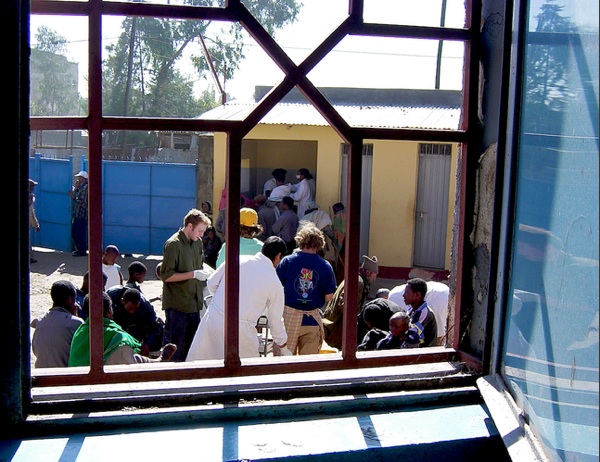
On Tuesdays and Saturdays, there was no other place for the makeshift outpatient clinic except for outside. Dozens of patients waited, sometimes all night, for the thick, metal, baby-blue gates of the compound to rumble open so they could file inside. They all had wounds that would not go away because of immuno-suppressed bodies and lack of resources to keep their wounds and bandages clean.

Most of the time, when someone returned a week later, their once-white bandage would be blacker than their skin, and often damp or wet. I would say with all my might, in my ugly, broken Amaric, “KEEP IT DRY AND CLEAN, PLEASE!” They would always nod their head, laughing at my effort to speak their language, and say, “OK, OK.”

I soon found myself obsessed with going to the clinic. There was no place I wanted to be more. Geology was something that I enjoyed, but now I had found a passion. Every Tuesday and Saturday morning I, along with a couple of other volunteers, arrived early and set up the benches in a square shape for the people to sit on, making sure that there was enough room for us to work in the middle. Then we would wait, with our gloves on, for the rumbling of the blue gates.

Community Connection:

This piece was originally published on Glimpse and has been republished here with the author’s permission. Check out more writing by correspondents like Adam Goldstein- visit the Glimpse site.

Narrative
 

About The Author

Adam Goldstein

  • http://alyssacmartino.com/blog Alyssa

    amazing, amazing, amazing piece.

  • Matt

    Wow, what an eye opener.

  • Kirsten

    When I was 14 MSF (Doctors without Borders) had a television show that followed the doctors in the field, and I decided to become an LPN when I graduated high school so that I could join them. A few years later I emailed them about whether or not they actually accept LPN’s and they informed me that no, only people with a degree in nursing. That one email made me change my mind and decide to get my degree, there was no doubt about it and no hesitation- I want to work with MSF or some other medical volunteer projects so that’s what’s going to happen!

    I see so many doctors here who have TV shows or dedicate their lives to facelifts and tummy-tucks and I get so frustrated and disgusted…these are people who *have the ability to save lives every day*! Being a doctor is the highest educational achievement there is in my opinion, you have the skills and the capacity to change and save lives, you are the highest healer, and there are so many who choose shallow things like fame or fortune over that and it’s so appalling to me! While I understand medical school is expensive and exhausting and I wouldn’t judge a doctor for wanting to have a good income, I believe your first priority should be to help people.

    Kudos to the doctor you described, he sounds like exactly the right kind of person for the job. Good luck in whatever you pursue and I hope you don’t forget this fabulous story!

Glimpse Correspondents →

It would have been naive to think I could relate to Uganda just by being Black.

World Events →

"When I reached the front line of the chaos a canister of gas exploded on the trash...

Narrative →

A Peace Corps volunteer reflects on her experiences in the Dominican Republic.

Climate Change →

Joyce Hanson joins the Human Countdown to send up a wake-up call to the world about...

Narrative →

Dominic DeGrazier visits Casa de Paz Orphanage in Ensenada, Mexico.

Activism + Politics →

Stephanie Downs looks ahead as she prepares for a voluntourism trip to Greece.

Activism + Politics →

Matador contributor Dominic DeGrazier expects to find a dirty, sad orphange. Instead, he...


When the exploitation runs amok on both sides, how to stop the hideous cycle?