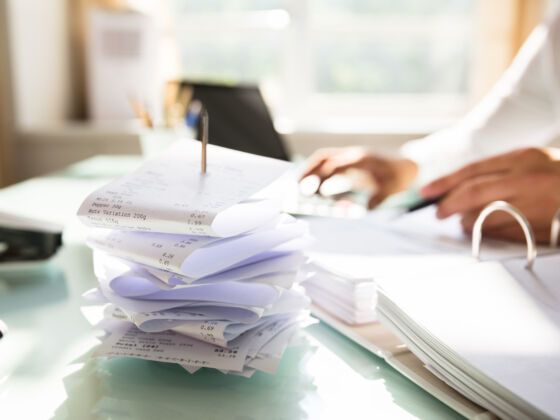
Photo: A receipt for a banana? functoruser

Paper receipts account for 640,000 tons of paper used in the US each year. That’s 9,600,000 trees.

[Editor's Note: This article is reprinted from the Software Advice blog with permission of the author. It has been edited for length.]

I’m a Whole Foods regular. I live right across the street and every morning I stop in on my walk to work. I pick up two breakfast tacos and a coffee.

I also pick up a useless paper receipt.

I certainly don’t need a paper receipt – I have no desire to return a taco. Paper receipts represent a wasteful vestige of the last millennium. There is no reason – legal or otherwise – why consumers or retailers need paper receipts. Electronic receipts are completely valid and far more efficient.

Moreover, the production of paper receipts does real damage to our environment. Here are some stunning factoids I found at AllEtronic, an interesting business working to move receipts to digital format:

50% of forests have been cleared and 50% of that is for paper. 9 million trees a year, just for paper. It takes approximately 15 trees to produce a single ton of paper. Receipt paper demands in the US are 640,000 tons per year. This equates to 9,600,000 millions trees cut down each year just to produce paper receipts.

It takes approximately 390 gallons of oil to produce a single ton of paper. At 640,000 tons of thermal receipt paper demanded per year, that’s 249,600,000 gallons of oil used during production. That much oil could produce 115,885,714 gallons of gas that could fill 7,023,376 gas tanks (assuming an average tank size of 16.5 gallons).

The amount of carbon dioxide emitted by producing one ton of receipt paper is equivalent to the amount of exhaust a car emits while driving for an entire year. That’s 640,000 cars driving 24/7 for an entire year.

It takes approximately 19,075 gallons of water to produce a single ton of paper. This equates to 1,220,800,000 gallons of water used during the production process of receipt paper. That’s a lot of showers and swimming pools without water.

Approximately 2,278 pounds of trash are produced while producing a single ton of receipt paper. This means 1,457,920,000 pounds of trash are being fed into our landfill. This produces enough carbon dioxide emissions to significantly damage the earth’s ozone layer, leading to global warming.

Yesterday at Whole Foods, a thoughtful cashier asked me if I wanted a receipt printed. Surprised, I said, “No, thanks.” This was the first time I had ever been asked if I wanted a receipt, before printing. Usually they print it, ask me if I want it, and then throw it away (thermal receipt paper cannot be recycled). I assume Whole Foods has good reasons for printing by default, but I’d love it if they only printed the receipt upon request.

All this got me wondering why we have not embraced electronic receipts. Why would Whole Foods – a very progressive organization when it comes to environmental responsibility – continue to produce this archaic little scrap of waste?

It seems clear that the main problem here is inertia. We are accustomed to paper receipts; some people really want them. It is, in large part, a generational thing. The desire for a tangible, paper receipt is probably more common among older consumers.

“All this got me wondering why we have not embraced electronic receipts.”

So, what we really need is a strong incentive to move to electronic receipts. We need incentives – primarily monetary – that motivate consumers and retailers to push toward the vision of paperless retail purchases. Here’s my list of motivations:

Retailers gain valuable customer data: Electronic receipts need to be delivered somewhere; more than likely, email is the delivery mechanism. If consumers buy into electronic receipts, they may well provide an email address. If retailers can market through these emails in a way that benefits the retailer and the consumer, there’s a win-win opportunity.

Consumers get special offers: Most of us don’t like irrelevant, aggressive marketing, but we all love good deals on things we truly want or need. When marketing is relevant, we love it. Of course, this requires some give and take. If we are willing to give up more of our personal shopping history and an email, the better marketers will make it worth our while.

Consumers can track their spending: I love Mint, the personal financial tracking web app. Its intuitive, interactive charts allow you to drill down into your spending detail. Unfortunately, you can only analyze the transaction level, not the item level. A structured data standard for electronic receipts would enable item-level data that would power more insightful personal finance tools. Overall, it’s not the most difficult engineering challenge.

Retailers and consumers gain efficiency. A paperless organization is a better organization. I know firsthand that our company operates far more effectively since we went paperless. We can produce any invoice, receipt, contract or other document all the way back to our inception. It’s all in PDF format, on a server, backed up and searchable for everyone who needs it – in seconds. This benefit would apply to retailers and consumers.

Photo: benonthemove

The challenge with realizing most of these benefits is that there are hundreds of millions of consumers and millions of retailers. Getting everyone to change their ways and embrace technology isn’t easy. In fact, it’s nearly impossible to enact quickly.

However, almost all consumer and retailers have a relationship with credit card companies – Visa, Mastercard, American Express and the banks that issue the cards. These intermediaries have a tremendous opportunity to drive the evolution to electronic receipts and make money facilitating the aforementioned benefits. The control these companies hold is incredible.

I don’t expect to see a switch to electronic receipts overnight. I don’t expect to see if in the next five years. However, with enough incentive, innovative companies will make this happen over the next 20 years.

Do YOU think we should move to paperless receipts? Participate in Software Advice’s poll and leave comments below.

Community Connection:

Small actions can make a big difference when multiplied by hundreds, thousands, or millions of people. Read about small steps you can take to become more environmentally conscious on our Global Environmental Issues Focus Page.


About The Author

Don Fornes

Don started Software Advice in 2005 after a ten-year career in the software industry. He enjoys observing the evolution of software markets,but is most passionate about running his own business, Software Advice. Don lives in Austin, Texas with his wife Lauren, daughter Hudson and bernese mountain dog Stinson.

  • http://travelerahoy.wordpress.com Alouise

    i work at a hotel, and I’d love to go paperless. But our computers are a bit archaic and we don’t even have email. We print an early copy of the receipt, which shows charges before 3am on checkout day. But the balance doesn’t say paid, so most guests have to get another receipt anyways. Then there’s the receipt for the credit card. And if someone forget’s they’re receipt we have to print out another copy and fax it. It’s such a waste of paper, we’ve talked to the management and owners but they won’t get email. We do shred the paper we can and recycle, but not printing in the first place would be better.

  • http://musictravelwrite.wordpress.com Michelle

    I’ve often thought this. It seems ridiculous, particularly when I’m asked if I want a receipt, say no, and watch the cashier print one and throw it away. Such a waste.

  • http://www.expatheather.com Heather

    Ok for a banana, no I wouldn’t want a receipt. But unfortunately as a freelancer receipts are essential for tax deductions. Yes I do want a receipt for those notebooks and pencils I bought at CVS. Receipts are also necessary if I want to return something. For example, right now I have a Target receipt tacked up on the wall because I bought a compass there and it doesn’t function – the receipt in necessary to return it because I live in a country where I don’t know the people I buy things from and they don’t know and trust me.

    I think we’d only be able to get rid of receipts when we have no need for them, which would mean an massive change in how we do business and keep records. I’m honestly not sure if the US can move in that direction.

    At the same time though, there would be changes made certain business (like coffee shops) where receipts can be ditched. For the rare customer that does want a receipt, one could be written by hand.

    I wonder, how did No Impact Man deal with receipts?

  • http://onceatraveler.com Turner

    I was curious that Whole Foods was doing the very same. Am glad that most ATMs now ask if you want a receipt with each transaction.

  • Pingback: Hello - stop killing trees for paper receipts

  • http://www.travel-writers-exchange.com Trisha Miller

    I completely agree with Heather – for small purchases or those that wouldn’t qualify for a return (like the banana or a breakfast taco) it would be great to have the option of declining a receipt, but it needs to be an option because there are a lot of business travelers that need to turn in meal receipts in for expense reimbursement. So as Heather said, before we can do away with paper receipts, we need a massive change in the need for them, primarily when it comes to returns, refunds, reimbursements, or rebates.

    And I detest the idea of giving some retailer my email address just to get an electronic receipt in case I do need to return something…do I want their marketing crap? Absolutely not, but I know I’ll get it if I give them my email address. The author of this article suggests that it’s somehow a fair trade, but I disagree. Getting my money for their product is a fair trade, having to give them my email address to get a receipt is not.

  • http://alainarose.wordpress.com Alaina O’Brien

    Receipts are annoying and more often than not useless, but their uses have been mentioned above.

    In Austria, restaurants don’t give receipts, but instead the server comes to your table with perhaps one receipt for a whole group and divides it out with a pen and paper. It’s a much more convenient way of paying, I think. And no useless receipt at the end. If one pays with a credit or debit card at an American restaurant, up to three paper receipts may be printed…

  • Cath

    Agree with most of the posters here: I don’t want a receipt for a coffee but would like one for my weekly food shop, only to check I’ve been billed correctly (unfortunately, barcoding means that the prices displayed aren’t always the prices that you’re charged for). Perhaps if there were a limit? No receipt for any purchase under £5?

  • http://www.myreceipts.com MyReceipts

    Dear Don,

    I think this is a great article and agree with you that there is a better way to do this. The funny thing is that our company MyReceipts is already offering a Digital Receipts solution to select Whole Foods stores primarely in the Mid-Atlantic region.With MyReceipts, not only do consumers get all of there receipts online instead of the paper receipt but they also get relevant offers that are automatically applied at the time of purchase. All this, without the need to share your email address with the store. So there is definitely a way to do this that would allow you as a consumer to get everything you want without having to worry about to share your email or other personal information with every store you visit. We can assure you that Digital Receipts are coming.. faster than we think :)

  • http://matadortrips.com/ Hal Amen

    I find most gas pumps and ATMs give you the receipt-less option these days.

  • http://www.yreceipts.com Alexander Stegmann

    Hey Don,

    You are right. We started a company called yReceipts (www.yreceipts.com) and aim at bringing email receipt to high street stores. Happy to have a chat about it if you like.

    All the best,
    Alex

  • Le’Order

    An eReceipt can be pushed either as a short message (SMS, which in case phone number is required) or bluetooth (which case no need to part with phone number). However for this to work the existing system needs to be updated and every other customer should have mobile phone with bluetooth enabled..

  • Pingback: 50 Ways to Use Less Oil

Family + Kids →

Power blogger "B" of STFU parents gives Facebook oversharers a little talking to.
by B.
36

Volunteer Guides →

Planning to voluntour? It might be end up being far from what you expect.

World Events →

People are attempting to draw parallels, seek connections, or compare recent riots and...

World Events →

Craigslist's "Adult" listings continue to run outside US. Opponents say the site promotes...

Language Learning →

Beyond the practical benefits of increased understanding or deeper cultural travel, these...

Soccer →

Still looking for a World Cup team to cheer for? How about North Korea?

Volunteer + Work →

Alyssa Martino reflects on the therapeutic effects of teaching English to refugees living...

Photo + Video + Film →

You beat your way to the next great "undiscovered" village, the ultimate "secret" beach....

Spirituality →

Maintaining certain values is often a cut and dry topic. But when there are so many...


Stories of customs declarations disasters from Chile, and why you should check - and...