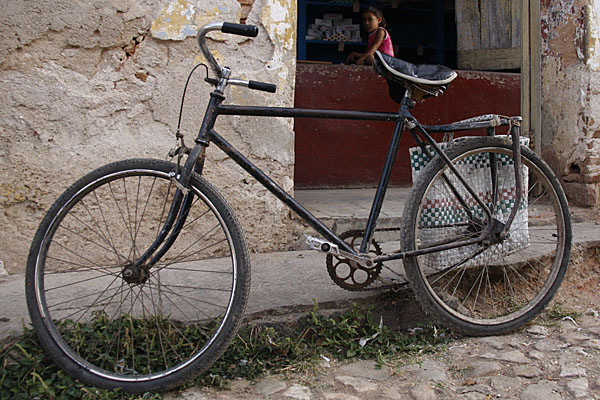
Cuban bicycle

All photos by author

Cuba is not cheap. You may have heard that before, but it’s easy to forget.

FOR THE VACATIONER in Cuba, that may sound weird. You can buy beers for one dollar, huge dinners for ten, and sleep for under thirty. But if you’re a long-term budget traveler headed to Cuba, you may want to pay attention.

CUC vs. moneda nacional

First thing’s first. Cuba has two currencies: the national peso (moneda nacional) and the convertible peso (CUC or, colloquially, the “cook”). For all intents and purposes, it’s easy to think of the CUC as being roughly equivalent to the U.S. dollar. At the time of writing, one CUC could be exchanged for 24 national pesos (from here on I will refer to national pesos simply as pesos).
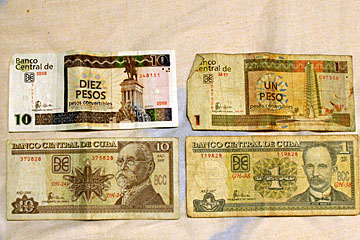
Cuban money

Top row: CUC / Bottom row: moneda nacional

Cubans deal mostly in pesos. Everything they need on a day-to-day basis is bought with pesos in shops and restaurants that specifically deal in pesos. “Luxury” items like toothpaste, toilet paper, soap, deli cheese and meats, and televisions are purchased in “dollar” shops — stores that only deal in CUCs.

TIP: Do NOT go to Cuba with U.S. dollars. You will incur a steep penalty (around 10%) to exchange to CUCs. Here is a Cuba Currency and Money Guide.

Accommodations

If you’re budget traveling, get to know this term: casa particular. These are private homes that rent one or two rooms to foreigners. They are similar to a B&B.

In Havana, you get what you pay for. We stayed in a beautiful mansion-like house for $30CUC in Vedado. But we also stayed in a tiny apartment in Central Havana, where our room wall didn’t extend to the ceiling, and we had to share a bathroom. For the latter we paid $15CUC.

Outside Havana, the prices seem to vary more, regardless the quality of the casa. In Viñales you could stay at a $35CUC casa which, as nice as it is, might have frogs on the bathroom walls at night. Or you could stay for $15CUC at a more humble casa, but with beautiful views of the mogotes.

Assuming your eye is on your budget, here are some tips when finding casas particulares:

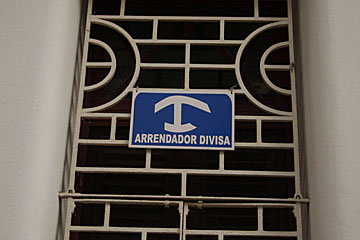
Cuban money

Note: blue signs = OK for foreigners,
red signs = only for Cuban nationals

Don’t book one listed in a guidebook — Not only are they generally more expensive, they’re the busiest. In most big cities and towns, there are loads of casas. They are easily identifiable by the sideways, blue “H” symbol on their door. (We also found the casa owners at the ones not listed in the guidebooks to be more friendly and hospitable.)

Don’t go with a tout — You’ll be approached at bus stations or if you’re walking/cycling around with your bags. The touts take a $5CUC commission so the prices are $5CUC higher than they would otherwise be.

Stay away from the center/touristy areas — Prices can drop dramatically even a couple of streets away. A little legwork can save you lots of money.

Try bargaining with the owner — If you can’t knock five or ten CUCs off the nightly price, try to get your breakfasts tossed in for free. If you’re staying long term (a week or more), you will be able to negotiate a lower price.

Eating

This is purely a guess, but probably 95% of visitors eat dinners and breakfasts in their casa particular. This is not a bad thing, and usually the food in them is superior to anywhere else. But if you want to save money, there are other ways.

Street food

Street food

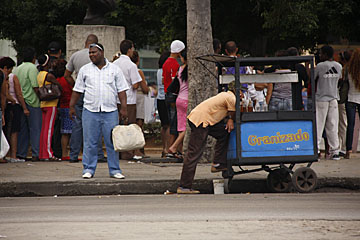
Street food — Entrepreneurial Cubans roll their carts streetside and hawk pizzas, meat-filled buns, hot dogs, and a multitude of other foods. You can be pickier in the bigger cities since something else will be around the corner if you don’t like what you see. It’s all sold in pesos so is very cheap.

A pan con jamon y queso (bun with ham and cheese) might cost 5 pesos on the street and $3CUC (equivalent to 72 pesos) in a restaurant.

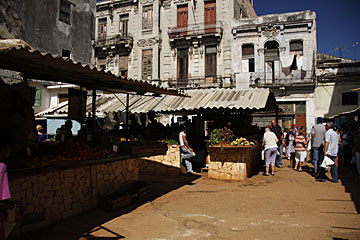
Farmer’s markets — Balance the street food a little with some fruit and veg. Sold in pesos, the produce costs cents.

Peso restaurants — Find these. And eat in them. They’re generally good and you can get a similar meal as you would in a casa particular (meat, rice and beans, veggies) for a fraction of the cost. 40 pesos (just under $2CUC) will net you a decent dinner.

Casa particular — You can save money eating here too. The dinners are so huge — compensation for the relatively steep prices — that they can either be shared between two people, or you can ask for a smaller meal for cheaper. For example, $5CUC instead of $8CUC for a meal that will still fill you up.

Farmer's market in Havana

Farmer’s market in Havana

Of course, only you can gauge yourself, so try the full meal first.

Hotel buffets — Mid-range hotel breakfast buffets are around $8CUC. Fill yourself up, then fill up your bag for the rest of the day.

TIP: Unless you have a steel stomach or no respect for your body, don’t rely solely on street food. It’s a good idea to mix it up with meals at the casas.

Entry fees

As in other times of bargaining, your power lies in how badly you want it. In Santiago de Cuba, we cycled to the Castillo del Morro to find out it cost $5CUC each to get in. We weren’t willing to pay it so we just walked away. Seconds later we were called back and told we could go in for $5CUC for the both of us.

Be vocal. Don’t be shy to ask if prices are in CUC or moneda nacional.

On the other hand, at the Necropolis in Havana, we were surprised that they raised the entry fee from $1CUC (as stated in our Rough Guide) to $5CUC.

We walked away there too. No one followed.

Don’t be shy

Be vocal. Don’t be shy to ask if prices are in CUC or moneda nacional. You might assume something is in pesos and then be shocked to find out it’s not and you’ve just spent 24 times what you expected to.

Although bargaining isn’t as big a thing in Cuba as in SE Asia, it never hurts to try.

Community Connection

Looking for more tips on Cuba? Be sure to visit our Cuba Focus Page and feel free to ask our experts, Conner and Julie, any questions you might have.

Budget + Backpacker
 

About The Author

Carlo Alcos

Carlo Alcos is the editor of Brave New Traveler and co-founder of Confronting Love. He blogs about his travels and life in general at Vagabonderz.com. You can also find him at the yoga studio and tweeting away as @vagab0nderz.

  • http://www.collazoprojects.com Julie

    Carlo- I learned so much from this article. Since I always stay with Francisco’s family, I don’t really know all these types of details. Thanks for this piece- a great evergreen reference.

  • http://www.kaleidoscopicwandering.com JoAnna

    Great for the tips Carlo! I hope to make it to Cuba soon, so this is very timely.

  • http://www.lenguajero.com Natalie Gordon

    Great tips. Another – Don’t buy bottled water. Casas should give you boiled water. When deciding to stay in a casa make sure to ask that boiled water is included. Some places try to make extra money by selling you bottled water.

  • http://matadortravel.com/travel-community/vagabonderz Carlo Alcos

    Excellent point Natalie. And one I was going to include, but since we didn’t do it ourselves I just couldn’t vouch for it. A Spaniard we met along the way never bought bottled water. While cycling, he would just pop into any ol’ house and ask the locals if they had some water they could give him.

    The next time we cycle in Cuba we’ll try that, after all, the Cubans certainly aren’t buying bottled water. We’ll also bring along purification tablets…just in case.

    If you’re not prepared to shirk bottled water completely, another suggestion is to buy the large 5L or more bottles and fill up water bladders/bottles. This is much cheaper than buying the 1.5L bottles and much much cheaper than buying the small ones. Over 5 weeks, bottled water adds up, especially when cycling!

  • http://www.twitter.com/gabimgarcia Gabriela Garcia

    Great article, Carlo! I’ve always stayed with family but last time I also spent a few days in a casa particular. It wasn’t an “official” one though. I found that a lot of people rent out rooms in their houses under the table and it’s quite easy to find them by just asking around. It’s significantly cheaper, but I guess a little more risky. I’d also recommend “paladares”…restaurants that people run out of their homes.

    Cycling around Cuba sounds amazing :)

  • http://matadortravel.com/travel-community/vagabonderz Carlo Alcos

    Thanks Gabriela. We did stay in one illegal one, but it was our only choice as it was getting dark and we were sort of in the middle of nowhere with our bikes.

    Couple things to mention about staying in illegal ones…while it’s not risky to the traveler (other than possibly being made to leave at whatever hour of the night it is), it’s very risky to the casa owner and they can get big fines, from what I understand.

    The other issue is fairness to those who run legal ones, because they have to pay license fees to the government regardless if they rent their room(s) or not.

    We never did eat in a paladar…we really didn’t see many around, and I think any that we saw were unofficial too. There was a famous one in Havana, but it got shut down some time ago…got too big for the government’s liking I guess.

  • http://www.hereishavana.wordpress.com Conner

    excellent advice here Carlo! Seems like you’re trip went well!

    A couple of things Id add:

    - casas make their $$ on the food, where the markup is greatest. When bargaining for a room, if they won’t drop the price, tell them you’ll be eating in the street instead of with them and see how negotiations loosen up.

    - in the bigger veggie markets, there’s often a fresh juice stand: they’ll fill up small water bottles for 2 pesos, the big ones for 7.

    - you lose 18% on the US Dollar when changing to CUCs (which I spell kooks, because they’re totally kooky!)

    - cannot BELIEVE they’re charging 5CUC for the necropolis (Ive only been there for funerals). Anyway, there is another entrance, around the bend on Zapata, where you can stroll right in.

    - we boil water in my home; some cubans do, some don’t but one bout with giardia here was enough for me.

    happy travels!

  • http://matadortravel.com/travel-community/vagabonderz Carlo Alcos

    Hey Conner, thanks for the correction on the US dollars. Damn, 18%! Worse than I thought. And thanks for the additional tips :)

  • Xtina

    Thanks for all of the above. Flying into Cuba tomorrow – a bit scared of the prices after backpacking through central America this will be a huge wakeup call I fear.
    Can anyone give me info on availability of using debit/credit cards there and fees for that? Cards are Canadian or Uk

    fankoo :)

  • http://matadortravel.com/travel-community/vagabonderz Carlo Alcos

    Hi Xtina. Thanks for the comment, have a great trip! As far as using debit/credit cards in Cuba…we didn’t, which is not to say you can’t. I found this:

    http://www.tripadvisor.com/ShowTopic-g147270-i91-k712342-Debit_cards_in_Cuba-Cuba.html

    You can wade through all the responses, although form a quick scan I didn’t see any definitive answer. We only took cash with us (for 5 weeks)…Euros to be exact.

  • Xtina

    Hi Carlo
    thank for that. Ahhh trip advisor- everybody comments even with nothing to say. Instead of “I used a card and it did/did not work” a hundred people relaying what they have “heard” *sigh* ahh well- in departure lounge , guess we will find out ;)

    cheers for the link though -c

  • Xtina

    Hi again! Back from Cuba and I thought I’d answer my own question regarding credit cards in case someone else searches for the answer.
    Yes, you can use your credit card in most banks in Cuba …. Sometimes…
    Like most other things there the answer is that there is no consistent practice. So one bank branch in one city says yes, but another branch of the same bank in the same city says no.

    Oh but don’t forget you are paying through the nose. Cash advance in Cuba gives you a. Bad exchange rate b) a fee by the Cuban bank and c) a fee by your own bank so you get a tripple whammy. Taking out 200 CUC will cost you roughly €215

    The ATM’s inside the banks (open only during bank opening hours) in theory do give cash advances but don’t rely on there being electricity to operate them even if you do go during opening hours. All in all though, unless you spend your last peso at 5pm on a Sunday and need money right there and then you should be able to get money with a credit card easily enough to not worry when your planned cash reserves are running low faster than expected. (as they will)

    Cheers C
    :)

  • http://matadortravel.com/travel-community/vagabonderz Carlo Alcos

    What? 215 euros for 200CUC?? That’s unbelievable. And exactly why we only took cash. How was your trip? Are you blogging anywhere?

  • Xtina

    In all honesty – I did not get on with Cuba at all! There were moments that were nice but they did not make up for many things I did not like sadly. The near permanent harrassment of the hustlers, the universally crappy food, the insane expensiveness all left us exhausted and wishing our trip was shorter. We rented a car and drove all the way east so really gave it a good shot to see a variety of areas and Baracoda (sp?) and Holquin really did redeem it a bit, but overall my response is that I have no desire to go back. To me the greatest joy of travelling is meeting people and I found Cuba ruins that and makes you not want to look up as making eye contact means you get approached again and hustled. I had less harrassment in India !!
    We are back in central America and have since met a few people that were recently there, and most said a similar thing. After travelling through El Salvador, Guatala etc Cuba does not hold up in comparison .

    (sorry if offends – was my honest experience) cheers C

  • http://matadortravel.com/travel-community/vagabonderz Carlo Alcos

    No need to apologize! Your experience is your experience. I agree, in some places (most notably, Trinidad) the hustling/begging is bad. I wrote about it in Cuba at my site: Thoughts on Dealing with Touts and Beggars.

    We cycled so in many parts of the country the locals weren’t used to seeing many foreigners pass through. I found Cubans to be one of the friendliest peoples. We had a terrible experience in Vietnam, which was backed up by many other travelers as well, but for Hal (co-editor here) who cycled in Vietnam, he had a completely different take. There seems to be at least two sides…one in which locals who are in constant touch with foreigners whose first priority becomes extracting money from those tourists, and the ones who aren’t used to it and treat foreigners as people, not as bank machines.

    Either way, I think it’s important to try to be understanding of why they are the way they are. Easier said than done I know, because when you’re in that situation, you just want some peace and quiet, to be left alone. It’s a complex issue.

    (PS – it’s Baracoa…and unfortunately we didn’t make it there! Heard it’s beautiful though)

  • Xtina

    Baracoa was really the highlight for me – beautiful and friendly people. The thing with the hustlers is not that they are trying to get money – I am richer than they are -by LOTS – and I know it so in principle it is ok by me. Seeing me as a human cash machine is something I have gotten used to in India and south & central America. But Cuban hustlers hustle you by pretending to befriend you, spin a long yarn of hey I am not one of them, and it is that emotional fake friendlieness betrayal again and again that just is soul destroying and crippling the empathy. Everytime you let your guard down : wham another hustle. In the end I found the rule – if you approach them they are super nice – if they approach you they are hustlers – no exceptions!
    Oh and finally one tip for how to enjoy Cuba on the cheap: learn the rules for Cuban style domino. People play it everywhere and you can have the nicest evening for no money playing

  • Kim

    Cheaping out on water is not wise. Bottled is the way to go unless you want to risk Giardia or worse. After 15 years of working/living in Cuba I can tell you from experience. Otherwise the rest of the info found here is pretty much accurate.

  • Luis Gonzalez

    Amazing help, thanks a lot.

    Is there any way to get in touch with a casa particular BEFORE getting go Cuba/Havana? Or am I sure to find one just because of the great quantity there are?

  • Luis Gonzalez

    Amazing help, thanks a lot.

    Is there any way to get in touch with a casa particular BEFORE getting go Cuba/Havana? Or am I sure to find one just because of the great quantity there are?

Budget + Backpacker →

Pricewise, French Guiana is closer to Europe than the rest of South America...

Budget + Backpacker →

Here are 5 videos from our friends at Positive World Travel featuring life and travels in...

Budget + Backpacker →

Peter wanders around San Ignacio sans guide, finding his way to the Cristo Rey falls,...

Parenting →

It’s not too late to trim costs on this year’s family vacation. Julie Schwietert...

Budget + Backpacker →

It’s possible to come away after a week or two in Montana with solitary experiences and...

World Events →

The foreign policy talk becomes tangible with the announcement of some new policies.

Budget + Backpacker →

World travel can be much cheaper and far less stressful than a normal American lifestyle.

Health + Lifestyle →

Matador’s Cuba Expert, Julie Schwietert, gives you all the planning tools you’ll need...

Financial Savvy →

Budget-conscious travelers understand the value of a great bargain.

Financial Savvy →

Intensive money saving requires some lifestyle changes.