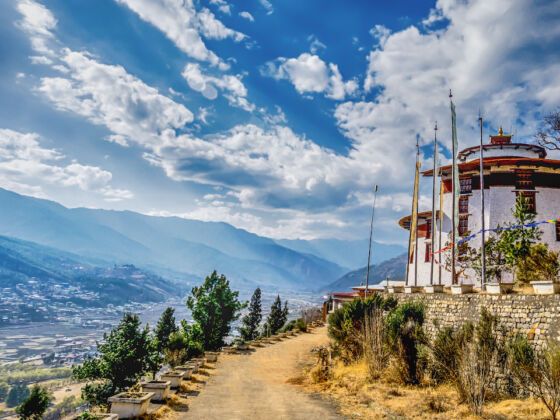
Photo: Graham King

How to measure your country’s progress? The Bhutanese use GNH, or Gross National Happiness. This is a sacred travel experience.

Whether you seek wilderness adventure, immersion in a unique culture, or a spiritual journey, a trek through Bhutan’s mountains puts you in the heart of this little-known Himalayan Kingdom.

Here are some considerations for first-time trekkers:

The Basics

Trekking in Bhutan involves a multi-day trip, arranged like a camping expedition. This is due to government guidelines and because many areas are remote, devoid of accommodations. It is not uncommon to walk for several days before encountering a village.

A typical day consists of 5 to 7 hours of walking among some of the world’s most pristine natural surroundings, including subtropical jungles, alpine highlands, and snow-capped peaks.

You will be accompanied by a licensed Bhutanese guide, cook, and mules or yaks that carry tents, sleeping bags, cooking equipment, food and other supplies.

In a nation steeped in Mahayana Buddhist traditions, the mountains are sacrosanct, housing deities. As such, you cannot scale peaks higher than 6,000 meters. At 7,570 meters, Gangkhar Puensum, the highest mountain in Bhutan, remains the highest unclimbed peak in the world.

While treks range from easy to strenuous, it helps to be moderately fit. Daily altitude gain is relatively high, so be aware of how best to acclimate your body.

Photo: jmhullot

When to Go

The best high altitude trekking seasons are in late April, when colorful bursts of wildflowers dot the landscape, or during the pleasant, clear days of October.

Short treks at lower elevations are possible during most months. You can also time your visit to coincide with one of Bhutan’s colorful festivals, getting a glimpse inside the dzongs, or fortress-monasteries, that serve as administrative, religious, and social centers.

Climate varies significantly by region. The north, bordering Tibet, is perennially covered with snow. The central regions enjoy four distinct seasons similar to those of Western Europe, and the subtropical south is hot and humid. Monsoon rains pelt the country from June to September.

Photo: jmhullot

The Treks

There are more than a dozen treks, ranging in difficulty. Some combine scenery and culture, passing dense pine and oak forests on the mountainside; whitewashed dzongs overlooking valleys; and chortens, squat monuments housing sacred Buddhist relics.

Druk Path is a week-long trek that crosses mountains connecting the valleys of Paro and Thimphu, Bhutan’s capital. The sparsely populated route winds around freshwater lakes, and if your timing is right, dozens of varieties of scented rhododendron bloom in late spring.

Photo: babasteve

Bumthang Cultural and Gangtey Nature treks are shorter, lasting from two to four days. Gangtey passes through isolated valleys, including the winter home of rare black-necked cranes.

Of the thousand or so trekkers who visit each year, most head for Jhomolhari, the third highest peak in Bhutan and “abode of the Goddess Jhomo.” Following the river, the trek offers some of the best mountain scenery, including highland villages, yak pastures, and a base camp embedded in natural beauty.

Taking two weeks, the Jhomolhari – Laya – Gasa trek is an extension of the above. It weaves through the high Himalayas, leaving the Jhomolhari trail and heading east along the Tibetan border to Laya, and then south to Gasa and its hot springs.

Lunana Snowman is one of the hardest high altitude treks, involving walking and living in remote areas beneath the peaks of 6 mountains, each over 7,000 meters high. The mystical trail crosses nine passes, taking you by villages and nomad groups, and through forests of blue pine, juniper and rhododendron.

Plan Ahead

You cannot visit Bhutan on a whim as the government controls the number of travelers allowed into the country each year. Arrangements must be made through registered Bhutanese tour operators beforehand, and you have the choice of customizing your own trip or joining a pre-planned tour.

Each visitor is required to pay a fee of US $200 per day. This sounds steep, but it includes taxes, accommodations, meals, a licensed guide, camping equipment and haulage for treks. This fee applies across the board, whether or not you go trekking.

The easiest way to get to Bhutan is by air. Druk Air, the national airline, is the only carrier that serves Paro Airport, offering flights from Bangkok, Kathmandu, Delhi and several other South Asian cities.

There are plenty of online resources. For starters, check out Matador editor Tim Patterson’s excellent guide to, and impressions of, Bhutan.

Photo: Graham King

The Tourism Council of Bhutan also provides handy information, including a list of tour operators (many of whom have their own websites), local news and events, approved treks, and the latest on travel regulations.

And finally, get a copy of seasoned trekker Bart Jordans’s Bhutan: A Trekker’s Guide , including insights on numerous trails, a comprehensive trek grading system, and information on trekking for families with children.

GOODS

Trekking + Exploring
 

About The Author

Voralak Suwanvanichkij

Voralak Suwanvanichkij is a Bangkok based writer who says she travels: "To gain new perspectives on the world. And in the process, to learn something about myself."

  • tom

    Thank you for this! I have been thinking about doing this trip in April and it has served as great advice.

  • Hal

    Great stuff! I knew the country had a unique tourism policy but had never read about it before. I'd love to go someday.

  • Helen

    thanks for sharing about Bhutan – it's definitely a place I want to go one day. the pictures are beautiful!!

  • Tim Patterson

    Nice post, Voralak! I can't wait to get back to Bhutan.

  • Sonam Wangchen

    Thanks for the great post on Bhutan, i am sure lot of people will be interested to visit Bhutan after reading your blog and seeing your beautiful pictures. Picture of the Trongsa Dzong looks stunning with the ray of sunlight. Keep posting about Bhutan!

  • http://metalchick.net/travel Metalchick

    Thanks for this awesome information. I saw this featured on Michael J. Fox’s Always looking up special and have been dying to go ever since.

  • ratu dorji

    Dear Sir/Madam,

    I am a new local tour operator in Bhutan with a trade name “Best of Bhutan”, just been four months old.. I really like the way you portray Bhutan , well organised information with beautiful pitures. i haven’t got a website yet but would like to link up with yours.
    great job.

    Thank you

  • Pingback: The 10 Cheapest Cities in the World 2011

Climbing →

Hiking is South Korea's national pastime. Hike, climb and scale frozen waterfalls with...

Trekking + Exploring →

Not many walk the 509km along Turkey's Mediterranean coast in winter.

Trekking + Exploring →

Our take on ten of the world's best towns for getting on (and occasionally off) the trail.

Trekking + Exploring →

Olivia Dwyer has chiller alternatives to the six Great Walks on the island.

Trekking + Exploring →

A mini-documentary on the most beautiful mountain hike in the world.

Trekking + Exploring →

Andrew Skurka is circumnavigating the state of Alaska by foot, ski, and raft.

Trekking + Exploring →

"To experience the canyon, you have to leave the rim." And winter might be the best time...

Climbing →

Some terrain is just made on too grand of a scale to be boxed into a snapshot.

Trekking + Exploring →

Yes, driving the Great Ocean Road is nice. But walking the coastline is a much deeper...


In the mountains, my mornings begin with the sounds of young nuns rising early to...

Parks + Wilderness →

From Africa to Asia to Europe to the American West, traverse these landscapes on foot.

Trekking + Exploring →

Comprehensive guide and outline of this Himalayan classic.

Sports + Adventure →

The ancient mountain path to Machu Picchu is one of the best treks in the Andes. Here's...