The 48-minute drive in from Charles de Gaulle Airport passed faster than I expected. I spent most of it with my forehead against the window, mouthing French words as they appeared on the road signs along the route. That is, until the car turned onto Paris’ famous Champs-Élysées, and suddenly, I was on one of the most recognizable boulevards in the world. Fresh spring leaves framed the sidewalks and elegant cafes appeared one after another. Beyond them, luxury-label stores lined the 1.2-mile stretch. And in the middle of it all was my destination, a cream limestone facade at No. 70: the Paris Marriott Champs-Élysées.
Champs-Elysees. Photo: Marriott Champs-Elysees Paris
In Paris, a 5-Star Hotel Holds a Hidden Fashion History
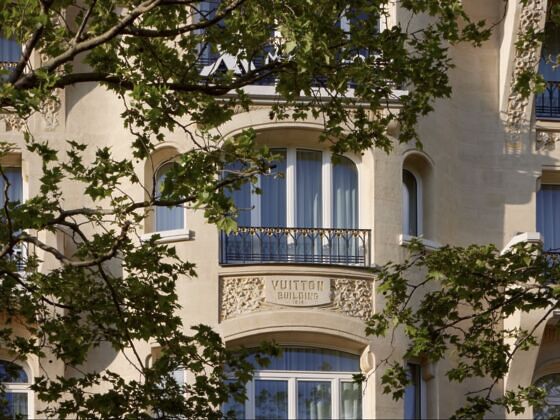
On the outside of the building, you can still see its original name carved: the Vuitton Building. It went up in 1913 and was unveiled in May 1914. It was commissioned not by Louis Vuitton himself, who had died decades earlier, but by his son Georges, who bought the land and raised a grand flagship for the family name on the city’s most famous avenue. Today it’s a late Art Nouveau building whose façade survives as a protected historic monument. And I was lucky enough to be spending the next few days there.
An immediate sense of grandeur (and friendliness)
Stepping into the lobby. Photo: Marriott Champs-Elysees Paris
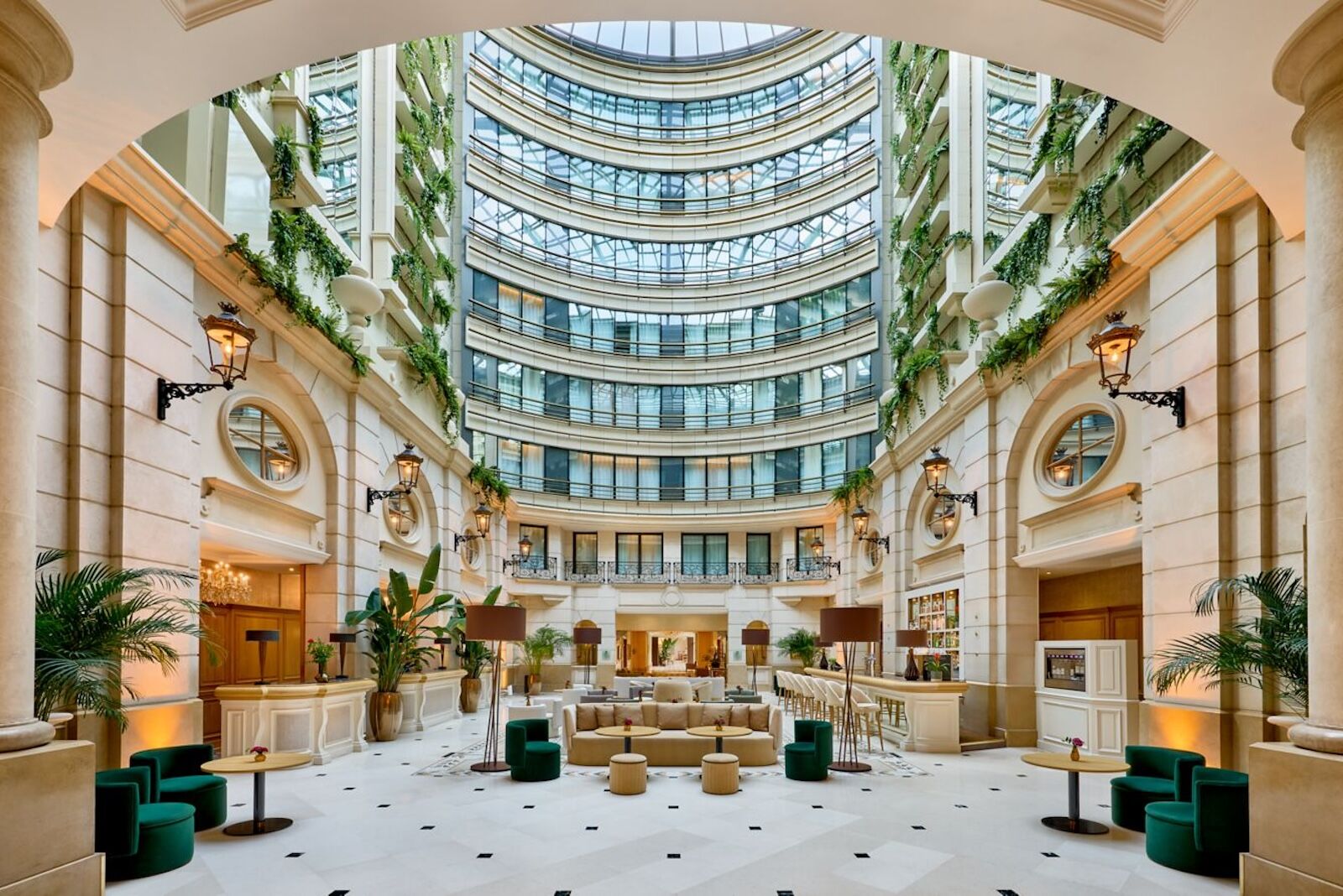
As I entered the hotel lobby, I was struck by the soaring glass ceiling that flooded the room with natural light and polished marble floors that both reflected the light and added to the sense of elegance. I was quickly met by the hotel’s porter, who greeted me with a warm “Bonjour, Madame” before bringing my bags to my room. He was even kind enough to help me with my goal to learn a few useful French phrases, writing some frequently used words down on a piece of paper I carried with me through the rest of the trip. It was a small gesture, but indicative of the friendliness I felt from staff across all departments during my stay.
I stayed on the fifth floor of seven, with an ornate wrought-iron balcony and a view of the Eiffel Tower and the busy road below. Though it was technically just a standard room not marked as Eiffel Tower view, I could still see it to the side. As a light sleeper, I was a little concerned about noise from the road, but the modern soundproofing in the historic building put that to rest immediately. I was insulated from the world when my door was closed.
The room was spacious, bright, and airy. It was anchored by a king-sized bed, with useful features like a high-end speaker and extra-plush linens. Gray marble lined the bathroom, echoing the elegance of the lobby, and the illuminated mirror both bounced light around the room and made it easy to get ready for evenings out in the city. But the detail that will stay with me the most is the view of the Eiffel Tower, especially when it sparkled with lights after dark.
The story behind the address
A portrait of Jenny Sacerdote, taken inside the building that now houses the Marriott Champs-Elysees. Photo: Thérèse Bonney/Wikimedia Commons

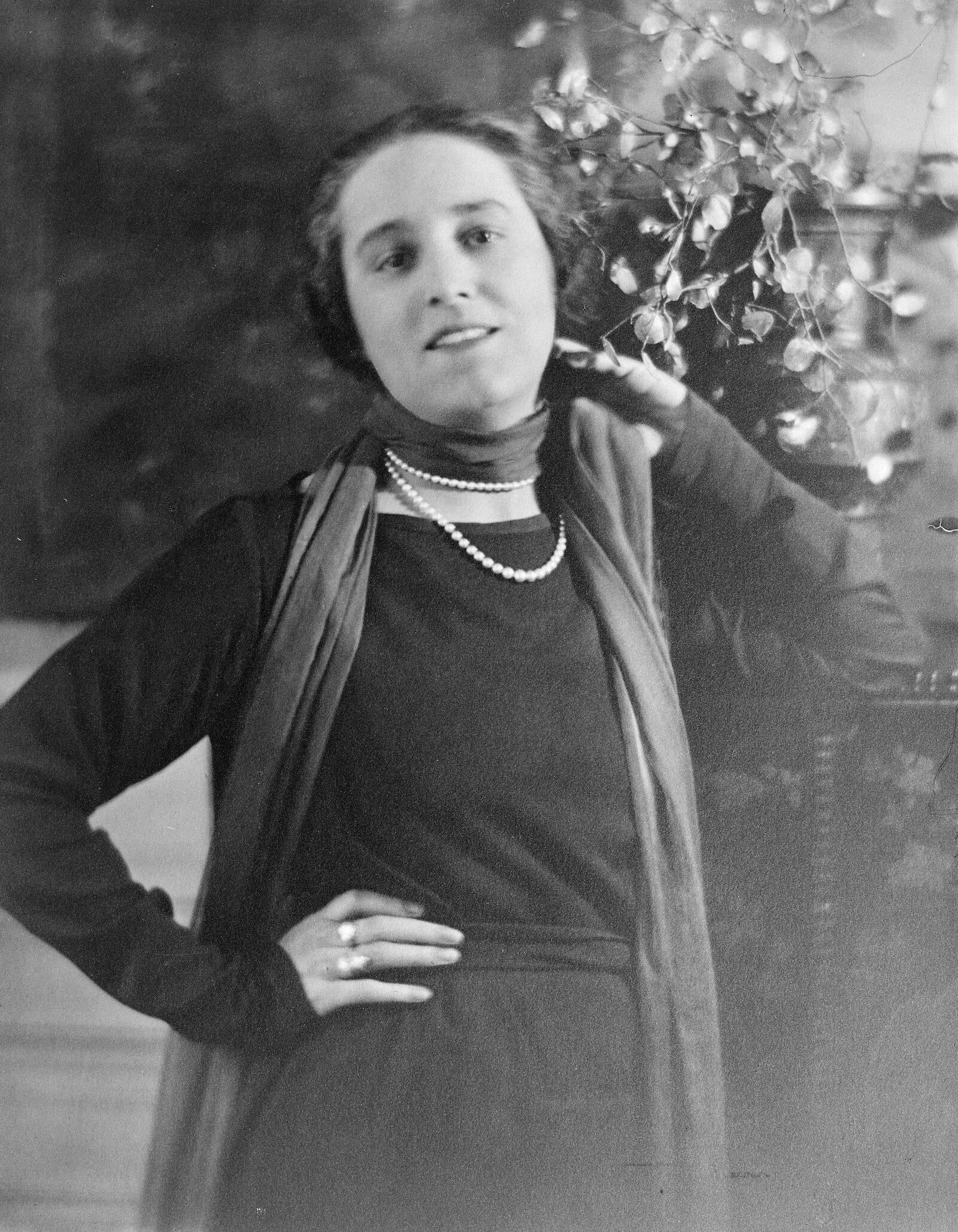
The name on the stone is the part everyone notices – but what most people miss is the story behind it. A high-end Louis Vuitton store occupied its lower floors for decades (though the trunks that made the brand famous were always made elsewhere, at the maison’s workshops in Asnières). But the upper floors, where my room was, were something else entirely. From 1914 to 1933, they held the couture house of a designer named Jenny Sacerdote.
If the name doesn’t ring a bell, you’re not alone. Her lack of name recognition is what makes the story so noteworthy. Born in 1868, Sacerdote trained to be an academic, not pivoting to fashion until the age of 39. But she was an immediate success. By 1915, her space in what’s now the hotel held about 20 workrooms, a restaurant, a fashion showroom, and nearly a thousand employees.
She’s most famous for designing the “little grey suit” for women, which was a must-have item for French women in the 1920s and ‘30s. During WWI, she was the most popular imported designer in the United States, and fashion historians liken the suit to the 1920s version of Coco Chanel’s more famous “little black dress” that came a decade later.. She dressed silent film stars and the then-Empress of Japan, becoming the second woman to be named to France’s Légion d’honneur for her contributions to the fashion industry. But the shop closed down during WWII, and her name slipped out of the history of fashion.
Celebrating the city’s high-fashion roots
The hotel is on Paris’ most famous street for designer and Haute couture shopping. Photo: Daboost/Shutterstock
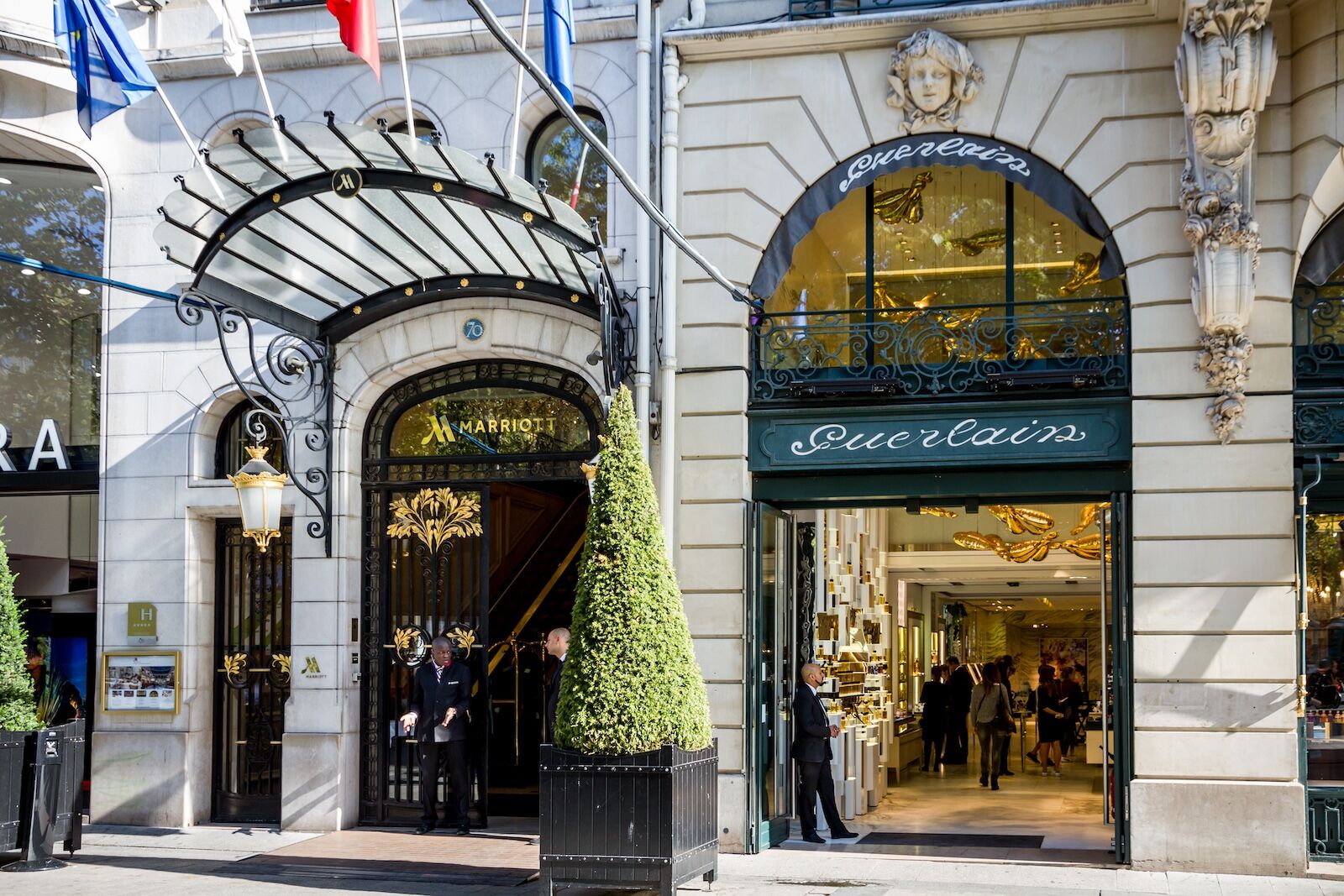
Today, the Champs-Élysées is the top-tier destination in Paris for high-end designers like Louis Vuitton, Dior, and Chanel. The hotel sits in a prime location not just for easy access to these designers, but for must-see sights in Paris, including the Arc de Triomphe, the Hôtel de la Marine, the Champs-Élysées Garden, the Eiffel Tower, the Grand Palais, and La Galerie Dior (and its delightful Café Dior).
For big spenders (or big splurgers), the hotel has an on-site Clefs d’Or (Golden Key) concierge. It’s a certification reserved for the very best concierge professionals around the world, and at the Marriott Champs-Élysées Paris, they’re especially dialed into the fashion scene. Guests can reach out to the hotel in advance for everything from assistance in securing Paris fashion week tickets (Haute Couture fashion week is usually mid-July every year) or arranging private shopping experiences at top boutiques. Naturally, fashion-related activities aren’t the only thing on offer, as Clefs d’Or concierges can work their magic for everything from restaurant reservations to guided tours. But shoppers staying here would be doing themselves a disservice if they didn’t at least ask for a few recommendations from the knowledgeable concierge team.
And speaking of restaurants, there is a wide range of options within a 20-minute walk. Highly recommended options based on my personal experience include Aqua Kyoto for modern Japanese and panoramic Eiffel Tower views from the rooftop and the well-known Chez André brasserie for unfussy French classics like frogs’ legs and bouillabaisse. And if you don’t mind a bit of Italian influence in France, nearby Zeffirino has both a listing in the Michelin guide to France and a fixed-price lunch menu starting at 29 euros.
The hotel’s own culinary scene is unmissable
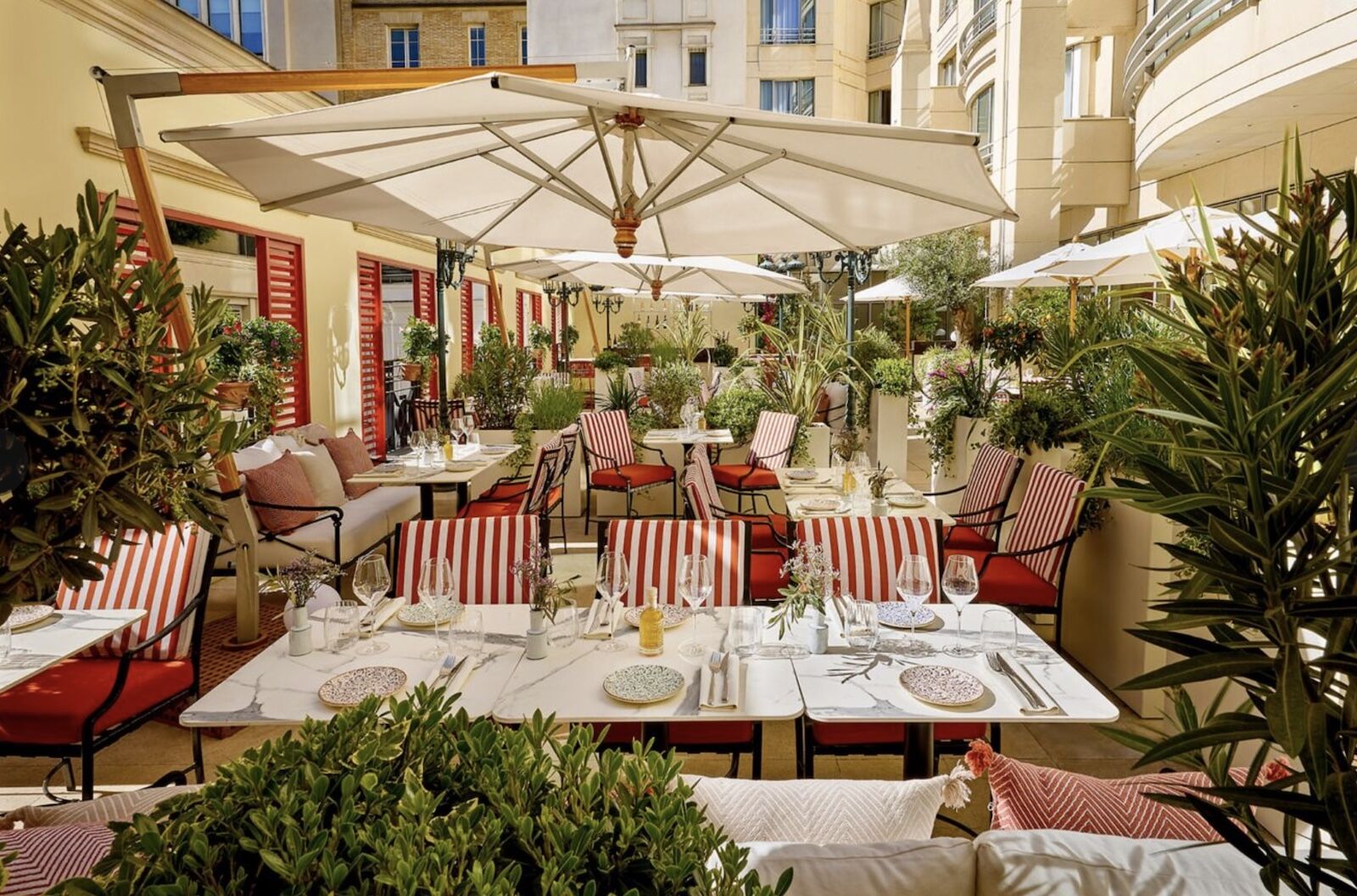
Cira at the Marriott Champs-Elysees. Photo: Marriott Champs-Elysees Paris
If your legs are sore from shopping up and down the Champs-Élysées all day, you can save the evening walk and dine at one of two fantastic on-site restaurants: Jenny and Cira. Beneath the glass ceiling in the lobby is the bar-restaurant Jenny, named as an homage to Jenny Sacerdote herself. It serves seasonal French dishes and cocktails “inspired by the vibrant spirit of Parisian culture,” plus an elevated tea service on weekends.
The newest restaurant at the Champs-Élysées address is the open-air Cira, with a Mediterranean-inspired courtyard. It trialed in 2024, but just reopened with a new concept in spring of 2026. The exterior is designed in warm red shades with citrus-colored touches, and the placement of tables tucked into the courtyard garden sets the mood for long, quieter summer dinners. The menu follows a matching Mediterranean rhythm, beginning with hors d’oeuvres like hummus, smoked eggplant caviar, homemade tzatziki, and local cheeses. Cira’s main courses are grilled over charcoal and dried grapevine cuttings, giving dishes a fragrant, smoky depth.
On Thursday evenings, the terrace hosts live music, from DJ sets to acoustic performances. On Sundays, Cira holds relaxed brunches designed for lingering, adding another reason to enjoy the hotel (beyond its rooms and famous address).
By the time I was packing to leave, I’d figured out what made the property so special — and it was something I hadn’t expected from a five-star hotel on one of the world’s most famous streets: I felt like I’d been let in on a secret. Yes, it was a stunning building smack in the middle of an iconic road in central Paris. But the history woven through it, paired with the quiet of its rooms and the hidden-garden calm of its courtyard, left me feeling like I’d done more than see the Champs-Élysées. I’d stayed inside a piece of its history. 