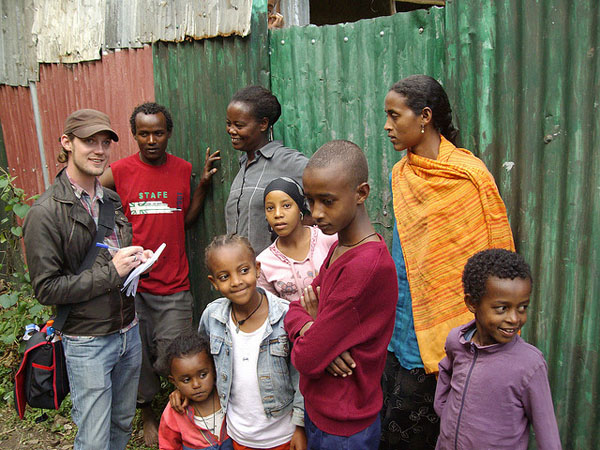
Journalism is a creative job.

DESPITE ALL THE professors who told me articles were a fixed formula plugged up with simple facts and despite the avalanche of clichéd crap that passes for most mainstream journalism, I stand by that statement.

Like any creative profession, you use your perception to re-interpret the world around you. You try to engage an audience with ideas and issues-you create something meaningful from all the incoherent information and noise out there.

But here’s the catch: good journalism is dependent on a total stranger’s cooperation and participation.

The finished product may be a piece of writing that you craft, but the material a result of the interviews you conduct.

At the heart of this issue is the interview. The finished product may be a piece of writing that you craft, but the material a result of the interviews you conduct.

And while sources vary-some people know exactly what they want to say while others love to make you sweat for a basic quote-how you conduct the interview has more to do with the outcome than anything.

It’s odd that so much emphasis is put on teaching journalists how to write an article when that skill is useless without also teaching journalists how to develop strong interview techniques.

In an effort to help other aspiring reporters develop this crucial skill-I brought together some of my colleagues and journalist friends to ask them what interview tips they think are most helpful:

#1 – Find a good location

Avoid Starbucks! It’s often easiest to suggest a centrally located corporate coffee shop but if there is any way you can interview in a place that has some relevance to the story or your subject you’ll have much greater success.

Not only because you’ll gain a further sense of context, people are often more comfortable (and open) when they’re in a familiar place or what feels like “their territory.”

Ask to meet at your subject’s house, work, or the location of an incident relevant to the story. Even meeting at the interviewee’s favorite restaurant is more interesting than a Starbucks.

#2 – Prepare Your Goals Ahead

Know what questions you’re going to ask and why you’re going to ask them.

Heading to an interview with a sense of what you want to get out of it (a colorful re-enactment of an event, an on-the-record opinion on the issue you’re covering, general background, etc.) is critical to conducting a successful interview.

You should already be thinking about what you want your piece to look like and what you need from this interview to get your article closer to that end result.

#3 – Write down your questions

Be sure and bring prepared questions with you. I usually go into an interview with twice as many questions than I expect to ask. The security of knowing that I’m not going to get stuck helps my confidence and you never know what question will get you the information you’re really looking for.

#4 – Work on your flow

This is probably the most challenging, but also the most important interview skill you can develop.

You want to strike a balance between a conversation (which helps make your subject feel comfortable and aids candor) and getting the job done. As your subject is answering your question, be thinking about what you’ll ask next and why.

The flow of questions needs to seem natural and conversational, don’t spin your subject off on a completely different topic just because that’s the next question on your list-think about segue’s and transitions.

This way your subject doesn’t feel forced to give you sound bites and may open up a little (particularly important for anyone working on an audio piece where you may need blocks of the raw interview).

#5 – Think about the medium

Interviewing techniques defiantly vary for different mediums. If you’re interviewing for audio or video you want to ask two part questions which encourages subjects to talk for longer blocks of time.

Conversely, when you’re interviewing for print, try and break questions up so you can get shorter and more concise answers (easier for taking notes and for quoting later). You can be more conversational with interviews for print, you can say “yeah,” and “uh-huh,” etc.

Not doing this is one of the biggest challenges when you’re interviewing for audio. Nodding and smiling accomplishes the same sort of conversational encouragement and keeps your tape clean.

Another great trick for audio interviews is to have your subject re-enact the story. It makes for good sound and helps you avoid having too much of your own narration later on.

#6 – Bring a buddy

I find having a second person as a note taker and extra set of ears can be very useful.

If you don’t think another person will overwhelm or distract your subject (I find that is pretty rare) it can be a lifesaver to have that second set of notes to check your quotes and information.

#7 – Avoid Obsessing

While good notes and recording are very important, you can do yourself a disservice by obsessing about recording every little detail of what your subject says.

As you’re interviewing you should be able to discern the gems from the chatter-focus on the quotes and info you know you’re going to use and make sure you get that right!

#8 – Be a little annoying

Don’t be afraid to relentlessly revisit a question or topic that you feel hasn’t been properly addressed by the interviewee. Sometimes people need time to warm up to you or a topic, or will respond better if your question is worded differently. Keep trying.

#9 – Be a little sneaky

Continue taking notes even after the interview is officially over. Sometimes people say the most revealing or intimate things when they feel that they’re out of the “hot seat.” If they don’t say “off the record,” it’s all game.

#10 – Empower them

A great question to ask if you don’t fully understand the perspective of your interviewee is “what is your ideal solution/resolution?” Obviously this only works in certain circumstances, but when appropriate it can help clarify a person’s point of view or opinion.

#11 – Work them up

Another great question is “Why do you care about this issue?” This can be an effective way to get a strong and emotional quote about why the topic you’re covering is so important.

You can also ask for the turning point in a story, the moment when everything changed or catalyzed. This can help you shape the narrative of your story as well.

#12 – Endure awkward silences

I know this is totally counterintuitive. My instinct is to keep chattering and asking questions to keep people feeling comfortable, but sometimes, especially when you’re dealing with sensitive subjects, you need to shut up and wait.

Ask your question, let them give you the rehearsed and generic answer, then sit there quietly and see what comes next. You’d be amazed how often this technique yields powerful results.

#13 – Ask for what you need

Seriously, sometimes interviewees are frustrating not because they’re trying to bust your chops but just don’t understand what you want from them.

I find that many interview subjects get a kick out of having you “pull back the curtain” a little and tell them about your process.

You can say, “Listen, I really need a quote from you encapsulating your feelings on this issue,” or “I really need you to walk me through the chronology of this,” or even, “I really need you to take me to a location that is relevant to this issue so I can set a scene.”

For the most part people want to be helpful and you just need to tell them how they can.

***

As you gain more experience interviewing, you’ll hone your own techniques. Your personality as an interviewer also plays a huge role in how you develop your approach.

In the meantime use these hints to help you mine the information you need to get down to the creative business of crafting a great piece of journalism.

Any other journalist techniques you’ve found effective for interviews?

How to Write
 

About The Author

Sarah Stuteville

Sarah Stuteville writes for The Common Language Project - dedicated to developing and implementing innovative approaches to international journalism by focusing on positive, inclusive and humane reporting of stories ignored by the mainstream media.

  • http://cultofdegan.com/weblog/ degan

    this is great, thank you! i discovered this site last week and have been loving everything on it since. it will all be very helpful for my upcoming trip to south america.

  • http://www.bravenewtraveler.com ianmack

    Glad you’re finding such useful material here at Brave New Traveler!

  • http://www.eyeflare.com Jack

    Great article, I’ve picked up a couple of tips from this: esp. number 7 about trying to not let the notebook rule the interview.

  • http://www.travelcloseup.com JennDZ

    Wow Sarah, your articles are just so helpful for me as a budding writer. I did a big project out in the American Southwest several years ago and I always had the hardest time with interviews, because I did not want people to feel “put on the spot” but that is exactly what an interview is, and I guess I have a hard time being the one to ask the questions, especially when it is a heated topic. You don’t want people to feel like you are prying. Any suggestions for putting people at ease—-including yourself??!!

  • http://www.pigsinthetoilet.com jv

    Those a pretty good tips! I especially like (and agree with) the tip regarding awkward silences. Classic interregator’s technique. If you can train yourself not to feel awkward, then the interviewee will be the only one … and the tendency is for an uncomfortable person to fill that silence.

    One tip I’d add: It helps to phrase certain questions in an open-ended way. “Tell me about …”, “How did you feel …”, “What do you think about”. You can always narrow things down in your follow-ups if you need more specific info, but open-ended Qs work well to get things rolling.

  • http://www.organicreform.org Derek C. Wallace

    Excellent tips, as always, Sarah!

    One article I’d be very curious to see from you (and maybe you’ve already done this one, if so, forgive me and link away!) is the role of objectivity in journalism and how you balance that out with your personal desire to report on issues that mainstream media doesn’t cover (which in itself reveals a bias). Can reporters ever truly be “neutral”? Or is everything we write a reflection of our biases and, hence, propaganda?

    Ian, I’d love to conduct that interview with Sarah! One independent journalist to another! :)

    • Harry

      The way to keep your thoughts out of the interview is to keep them out of the questions. You do this by keping descriptive words out of the questions. You ask “what did you think of the accident” and not “what did you think of the ++++++ accident’? If you want a bad example, watch Sean Hanity, he spends 2 minutes giving his opinion in a question and then lets you answer in one minute. I have done an interview for hours and never gave my opinion. My opinions were not in the written report of the interview as I did not put them in the interview questions.

  • Becka

    Great!! This will be perfect for my staff! Thanks :)

  • Pingback: thefemaletraveller.com » 5 Useful Resources for Writing Travel Articles

  • Chris

    This article is really informative and helpful, thanks!! I love to write, but I am definitely a little intimidated by the interview and unsure how to go about it at times. This is a very good outline. Thanks!

  • Nick Rowlands

    Fantastic article!

    One tip someone told me is that if you haven’t got what you need from the interview, if there’s one killer question that you haven’t quite been able to work in, or get a decent answer to, then pack up and leave. On your way out, ever so casually, ask your question. Make it sound like you almost forgot it – “Oh, by the way …” or “Out of interest …” are quite good openers for this. You may find your subject opens up so much that you have to sit down and do the whole interview again!

  • http://www.writingandreporting.com Joshua M Rosenau

    Great article.

    The other day I found myself in an impromptu interview with a D.A., and I bombed it because I hadn’t codified the questions in my head.

    Normally, I am smart enough to get around to the necessary questions after a little conversation, but the D.A. was not only busy, but also fairly adept at delivering brief, incisive answers that are intentionally dull.

    Had I followed the steps recommended here, I am sure it would have gone much better.

    Thanks for writing such a useful post.

  • Kruger Siankulu

    Everything i have ready are practically helpful.

  • http://winebeforelaundry.tumblr.com AJ

    I especially like the tip on not going to the local Starbucks. I write for my college paper and needed tips on interviewing a school fraternity leader. Thanks!

  • Yana

    I just want to say thank you. This was a very very helpful article.

  • Maggie

    Thanks for the great, insightful article! I don’t have any official journalism training, but I do volunteer writing for a local street paper. I certainly have made the mistake of interviewing at Starbucks, and I could barely hear what my interviewees were saying over the din of the coffee-making!

    It’s good to know that it’s ok to be more direct in asking for a specific item, too.

  • johanna

    very useful material for my newspaper class

  • http://www.GottaBeGolden.com K

    This is GREAT!

    Many thanks :)

  • http://www.GottaBeGolden.com K

    Many thanks :)

  • Pingback: Interviews, Part 1 | Mr. Olivo's Classroom Blog

  • Harry

    as to #4, I believe it is better to listen to the subject’s answer than to be thinking of my next question, because my next question very well may come from the last answer the subject gave. I write down the topics I want to cover and then I question you all day long if need be.

  • http://thewritepractice.com/how-to-conduct-an-interview-like-a-journalist/ Joe Bunting

    Good post! I love what you said about picking a location that is NOT starbucks. I made this mistake early on, and by the time I started meeting people in their offices or another location important to them, I was blown away by the improvement.

  • http://thewritepractice.com/how-to-conduct-an-interview-like-a-journalist/ Joe Bunting

    Good post! I love what you said about picking a location that is NOT starbucks. I made this mistake early on, and by the time I started meeting people in their offices or another location important to them, I was blown away by the improvement.

  • Reporter?

    Thank you so much for this article!  It really helps a novice like me get her bearings on the art of interviewing!

  • http://twitter.com/OhYeah_Her Maegan E

    Thanks! This is a great piece and obviously stands the test of time!  I’m new to the interviewing scene and wanted to be able read more about technical aspects – so thank you for the tips!

  • http://twitter.com/OhYeah_Her Maegan E

    Thanks! This is a great piece and obviously stands the test of time!  I’m new to the interviewing scene and wanted to be able read more about technical aspects – so thank you for the tips!

  • Mix

    This is really useful, thank you.
     

  • sheishimi

    Thank you. I will share this with my students.

Musicians →

More Americans have had their perceptions of place influenced by hip hop than travel...

How to Write →

From advice columns to creative nonfiction to travel blogs: How "truthful" is it?

How to Write →

From linearity to superlatives to the "sin of omission" here are 5 common mistakes of...

How to Write →

"Whenever we are traveling, we are outsiders looking in, no matter how we travel. In some...

How to Write →

Ironically, creating a new framework for expressing your perceptions is just another way...

How to Write →

JoshyWashington says: stop dreading reading your writing out loud and start shouting your...

How to Write →

Tips, resources, and quotes on dealing with writer's block, brought to you by...

How to Write →

"I realized the value of that travel journal I was keeping – jottings that, although I...

How to Write →

Ever thought about pitching your writing outside the US? The UK, Ireland, Australia and...

How to Write →

Accomplished travel writer Beebe Bahrami shares her thoughts on the craft and what it...

How to Write →

Every day, in many different ways, I massage my brand and am pitched by other writers who...

How to Write →

Writers tend to fall easily into the coffee / computer / confined office trap. If this is...

How to Write →

How do publications' policies on what a writer can and can't accept for gifts or comps...