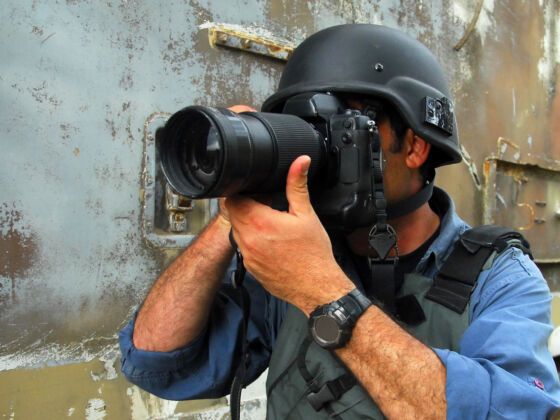
War photographers are accused of being adrenaline junkies. But they bear a terrible burden for witnessing the worst.

Photo by Mark Brecke

A photographer is a witness. Witnessing war is one of the ultimate human tragedies.

But what if you held a camera and not a gun? What would you see? What would you choose to shoot?

But perhaps, more importantly, what would happen to you after you took the shot? How would the experience change your view of humanity? How would it change your view of yourself?

War photographers are accused of being adrenaline junkies. Continually on the hunt for the next war, the next picture, they shove their lenses into the faces of their traumatized victims.

They are portrayed as voyeurs of suffering, and scavengers of the worst that humanity has to offer – mere human robots snapping pictures in the theater of war.

But there is a price to be paid for viewing all of this suffering.

Haunting Memories

The photographers all spoke of filming scenes of such grotesqueness that they knew the photos would never be published.

According to a study published in the Columbia Journalism Review, war journalists had significantly more post-traumatic stress disorder (PTSD), depression, and psychological distress than their domestic counterparts.

The war group also experienced a rate of PTSD over the course of their lives that far exceeded that of firefighters and police officers. In fact, war journalists approximated the PTSD rate recorded in combat veterans.

The photographers in the study all spoke of filming scenes of such grotesqueness that they knew the photos would never be published. Yet, even in the light of public squeamishness or editorial sensitivities, they felt compelled to record a visual testament.

Although the images never went further then the vaults of their mind, the collective weight of their memory would often intrude on their waking consciousness and nightly dreams.

With all the invasion of privacy, with all the peril, there is still this sense of mission.

Read full article on MatadorU

Community Connection

Check out The Face Of War in A Child, a profile of Mark Brecke published last year in Traverse magazine.

What do you think of war photographers? Crucial service or crass opportunism? Share your thoughts in the comments!

About The Author

Ellen Wilson

Ellen Wilson is a freelance writer/photographer based in Michigan. She has taught English and biology in the US and the UK, and is constantly on the lookout for opportunities to educate and inspire others through her writing and photography.

  • http:///www,twistedcompass.com/pnomads Jacob

    Great article! I think from an archive perspective that these photographers are downright vital. From a “telling the story perspective”, I’m not so sure.

    I remember watching “Gunner’s Palace”–the heart wrenching documentary of 2/3 Field Artillery Division–whose tagline was “Some stories will never make the nightly news”. The documentary was great, with soldiers breaking into rhymes seemingly “spontaneously” and young soldiers speaking candidly about accidentally firing their weapons. One scene even shows a soldier playing “Medal of Honor: Allied Assault” at his guard post. It all showed the blundering of the American forces in Iraq, in a deluge of images that were at times as funny as they were tragic. I loved “Gunner’s Palace” and thought 2/3 FA must’ve appreciated having the “real” story told.

    My brother was attached to the 1st Armored Division in Baumholder, Germany–the same place as 2/3 FA. “Gunner’s Palace” is a running joke there. Once, my brother brought up the movie to a colleague of his in 2/3 FA (who was “there” during the filming), at which point the officer rubbed his temples and said, “It’s like they took the few people in our unit with criminal records, and shone a spotlight on ‘em”

    My point–or rather, what I feel is important in this–is that “Documenting” is not a “story”. Stories have a slant, an angle, a purpose–protagonist, antagonist, etc. Filmmaker Michael Tucker seems to suggest that this film was a documentary and people such as myself were quick to take it for gospel. But for the people who “were there”, the remaining 90% of 2/3 FA, it’s nothing more than a highlight, a cute story about a few silly soldiers in a short period of time.

    This does nothing but entertain.

    When you say “Yet, even in the light of public squeamishness or editorial sensitivities, they felt compelled to record a visual testament,” THAT is what I feel is the vital service of combat photographers–to merely document, in spite of the economic gains.

  • http://www.matadorpulse.com Eva

    Great article.

    It’s never even crossed my mind to think of war photography as “crass opportunism”. Again and again in recent history they’ve been the ones bringing home news and evidence that governments might not want ordinary people to see. Robert Capa’s Spanish Civil War photos, for example, or most famously the many photos that came out of Vietnam. (Vietnam’s tribute to American war photographers in the War Remnants Museum in HCMC is one of the more moving museum exhibits I’ve ever seen…) Even when they’re not unveiling “reality” in a political sense, they can teach those of us who stay back home so much. Capa (again – I’m a big Capa fan) is pretty much the reason why ordinary people know as much as we do about the experience of the D-Day landings.

    (Capa’s book, by the way, is called Slightly Out of Focus. He wrote it about his career in Spain and Normandy before being killed by a land mine in Vietnam.)

  • http://www.ianmack.com Ian MacKenzie

    I found a recent talk from James Nachtwey where he talks about being a war photographer. Check it out!
    http://www.ted.com/index.php/talks/view/id/84

  • http://www.gogreentravelgreen.com Kimberly

    Really great post. I hadn’t thought of what photographers go through – and the decisions they’re forced to make – during war and natural disasters until I visited the recently re-opened Newseum here in DC 2 weeks ago. The Pulitzer Prize winning photo exhibit was harrowing.

    The photo that sticks out most in my mind was of a starving African child on the ground with a vulture right behind her, waiting for her to die. The quote from the photographer said that image haunts him and if he could go back and pick her up, he would. I can’t imagine trying to stay objective when witnessing something like that.

  • Grace

    I know that photo well, it raises a lot of discussion amongst the viewers of the image as well as photojournalists-it’s from the early 1990′s taken by Kevin Carter, who committed suicide shortly after. It isn’t just the image that remains with me but the heart of the man behind the lens.

  • http://www.eyeflare.com/article/war-junkie-by-jon-steele/ Jack from eyeflare.com

    This is a great article. A book that really hit home when I read it, was Jon Steele’s “War Junkie” (review at http://www.eyeflare.com/article/war-junkie-by-jon-steele/).

    While Mr Steele was an ITN (Independent Television News) video photographer, he visited a number of the worst flashpoints of the time, including Rwanda. It’s a gut wrenching read, but I couldn’t put it down even while feeling quite ill imagining the brutalities he’d witnessed.

    The photogs who cover these situations aren’t opportunists, they’re very brave people who risk their life to bring us the reality of what our (and “the other side’s” politicians are throwing our soldiers into.

  • http://blog.sduffyphotography.com Shawn

    Great article Ellen!

    Being a photographer who aspires to this field, this is something I’ve thought about long and hard… I wouldn’t say I wanted to be a “war” photographer but, being a very political and socially aware person, I want my photography to be the voice of those that cannot speak for themselves and the eyes for those who can’t see for themselves. I want to take photos that make someone, anyone, stop what they’re doing and say “It doesn’t have to be this way”. Does that include war? Sure. It has to. But when, and if, the time comes, will I be able to put my lens in the face of someone suffering and take their picture? I don’t know. I really don’t. My soul will surely be screaming for me put down the camera and help them. I’m just hoping that I have the wherewithal to realize that taking their picture just might be the best way that I can.

  • Pingback: Friday Link Love

  • Pingback: bwuphoto.com » Blog Archive » On photographing conflict

  • Pingback: current events in rwanda

  • Craig A Sheffield

    I am looking, at this time, into becoming a war photographer. My dad and grandfathers were soldiers, but I was unable to make the cut in the military due to my health. So, I would like to understand war through the lens of my camera. I would like to help portray the story of the dying soldier, and those who have passed on. I have a love for photography, and a high regard for the men and women who are fighting these wars. Trust me; I don't like war, but those soldiers who are fighting for our freedom deserve to have their story told through an unbiased source, because I can only shoot my camera by the freedoms they fight to uphold.

  • http://www.volpe.be Pierre Volpe

    I think I can be …

    contact me
    Pierre Volpe

  • Paul Thomason

    Hi

    I’m a middle aged man living in Liverpool, Uk. I’m very interested in using what remains of my life to pursue a career in War photography. Like a previous commenter I wanted desperately to join the military but was unable to due to health concerns. My reasons for wanting to join were to do with the absence in me of a coherent sense of identity, knowing who I am. Watching a documentary about Jim Nachtwey I was intrigued by his realisation that in doing what he did he came to know who he was, I guess that ties in with recognising his purpose and hence finding meaning in his life. This is what I want, what I need.

    I’ve recently returned from a road trip I took on my Motor cycle around central Europe focussing on the Balkans. I did this in an attempt to find this elusive aspect of my personality, to find myself and to find truth which, in essence, is what people like Nachtwey do. My trip reached its climax in the Albania, Macedonia, Serbia region and most significantly in Kosovo where I discovered there is an ongoing peacekeeping mission taking place under a Kfor banner. It was here I experienced the synthesis of truth and contemporary reality as I witnessed NATO/ Kfor American Humvees, Italian APC’s and Turkish military vehicles among others patrolling in and around Pristina. I travelled north into Serbia to be refused entry for having a Kosovan state immigration stamp in my passport whereupon I had to take a long diversion through Montenegro to cross at an undisputed border checkpoint. I spoke with and experienced Serbians hospitality and frustration at finding themselves having to shoulder the burden of loser and, by extension, the guilt and shame for a conflict saturated in complexity and the weight of history.

    I also shared time experience with others involved; Bosnians, Croats and perhaps most significantly Kosovan Albanians who appear to have benefited most obviously from the post settlement peace. I was puzzled by this as they seemed to be very much on the periphery of the conflict but again the picture became clearer and again deeply fascinating when I discovered how rich Kosovo is in mineral deposits. All of this, of which I have only shared a glimpse changed me, it made me aware reality in colours and tones I’d never experienced before. I treasured the dust on my bike and camera equipment for the days it remained and I want nothing more strongly than the chance to return to this kind of environment and capture images similar to the ones I got while I was there. I would be grateful for any and all advice.

    Yours Paul Thomason

  • émilie

    Hi,
    my name is Emily, 20 years old and I’m studying photography at Montreal. I am interested by war photography. Make the picture of war would be a dream. Unfortunately since I am a woman no one takes me seriously. Despite my research I have not found other ways to go with the army without a military service or work for a newspaper that does not give jobs. If someone could give me information about it would be greatly appreciated.

    thank you
    Emily

Photo + Video + Film →

A photographer stands still on a busy street corner in Mexico City.

Photo + Video + Film →

Photographer Zack Arias journeys to confront the struggle of being an artist.

Photo + Video + Film →

For the sake of art, a ragtag of photographers descend on Penang

Activism + Politics →

In the wake of a fine surfing day, Rob Chursinoff finds himself face-to-face with a US...

Photo Essay →

See Burning Man from a completely different point-of-view.

Photo Essay →

An impromptu portrait session while riding the subway in Taipei.

Photo Essay →

"There’s at least six decades of history stored in [this apartment]."

Photo + Video + Film →

You either love it or, like me, would rather skewer your own eyes out with a monopod than...

Photo + Video + Film →

Print photography magazines are still alive and kicking. Which one is your favorite?