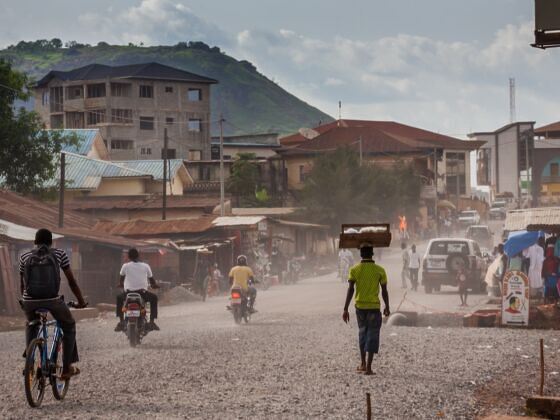
Photo: Allison Cross

Journalist Allison Cross ponders how to deal with aggressive men in a culture steeped in inequality between the sexes.

“Do you have a husband?” It’s a question I get asked every day, sometimes two or three times.

It’s usually as I ride on the back of a motorbike on my way into town from my house, which is out in the country. Clutching tight to the small handle on the back of the bike, doing my best not to fall off, I’ll lean forward to try and hear the driver as he talks to me from inside his bulky helmet.

“Are you married?” he’ll ask, again.

In the beginning, I was mostly honest. I’d say I wasn’t married, but I’d fib a little and say I had a serious boyfriend back in Canada.

As more and more men asked for my phone number, asked to see me every day and asked to be my Sierra Leonean boyfriend, I upgraded the serious boyfriend to a fiancé. But I soon discovered this didn’t dissuade the constant winks and offers for love, marriage or sex.

The men in Sierra Leone are aggressive. They whistle and hiss at women as they walk the streets and I’m told I get the brunt of the public attention because I’m a foreigner.

Roaming Eyes

Some days it’s easy to ignore the calls, but other days a knot will form in my stomach, my cheeks will burn and I’ll long to turn around and release stream of expletives in their direction. But I’ve never done that. Instead I’ll keep my eyes forward and keep walking.

Some days it’s easy to ignore the calls, but other days a knot will form in my stomach, my cheeks will burn and I’ll long to turn around and release stream of expletives in their direction.

And it isn’t just men who see me on the street. Boys as young as ten lick their lips and call me “baby” as they try to sell me fruit. Men I meet while out working with local journalists will lean very close to me as we talk – too close – and let their hand fall from my shoulder and trail down my back.

Others won’t look me in the eye as we talk, instead letting their eyes roam up and down my body.

Speaking to veteran journalists before I came to Sierra Leone, they warned about the male behaviour, and how it might shock a Canadian like me so accustomed to political correctness. But they counseled me to use the attention to my advantage, and seek out interviews male foreigners would never be able to attain.

Fight or Flight?

Speaking to a local female journalist for advice on how to avoid so much attention, she recommended I placate the men who sought me out, and tell them that although I’d love to spend time with them, I’m committed to my fiancé and to my work.

I was encouraged to laugh about it and throw some humour on the whole situation. I didn’t want to burn any bridges with these men, she told me.

I didn’t like this advice. I didn’t like the idea that I had to appease men in order to stop them from harassing me and touching me without my permission.

Some men take disturbing liberties with the bodies and freedoms of women in Sierra Leone. The West African country has extremely high rates of rape, forced and underage marriage, teenage pregnancy and female genital mutilation.

Widows regularly lose their property when their husbands die, after his brothers or children from previous marriages claim it as their own. Sexual violence was used widely as a weapon of war during Sierra Leone’s brutal 11-year civil conflict.

But speaking up against abuse hasn’t been a part of the female culture in Sierra Leone. Three laws enacted by parliament in 2007 made domestic abuse and child marriage illegal, but many rural women are still unaware of what their rights are.

The Dilemma

Speaking up about abuse can mean women are ostracized by their husbands and exiled from their communities.

None of this is to say many women haven’t successfully entered aspects of public and political life in Sierra Leone. But the liberties men continue to take with women’s bodies are unacceptable to me.

Living abroad requires finding that tricky balance between holding on to your own ideals and adapting to the ideals of your host country.

For me, it’s eight months of uncomfortable but generally harmless advances by men. Whether I stand up or not only matters to me and whether I feel offended or unsafe in a certain situation. But there’s much more at stake for a woman in Sierra Leone.

I’m left wondering if it’s better to try and take a stand, to set an example, or to let their fight for equal rights and respect run its own course.

As a foreigner, what’s the best way to deal with sexual harrassment in other countries? Share your thoughts in the comments!

Activism + Politics
 

About The Author

Allison Cross

Allison Cross is a Canadian journalist working in media development for a Canadian NGO in Sierra Leone. Visit her personal blog.

  • http://www.bearshapedsphere.blogspot.com eileen

    My situation is totally different from yours, as I live in Santiago, Chile. I don’t exactly look like a local, but it would be hard to pick me out of a crowd at a distance. Also the divide between men and women is not as great here as there, though it does exist.

    I think as a foreigner you are somewhat outside of regular social norms, which is to say you can be a shade more assertive, aggressive or oppositional in what you say or do than a local woman could. But never enough to endanger yourself or the women you will later leave behind when you eventually leave.

    And as for that seething feeling of helpless and mad? Best to sound off about it with other people who “get” you. Here in Chile I’m just told, oh who cares? they’re just jerks. If it’s part of the social fabric, it’s unlikely a local woman will know your ire, much as she dislikes the “attention.”

    Thanks for writing this article. It’s an important topic. Universal, if you will.

  • http://wayworded.blogspot.com/ Hal

    I’m curious why you stopped at fiance? Why not pick up a ring and take it all the way? Of course it’s disgusting to have to play out a farce like that, but wouldn’t that buy you some more peace?

  • http://www.theallisoncross.com Allison Cross

    Now, I do say I’m married, and have switched one of my rings from my right hand to my left, but that doesn’t do much, unfortunately.

  • Mandino

    I can say that the men there are really vocal… another tip would be to bring with you a trusted partner since foreigners have the highest abuse rate because they are not native there and people tend to look at foreigner and they would also treat you as someone who does not know anything… knowing a little psychology would really help and some kung fu :) I have been reviewing places and I am really concerned with how men treat women… Thanks for the info, I got to learn about your experience… I suggest that you could also share some of your words in Baraaza where a lot of travelers especially those lone woman travelers… it will greatly help :)

  • Amanda

    From my experience in South Asia and getting groped by men on streets and buses (and truthfully, from my home in Brooklyn) responding to passing comments is giving the attention they seek. Responding that you are committed to someone as well as your work wards off temporarilarly. But in the end, when the hands come up, the best advice in South Asia was to respond “do you have a mother? a sister? how would you like that if someone did that to her?” For South Asian culture, grounding them by using family values shamed them — and that was key.
    Best thing to do is listen to a local and do as she says.

  • Meli

    You may want to take what the female colleague told you and try it. It’s not about appeasing but more going with the flow. As long as these men know you’re already married, and u joke around may be it may not be so bad.

  • http://www.extremetelecommute.com Liz @ extremetelecommute

    Allison, I completely understand the frustration. I’ve traveled extensively in Central America, where the machismo tradition is alive and well–and as a blonde woman with blue eyes and pale skin, the harassment can be impossible to bear. I try to follow the example of local women and ignore the comments, but at times–like when men grope me in the street–it’s all I can do to keep my cool.

    For the sake of my sanity, I find it cathartic to vent with other solo female travelers and compare stories; I also take every opportunity to discuss the issue with local men, who are often surprised to learn that their behavior is upsetting.

    And it’s so great to read articles like this one, to know that I’m not alone!

  • Andrea

    Strange that there are so few comments on this article, which brings up a very universal experience for women when traveling (and at home), in contrast to the article on a male traveler seeking companionship with a young Asian girl. (7/02/09, White Man-Asian girl..who decides the nature of love?).
    I received a lot of attention from men when traveling and studying in Cuba and it was amplified by the invisible dollar sign on my forehead. I came to a place of peace instead of fear or irritation since it was an opportunity to talk to Cubans and learn something about their life. I just had to say no a lot and hear a lot of rather randy Spanish. Only once did things heat up a bit too much in a scary way.

  • redspyda

    hmmm I am sierra leonean male leaving in the US and I will say that not all sierra leonean men behave that way. I dont think it is any worse than women receive anywhere in the world. That doesnt make it right, but it just seemed that it was generalized. There are pigs everywhere

  • Jon

    lol…Apparently, a lot of you are-get over it. Truth hurts. Certain countries have a lot of this behavior, this one being no exception.

  • Lango Deen

    allison, i am a sierra leonean woman and i recognize a lot of the behavior you describe. for what it’s worth, those personalities didn’t/don’t fit well with mine, or with a lot of women and girls in sierra leone, either. that women haven’t done more to fight for respect beats me, too. but the longer you spend in sierra leone and understand what you see, the more perspective you get on why it’s not a fight you’ll want to take up. for the rest of your stay, i suggest that you take a trusted male friend with you as somebody suggested. good luck and enjoy your stay. kind regards, lango deen

  • Deepak Singh Rawat

    I think if you know the local language and doesn’t look too lost then people are discouraged to take advantage of you. Knowing the local language is a very important tool to avoid any conflict and to seek help when in distress. People try to take advantage of someone who looks out-of-place. The other thing is to avoid places which you know are dangerous. If you have to go to any such place then I would suggest not to go alone.

Activism + Politics →

Join Reddit and dozens of other high-profile sites this Wednesday.

Activism + Politics →

Hungary does not permit genetically modified crops, even Monsanto's.

Activism + Politics →

The local operator for the company hired 32 community members to clean up the mess. With...

Activism + Politics →

Judging by the number of people pouring into the square before 11am this morning, it's...

Activism + Politics →

Wikileaks announces its intention to sue Visa and Mastercard and taunts them with a fake...

Activism + Politics →

"What will I do with the unrestricted Super PAC money? Give it to me and let’s find...

Activism + Politics →

Mass protest seems alive and well. Yet is protest just another form of victimization?

Activism + Politics →

Dismembered, bleeding, drowning, eaten alive: this is the fate of tens of millions of...

Activism + Politics →

This is a particularly gnarly example of how multinational corporations can dictate...

Activism + Politics →

BNT launches a new column from Allison Cross, a Canadian journalist in Sierra Leone for 7...