Previous Next

Photo: chadmiller

This story was produced by the MatadorU Traveler-in-Residence program in partnership with Adventure Center.

KONYA WAS FREAKING me out, and that made me feel a little guilty, a little shallow, a little spiritually bankrupt.

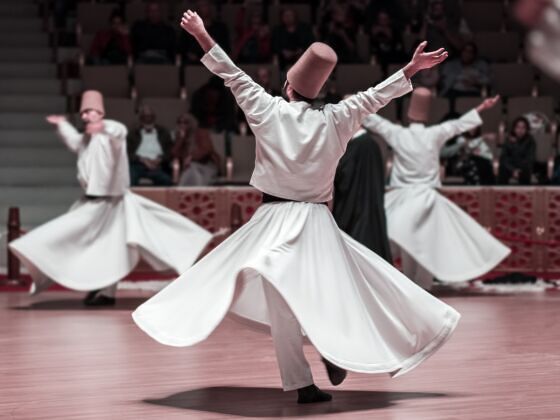
I was in the famously devout, conservative city to visit the Mevlana Museum. Mevlana (master) Celalledin Rumi was the 13th century founder of the Mevlevi order of dervishes popularly known as whirling dervishes for their practice of spinning in a ritual to connect with their divinity. Me? I was uptight.

I knew Rumi from inspirational posters, coffee mugs, and the email signatures of my more tuned-in friends. Rumi was a mystic, our guide, Iskender, told us. He was a jurist and a poet. Then, as though this day were planned for maximum cringeness, Iskender took a small notebook from his back pocket and began to read:

    Come, come, whoever you are.
    Wanderer, worshipper, lover of leaving — it doesn’t matter,
    Ours is not a caravan of despair.
    Come, even if you have broken your vow a hundred times,
    Come, come again, come.

In the crush I was witness to all sorts of devotion. A group of people were in a circle singing, their faces so close to each other that they looked as though they might kiss. A few meters away, believers openly wept, eyes closed and palms up. Suddenly, the cluster of people around me began to shift and, spooked like livestock, we crowded into the corner. As the group parted, I saw that we were making way for a congregation in pointy felt hats, heads bowed, who were shuffling backwards away from Rumi’s tomb. “They’re showing respect,” someone whispered.

I felt the tightness in my chest release as I stepped outside and dropped my plastic slippers in the bin.

To my left, a woman held up her baby, touching his lips to a glass case. Inside, a box rested on a piece of embroidered cloth. I must have been staring because Iskender, the Adventure Center guide, leaned over and explained in a low voice, “They say the box contains the beard of Muhammad the prophet. They say it’s fragrant. They’re trying to smell it.” For a minute I thought I’d misheard him — there’s a beard in that box? — but when I sidled a little closer I could see holes drilled into the glass, and the wear on the wood around the vents from years of devout inhalation. I was trying to understand, to see the beauty in these dramas, but I knew I shouldn’t be there. I felt the tightness in my chest release as I stepped outside and dropped my plastic slippers in the bin.

That strange day ended with a typical evening, outstanding only in the unavailability of wine or other alcohol with dinner. The following afternoon we got our first glimpse of the Mediterranean, shimmering and impossibly blue, and I forgot about Mevlana and the dervishes and even Muhammad’s beard. Faith and devotion returned to their usual spot in my consciousness, neither deeply buried nor raw.

But after the Mediterranean, not everything went back to how it had been. The entire country seemed cast in a new context. In the mornings, I was woken not by roosters or brawny shards of light, but by the first mournful call to prayer, broadcast long before I’d left my bed. In the darkness I’d lay there and think about the people around me in their houses waking, washing, praying. They were thinking about god and I was thinking about them thinking about god. We were connected.

Photo: quinn.anya

“Dervish means poor,” Iskender had explained. “A poor man is in need of food or money, but a dervish is in need of god.” I wasn’t sure I even understood what that meant, but also I couldn’t stop thinking about it. Travel has a way of spotlighting all manner of sudden, urgent, internal requirements. I was afraid, now confused, now lonely, and sometimes I’d weep, eyes closed and palms up. Was I in need of god? When I’d slow my thoughts and still my heart, was this prayer? When I received what I most needed — useful information or friendly company at breakfast — I’d take a quiet moment to be thankful. To whom was I giving thanks?

In the end, a compromise. Turkey asked for my belief, with its handsome landscapes of domes and minarets, and its five-times-daily songs of devotion. Though I could not submit, I also did not resist. In Turkey, everything was in context with the soul, including this worn traveller’s prayer: “Things will work out.” I heard it no more frequently in this country than in that, but cast as lyrics to the muezzin’s song, I found it easy to nod and respond. “They always do.”

[Note: The author is a Matador Traveler-in-Residence participating in a partnership between MatadorU and Adventure Center. During 2011/12, Adventure Center is sponsoring eight epic trips for MatadorU students and alumni.]

Religion


About The Author

Keph Senett

Keph Senett is a Canadian writer who's currently in transit. She’s a blogger who writes about travel, soccer/football, human rights, LGBT and gender issues, world politics, community, culture and her own folly.

Archived Responses to In Turkey I became a traveling dervish

  1. Conceptualcat says:

    Rumi, ahh, he speaks to the need in all our hearts whether, Suffi, Hasidic, or Pentecostal, of the mystic want of transcendental relationship with the divine, even if it is only that small place of neurons in our brain. Gandhi said that “Man cannot live by logic alone, but also needs poetry.” Nice article. 

  2. Anonymous says:

    Beautiful piece Keph, congrats. I understand your story, confusion and emotions.

  3. Jivebonz says:

    I didn’t want to like this piece. As a devout atheist, it challenged what I want to believe. Nevertheless, you make such good points that I can’t help but appreciate the cultural shifts in experience. You make me want to go to Turkey to “try this on” for myself. What a powerful piece. Thanks for making me think and expand!

  4. Keph Senett says:

    Thanks, everyone, for your thoughtful responses. This article kicked and protested before coming into existence, and at times I wasn’t sure it would ever emerge. I’m so pleased that it’s sparked all this discussion. Cheers,

    K-

  5. I cannot wait for more from Keph. She is a traveler well worded indeed, a real talent.

  6. Maurice says:

    my buddy’s mother makes $72 hourly on the internet. She has been fired for 6 months but last month her check was $7635 just working on the internet for a few hours. Go to this site nirl.eu/m

  7. neha says:

    Beautiful, complex piece. 

  8. Jo Magpie says:

    Ahh, yes, Turkey did this for me too. Perhaps one day some of my words about that experience will be up on this site. I hope so. Thanks you for sharing yours with us.

    http://agirlandherthumb.wordpress.com

  9. This complex piece reminds me of the travels and time I spent in Turkey. The one response I can muster is : Turkiye cok cok ozledim!!

  10. Laura Cook says:

    Only just seen this Keph, an honest and well written account. Well done

With a cocky grin, Andrew feeds a bit more flame into the envelope...
Am I alone in my fantasy of nibbling shish kebab in Istanbul?
Turkey is much larger than I’d thought...
Hannah Barth gives a glimpse into what happens when a non-believer decides to participate...
A day in the life of an English teacher in Istanbul.
There are over one hundred underground ruins in Cappadocia, Turkey. Join travel vlogger...
Matador's editor-at-large, Paul Sullivan, interviews eco-architect Ken Yeang about a new...
Turkey doesn’t have a desert, and it doesn’t have any (native) camels either.
Matador's destination expert on Istanbul lays out the city's avoidable attractions...and...