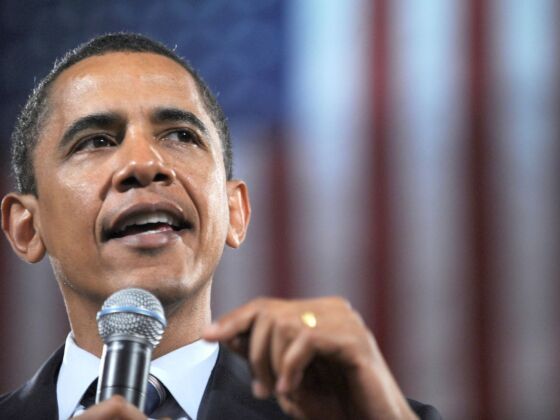
Obama in the White House / Photo: Whitehouse

As past Laureates welcome our President into the fold, we take a look at the concept of peace in the wider world.

A week ago, President Barack Obama won the Nobel Peace Prize. Many were shocked.

Mock speeches were drafted in which he declined the prize or accepted it on behalf of others. The town-hall criers cringed in agony, the media salivated. On Meet the Press, Paul Gigot of The Wall Street Journal wrung his hands at the idea of “subjugating American values to global values.”

We’ve spent the week struggling to make sense of the decision.

There is one group of people who maintained their equilibrium and instantly reached out to welcome Barack Obama into their midst: the most recent Nobel Peace Prize Laureates. If we consider their comments in light of the wider world, we might better understand the choice.

But how to visit the wider world? We need to get out there to see what those ominously evoked global values are. We can throw on a backpack and witness conditions firsthand, or… here is an alternative.

David Elliot Cohen has created What Matters, a book of images and ideas in which the world’s preeminent photojournalists and thinkers depict the “crucial yet curable” issues of our time.

As Omer Bartov writes in his essay on genocide, “These photographs tell a truth we would rather not know. They have the power to take us to places we will never visit, show us sights we hope never to see.”

He challenges every one of us to do something, however small, to make this world a better place.

What Matters provides a framework in which to contemplate the Nobel Committee’s reasons for awarding the prize to Barack Obama and the statements of the past Laureates.

1. Encouraging Co-operation

Kofi Annan (Nobel Prize Laureate 2002) called the decision “…an unexpected but inspired choice. In an increasingly challenging and volatile world, President Obama has given a sense of hope and optimism to millions around the world. He has shown the way forward is through genuine cooperation with other nations.”

Obama’s diplomacy, according to the Nobel Committee, is founded on the concept that those who lead the world must do so on the basis of values and attitudes that are shared by the majority of the world’s population, which makes Paul Gigot’s melodramatic hand wringing a little out-dated.

This is what Obama had in mind when he addressed the United Nations on September 23:

“In this hall, we come from many places, but we share a common future. No longer do we have the luxury of indulging our differences to the exclusion of the work that we must do together. I have carried this message from London to Ankara; from Port of Spain to Moscow; from Accra to Cairo; and it is what I will speak about today – because the time has come for the world to move in a new direction. We must embrace a new era of engagement based on mutual interest and mutual respect, and our work must begin now.”

2. Saving Darfur

Jimmy Carter (2002) said: “A bold statement of international support for his vision and commitment to peace and harmony in international relations. It reflects the hope the Obama administration represents across the globe.”

One place increasingly devoid of hope is Darfur, as we can see from the eyes of a child on the streets of Adre with his finger on the trigger (What Matters, The Scorched Earth of Darfur – Marcus Bleasdale, photo).

Genocide, which President Obama called “a stain on our souls,” must be stopped in Sudan. For this to happen it must move up on the agenda of world leaders. Obama pinpointed Darfur in his call for a new era of engagement among nations.

Lawrence Woocher of the U.S. Institute for Peace Center for Conflict Analysis and Prevention said this was notable and indicates a real policy priority. Save Darfur Coalition Board member and co-founder of My Sister’s Keeper, Rev. Gloria White-Hammond said the Nobel Prize should reinforce Obama’s leadership role in Sudan and Darfur with the international community.

3. Closing Guantanamo & Ending Torture

Shirin Ebadi, (2003) said:

“I congratulate and welcome President Obama to the large family of Nobel Prize Laureates, and would like to say to him that this is a huge responsibility. I hope he’s able to realize that the word peace is not just the absence of war. It is a collection of circumstances that will eradicate children dying of hunger, a person imprisoned for writing an article, or a person tortured while in detention. It is through understanding all of this that the true meaning of the word peace can be implemented.”

January 22, 2009, the day after the inauguration, President Obama issued three executive orders. He ordered the closure of the prison at Guantanamo Bay (currently in progress, though the deadline will likely be delayed), and a review of our detention and interrogation policy. He revoked Executive Order 13340 of July 20, 2007 (George W. Bush’s belated attempt to reinterpret those quaint Geneva Conventions). Obama has clearly prohibited the use of torture.

This was a first step in healing our image with the rest of humanity. Here at home we only grasped a fraction of what the photos from Abu Ghraib did to our reputation around the world. They struck fear of Americans into the hearts of many and is one of the high costs of the war on terror outlined in What Matters.

4. Promoting Engagement

Wangari Maathai (2004): “I think the U.S. has been largely judged by the reaction to the act of not signing the Kyoto protocol and also not believing that climage change is a reality. Now look at the U.S., it is engaged, it is supporting the events leading to Copenhagen…”

Maathai knows the difference one person can make and the importance of calling others to action. She planted nine trees in her backyard in Kenya and this grew into the Green Belt Movement – which has planted millions of trees to help restore Africa’s forests.

On the 100th day of his administration, Obama signed the Edward M. Kennedy Serve America Act, increasing the size of Americorps and “connecting deeds to needs.” This summer our president launched United We Serve. He has engaged Americans in imaginative volunteerism.

5. Abolishing Nuclear Weapons

Mohamed ElBaradei (2005): “I cannot think of anyone today more deserving of this honor … President Obama has provided outstanding leadership on moving towards a world free of nuclear weapons.”

When ElBaradei accepted his Nobel, he asked people to imagine a world without nuclear weapons. In awarding the prize to Obama, special importance was attached to his vision of and work for a world without nuclear weapons.

The photos in Fallout- The Enduring Tragedy of Chernobyl leave nothing to the imagination. Nineteen years after the evacuation, an empty kindergarten room reminds us of the absolute necessity of nuclear arms reduction and increased safety measures. Other images in What Matters link to the frightening possibility of terrorists using nuclear weapons.

In September, after chairing the meeting in which the new UN Security Council Resolution 1887 was drafted and signed, President Obama said,

“We harbor no illusions about the difficulty of bringing about a world without nuclear weapons. We know there are plenty of cynics, and that there will be setbacks to prove their point. But there will also be days like today that push us forward – days that tell a different story. It is the story of a world that understands that no difference or division is worth destroying all that we have built and all that we love. It is a recognition that can bring people of different nationalities and ethnicities and ideologies together. In my own country, it has brought Democrats and Republican leaders together.”

6. Ending Poverty

Muhammad Yunus, (2006): “The prize has really bet on him because he has a real chance to bring change.” Yunus also stated, “Getting the prize at the beginning is important, because it encourages those forces of peace for a lasting framework.”

Twenty-seven dollars out of his own pocket became the Grameen Bank, which turns Yunus’s vision of eliminating poverty into many realities every day.

What Matters is a comprehensive pictorial of the plight of the world’s poor, and the essays offer a sometimes scathing chronicle of our efforts to help. A sharp awareness of the issues—from AIDS to water supply problems to our own consumer culture—is essential in our leaders.

President Obama demonstrates this understanding:

“Far too many people in far too many places live through the daily crises that challenge our humanity – the despair of an empty stomach; the thirst brought on by dwindling water supplies; the injustice of a child dying from a treatable disease; or a mother losing her life as she gives birth.”

President Obama’s advocacy of the poor is reflected in The American Recovery and Reinvestment Act. He is also one of the strongest advocates for the Millennium Development Goals (MDGs).

7. Tackling Climate Change

Al Gore, (2007) called the decision: “Extremely well deserved and an honor for the country.” When Gore accepted his award for furthering man’s peace with the planet, he said, “We have everything we need to get started, save perhaps political will, but political will is a renewable resource.”

The Nobel Committee believes this resource has been renewed: “Thanks to Obama’s initiative, the USA is now playing a more constructive role in meeting the great climatic challenges the world is confronting.”

“For a long time—the first fifteen years that we knew about global warming and did nothing—there were no pictures. That was one of the reasons for inaction,” states Bill McKibben in his essay in What Matters, Meltdown – A Global Warming Travelogue.

The photographs throughout the book depicting environmental conditions— glaciers disappearing, China’s extreme pollution, scenes from the Niger River Delta—are meant to cause outrage in us, for that is what leads to action.

In our country, the 2008 election ended an era of denial. President Obama has both said and shown that the days when America dragged its feet on this issue are over.

The environmental policies of Obama’s first months in office entailed the dirty job of digging out of the messy pile of Bush’s policies, while building a whole new mountain of better investments, tougher standards and guidelines for a cleaner, more sustainable future.

8. Building Real Peace In The Middle East

Maarti Ahtisaari, (2008): “We do not yet have a peace in the Middle East…this time it was very clear that they wanted to encourage Obama to move on these issues. This is a clear encouragement to do something on this issue. I wish him good luck.”

Ahtisaari is a mediator who has dedicated his career to solving international conflicts. When he won his Nobel last year, he expressed frustration that so many conflicts had become frozen. Clearly, Iraq and Afghanistan topped the list.

In the wider world, dialogue and negotiations are greatly preferred as instruments for resolving even the most difficult international conflicts. We forget that millions of people around the globe took to the streets (and still do) in protest against both Afghanistan and Iraq.

It seems impossible to get an accurate count—in lives, pain, displacement, not to mention dollars—of the cost of these wars. Bitter Fruit – Behind the Scenes, America Buries Its Iraq War Dead asserts that the Iraq war, because of the scarcity of images available, has been largely invisible.

The essay highlights America’s complacency and the deep sacrifices of military families, and suggests, “We owe it to ourselves to remember what war is, so that we do not go lightly into its great darkness.”

The timing of this Nobel has put the U.S. in the scorching heat of the world’s spotlight in regards to Afghanistan in particular. Responsibly ending the war in Iraq remains a top priority.

The president revealed his always growing understanding and constantly widening perspective when he said in March, “Going forward, we will not blindly stay the course.” The approach Obama is taking is all-encompassing and is another one of the reasons he won the Nobel Peace Prize.

Conclusion

These Laureates seem to recognize Barack Obama as a transformative figure for peace.

In the view of the Norwegian Nobel Committee, “Only rarely has a person to the same extent as Obama captured the world’s attention and given its people hope for a better future.”

The worldwide need for hope is shown in every image in What Matters. Perhaps this is what David Elliot Cohen had in mind when I asked him about Barack Obama winning the Nobel Peace Prize and he responded, “Both the Nobel Committee and I, probably for the first time in both cases, are enjoying the rich pleasures of blind faith.”

Our president knows that never before has anyone been made a Laureate so early into their term of office. He knows the magnitude of his challenges is yet to be met by the measure of his actions.

But he knows something else, something that makes me also enjoy the rich pleasures of faith in him – he knows that peace matters.

What do you think of the Nobel’s decision to award Barack Obama? Share your thoughts in the comments.

Activism + Politics
 

About The Author

Erin Byrne

Erin Byrne writes travel articles and essays. In the past year, her writing has won several awards. Most recently her essay, Placed in the Place, won the Grand Prize at Book Passage Travel Writer's and Photographer's Conference in Corte Madera, California. She is currently working on two travel related books. Upcoming trips include France, Spain, Greece, and Turkey. You can find links to her work at www.e-byrne.com

  • Carl Hancock

    Is this Brave New Traveler or Brave New Politics?

    • http://www.ianmack.com Ian MacKenzie

      We heard you on the BNT feedback article. Christine and I will be reviewing our choices in the future, and tone down the straight politics.

      That said, I think this article is very relevant regardless. It speaks to the world’s impression of Obama winning the prize, and the USA’s position to all people and countries around the world.

  • Nick

    Regardless of where this article was placed, I’m glad someone wrote it, and that I’ve read it. Thank you, Erin!

    I’m still confused about the whole thing, mind, but you’ve provided some much-needed balance, and context, to the general frothing and gnashing of teeth that greeted the award.

    Nice one!

  • http://www.holisticwithhumor.com/ Christine Garvin

    Erin, thank you so much for this piece. You outlined many of the concepts I’ve been grappling with this week, as I also thought the choice of Obama was about what lies ahead, and the paths he has already created that will hopefully lead to literally, a whole new world.

    I do hope that this prize will help him rethink the magnitude of not only sending more troops, but staying in Afghanistan, period. While I understand it is not so easy to simply pull out, I think it’s pretty clear that staying in will only help to increase Middle Eastern hatred of the US and the West, and really is a non-answer to Al-Qaeda and 9/11. Also, just today, I read of the disgusting head of Blackwater, his penchant for child prostitutes and wife-swapping for his workers, and his hope to obliterate Muslims. The Obama Administration just extended their contract for “security services” in Iraq.

    http://www.presstv.ir/detail.aspx?id=102887&sectionid=3510203

  • http://www.thelonglayover.blogspot.com Carlo Alcos

    This article is extremely relevant here – I don’t see this as politics. From an article I read in The Age the other day:

    Columnist Robert Naiman said that “anyone who thinks this award is unprecedented hasn’t been paying attention”.

    “The Nobel committee gave South African bishop Desmond Tutu the Nobel Peace Prize in 1984 for his leadership of efforts to abolish apartheid in South Africa. Apartheid wasn’t fully abolished in South Africa until 1994,” Naiman wrote.

    ”The committee could have waited until after apartheid was abolished to say, ‘Well done!’ But the point of the award was to help bring down apartheid by strengthening Bishop Tutu’s efforts … that’s what the Nobel committee is trying to do for Obama now.”

    • http://www.joelrunyon.com Joel

      Its also worth noting that the people who award the noble peace prize aren’t necessarily terribly consistent in general.

      From the wikipedia article on it –terribly authoritative, i know :)

      The omission of Gandhi has been particularly widely discussed, including in public statements by various members of the Nobel Committee. The Committee has confirmed that Gandhi was nominated in 1937, 1938, 1939, 1947 and, finally, a few days before he was murdered in January 1948. In 1948, the year of Gandhi’s death, the Nobel Committee declined to award a prize on the ground that “there was no suitable living candidate” that year.

      If Ghandi doesn’t get deserve the award, we can make an argument that the rest of the recipients don’t either :-D . In the end, the award is just an award. The people who award it are just people. The work and accomplishments of the recipients have been recognized by the award, but the award in of itself does not validate the work done, and neither does is invalidate all the work for peace that is done but is not recognized.

  • Poe Ettic

    The issue still stands that Obama hasnt actully DONRE anything yet let alone anything to warrant a nobel peace prize. Regardless of what he has signed Guantanamo is still open and the date to having it closed (just like the date of our departure from the middle east) is constantly on the retreat. What your listing here are all abstract things that are based upon perspective.

    All your doing is posting snips of his speches. He can stand at the podium all day and talk but that doesnt mean he has done anything. People constantly say well its only been 9 months and this statement makes no sense to me. In nine months he should have done SOMETHING by now. Aside from get the bailout to fund banks eating other banks im not sure as to what exactly he has done

  • http://laobumpkin.blogspot.com/ Somchai

    I too was surprised but not perturbed, when I read of the committee’s reasons I understood very well.

    I don’t think I’d call Obama’s receipt of Nobel politics, more in the nature of current events, and most especially Erin I applaud you posting your thoughts about it here.

    Too often I hear the exclamation, “travel with passion not with politics”. We owe it to the people of the places we visit and to ourselves to be aware of the conditions of those in the countries we see, and how the policies of our own country effects life in those in which we travel. I prefer to be a tourist with my eyes wide open. Thank you for opening them slightly more.

  • http://www.withthisringproject.org christina ammon

    Erin,

    Using David Elliot Cohen’s book What Matters is a great idea for outlining the reasons Obama is suited for the Peace Prize. This is the clearest articulation of the reasons I’ve read so far … Nice work!

  • http://www.joelrunyon.com Joel

    Politics aside, I really can appreciate what Obama has done for the Unites States’ image abroad. I think he has stated some lofty goals that are worthy of pursuing, however the Nobel Peace Price has traditionally been rewarded to those with years of accomplishments under their belts (i.e. Mother Theresa, Dalai Lama, Nelson Mandela). Judging from the past recipients and their accomplishments of the prize, it would seem awarding Obama may be a little premature…however, I know first-hand that, in general, internationally Obama is more universally popular abroad than he is domestically (affecting the vote accordingly)

    That said, his initiatives have merit worthy of reward. If he succeeds with his goals, the award will be seen as visionary or predictive, but if he doesn’t, they may wish they voted differently.

    It is interesting to note how differently the US and the rest of the world view the same leaders.

  • http://onceatraveler.com Turner

    I’m still split on this, but I was a little swayed by Carlos’ quote by Naiman.

  • DHarbecke

    My first reaction (as well as, reportedly, Obama’s) was “What fer?” So I decided to do some research on the previous prize winners. The prize is apparently symbolic of the initiative carried forward by individuals or organizations, not for the encompassing scope of change.

    Technically speaking, Nelson Mandela “didn’t DO anything” except sit in jail for nearly two decades. And Al Gore was focused on global warming – not sure when that had anything to do with peace. As far as I know, Gore hasn’t ended global warming, Carter hasn’t given all the homeless homes, Martin Luther King didn’t end racism. But they led in directions that mattered in terms of building stability.

    Americans are more concerned with what Obama does domestically, so I think his peace initiatives are better recognized outside the US than within it. And that does matter from a travel perspective, in terms of understanding ourselves by how others see us. Obama’s done a fair amount toward restoring our international credit, not to mention working to reverse the damage of the past 8 years in the areas listed in the article.

    Compare this to his predecessor, who had us heading off to Afghanistan by this time, after nine months of rolling back civil rights in between vacations. By the measure of “doing something”, oh yes – Bush “did something”.

    As far as I’m concerned: it’s their prize and they can award it to whomever they want. The controversy seems to have less to do with Obama and more to do with our understanding of the prize itself.

    • http://www.joelrunyon.com Joel

      @DHarbecke Agreed with you last statement completely. Its their prize…they can do what they want!

      I”m really tired of people comparing Bush to Obama. ESPECIALLY in this case. Stating Bush involved us in a war in Aghanistan has nothing to do with whether Obama deserves the award. I know Bush isn’t popular on BNT, and I’m not terribly fond of him either, but I’m tired of people bashing him…it gets old. Also, people dismiss any of his good efforts. Somebody check out his AIDS initiatives with Africa. I don’t think I’ve ever heard anyone talk about them…he’s not a saint, but I don’t think he’s the bloodthirsty, war-monger everybody seems to paint him as. Cheney on the other hand…

  • melinda patterson

    Thank you for an excellent article, well researched & presented. I, too, enjoy the “rich pleasures of blind faith,” and have the hope & belief that Obama is making a difference to world peace.

  • Toby

    very nice article indeed…

    but…what has chernobyl to do with nuclear weapons?

  • DHarbecke

    I agree Bush is an easy target. Believe me, I prefer that he never to mentioned in polite company again. But. The reality is, we’re stuck with it – and the mess – for a very long time, as well as the people who think it was all unavoidable.

    In this case in particular, you need the whole picture to see where the Norwegians were going with this. The questions the USA asked were different from the questions everyone else asked.

    We asked: “How many more soldiers? How much more will this cost? What’re we doing there, anyway?”

    They asked: “What else are they going to aggravate? Isn’t anyone paying attention in the US? How could they vote for four more years of this?”

    No arguing Bush’s AIDS initiative! Well done. But it’s on the short list. You simply can’t put Obama’s award in perspective without looking at the longer list. Much as I want that list to go away, we don’t have the luxury to ignore it. We’re IN it, neck deep.

  • http://nancythegnomette.com Nancy

    Relevant and thoughtful article. I agree with everything you said. I enjoyed reading this perspective and will be forwarding to all my friends who have been been in discussion about this.

  • Jane

    So the man who is CiC of TWO WARS, one he might escalate US involvement in and another he’ll end no sooner than Bush’s end date, deserves a peace prize because he talks a good talk?

    No offense intended, but when even his own staff reacts in disbelief to the prize, you look completely biased in trying to justify it.

    He TALKS about closing GITMO but has done very little about it, realizing belatedly that it’s not as easy as he previously thought (for the record, Bush moved more people out of that prison in his last year than Obama’s been able to do). He TALKS about ending torture but plans on utilizing rendition more than Bush ever did.

    He TALKS about cooperation, engagement and peace, but where the hell was he when the people of Iran were being slaughtered (they still are)? He’s welcomed Ahmedinejad with open arms. He TALKS, but everything he says comes with an expiration date. Remember the missile shield he chunked? Yeah, that’s back already. He TALKS about reducing nukes but just made an agreement with Iran that will see to it that they can actually build one. And what cooperation? All he’s done is give in to other world leaders. He hasn’t been able to get any to even meet him halfway.

    Ending poverty? How’s he planning on doing that? Giving more bailouts to the wealthiest Americans and then cutting their pay and thus losing out on the taxes? America is at its highest unemployment in 26 years. Americans are seeing more poverty, not less.

    Darfur? Again, he’s TALKED.

    Climate Change? The man won’t even cut the AC in the White House. And Cash for Clunkers was a climate disaster, as it meant destroying perfect good cars and buying new ones. Though they have better gas mileage, it takes years to make up for the CO2 emissions from creating the cars in the first place. Driving that clunker until it dies is by far the green approach.

    All the man’s done is TALK, and even then, he’s reversed himself and proven through his actions that he didn’t mean what he’s said. But even if we haven’t had the last nine months to see what a leader he is, how can anyone give a politician a peace award for making promises? Since when do any politicians keep every promise, let alone presidents?

    It’s disappointing to see this article here.

  • Jane

    And to those who say that the award is often awarded for work not completed, I 100% agree. That’s very true. However, it’s generally awarded for work, not talk.

    If you could point to at least one thing he’s done that could possibly move us toward peace, aside from just talking about what he might/could/kinda wants to do, I might be inclined to agree. Hell, if he’d been given the award in two more years instead, I wouldn’t even be surprised. But as it stands, he’s not even starting to work towards anything but is still in the talking phase.

    If all he ever does is talk, will all of you still believe he deserved the award? Are glowing speeches enough, and if so, shouldn’t the award go to the speech writers?

  • Richard

    I want to end world poverty and stop child slavery in India and Africa. I don’t buy chocolate just because a majority of it is produced via slave labour. So I beg the question: since I want to stop poverty and global warming and animal torture and war and genocide………

    when do I get my Peace Prize?

    I guess anybody can get one as long as they talk the good talk. No need to walk the walk.

Activism + Politics →

/“If you undermine trust in our system, you undermine everything."

Activism + Politics →

Two people, caught between the sides in the Israeli-Palestinian conflict, show that peace...

Activism + Politics →

Some travelers morally object to visiting certain countries with poor human rights...

Athlete / Explorer Profiles →

38 years after it was recorded, an impromptu interview with John Lennon has surfaced as a...