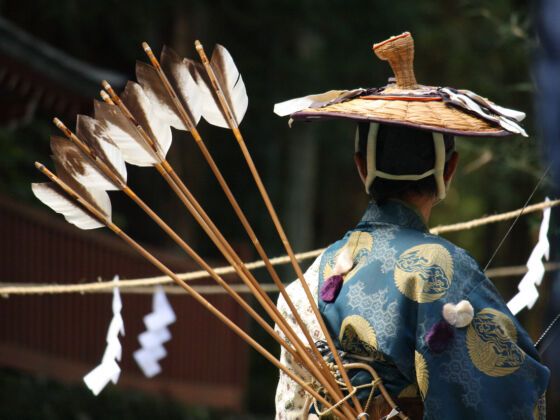
Image by Kazunori Matsuo

Drive two hours from Tokyo to travel 800 years back in time.

EVERY SPRING IN THE remote town of Kamakura, Japan, samurai continue to battle. Mounted on elaborately-dressed horses, with quivers full of specialized arrows, trained men and women charge at targets at 40 miles per hour. Not exactly at war, the participants in yabusame are keeping an 800-year old tradition alive.

During the Kamakura period in Japan’s 12th and 13th centuries, shogun Minamoto Yoritomo became alarmed at the samurai’s lack of archery skills, although the use of bows and arrows had long been a part of Japanese military culture by that point. The bow and arrow were a symbol of power and authority in ancient Japan, hence Yorimoto’s dismay at his samurai’s lack of skills.

As opposed to on-foot archery used prior to the 12th century, Yorimoto structured mounted archery as a method of preparation for war. The practice was also designed to include offerings to Shinto gods, who would in return grant prosperity to the Japanese people as well as victory in battle.

Image by Nicky Fern

Zen Buddhism helped this mounted archery evolve into yabusame. Breathing techniques derived from Zen helped warriors achieve clarity and calmness during battle. Buddhist monks were also instrumental in phasing out the practice of inuoumono, which used dogs as targets for archers, in favor of the use of cedar planks.

Because of the spiritual nature of yabusame, most matches are held at Shinto shrines. At the festival held in Kamakura, the ceremony begins with offerings held at one of the town’s most famous shrines, Tsurugaoka Hachimangu. At the beginning of the ceremony, the priests bless the groups of riders, as well as their horses. The first rider then reads a vow from a scroll and tosses a ceremonial fan called an age-ogi starting to ride.

The archer gallops down a 250-meter long track, using his or her knees to control the horse while drawing the bow, which measures about the same height as the rider. When reaching the target, the archer then aims, and with a loud chant of “in-yo-in-yo” (“or darkness or lightness”), fires.

The sound made by the arrow hitting the target is almost as important as riders’ accuracy. The explosion created in the strike is traditionally believed to transfer the archers’ courage to the spectators.

Experienced yabusame archers can choose to use V-shaped pronged arrows, so that when the arrow strikes the board, it and the board splinter into confetti-like pieces.

At certain events, such as that held at Kashima Jingu, broken fragments of cedar are considered lucky and are signed, dated and sold with the arrows in order to raise funds for the following year’s events. The targets themselves are designed to copy the necessary placement for a fatal blow to an opponent wearing traditional samurai armor, which had a space beneath the helmet visor.

Image by Nicky Fern

Yabusame was historically split into two main schools. One was led by Yoritomo, and an earlier one created by Minamoto Yoshiari in the 9th century, called the Takeda School of Archery, began to incorporate yabusame training in the 12th century as well. The Takeda School, which is still operational, gained popularity through modern films and alumni, and holds exhibition matches as well.

Community Connection

Not that interested in Japanese archery? Get ready for Sumo wrestling instead.

Feature Image by Kazunori Matsuo

Sports + Adventure
 

About The Author

Benita Hussain

Benita Hussain is the Editor of Matador Sports. With a degree from Cornell University, she is a New York City-based writer, lawyer and yoga teacher specializing in outdoor adventure, travel and environmental topics. She has also written for Wave Lines, Museyon Guides, BioScience and Lonely Planet's Around the World with 40 Lonely Planet Bloggers.

  • Morgan

    “The explosion created in the strike is traditionally believed to transfer the archers’ courage to the spectators.”

    Wow! Very interesting.

    • Benita Hussain

      I’m just shocked by the level of accuracy and balance these riders have! Thanks for the comment!

Sports + Adventure →

Seth Leighton had already gone three rounds with his Muay Thai trainer when a local boxer...

Sports + Adventure →

Examining the relationship between social media and this year's World Cup

Sports + Adventure →

I don't care where in the world you've skied -- a sunny day of flying in the heli with...

Sports + Adventure →

David Beckham has probably missed his last chance to play in the World Cup.

Sports + Adventure →

Approximately 250 dogs--primarily kelpies, border collies, and mixes of the two--will...

Sports + Adventure →

Comprehensive trail options and itineraries for cross country skiing Montana's...

Sports + Adventure →

Notes from Richard McColl in the jungles of Colombia, on the edge of tourism.

Sports + Adventure →

Kok boru is not a game for people with weak stomachs. Sophie Ibbotson goes to a match in...

Sports + Adventure →

Marjan Kalhor has little chance of winning a medal, but her participation is already an...

Sports + Adventure →

Gloves for the ultimate winter enthusiast...

Sports + Adventure →

Is it possible to re-imagine our understanding of dangerous destinations? Natalie Grant...

Sports + Adventure →

My father always made backyard skating rinks for me.