Original photo: TheTruthAbout

Reexamining sneakers’ superiority

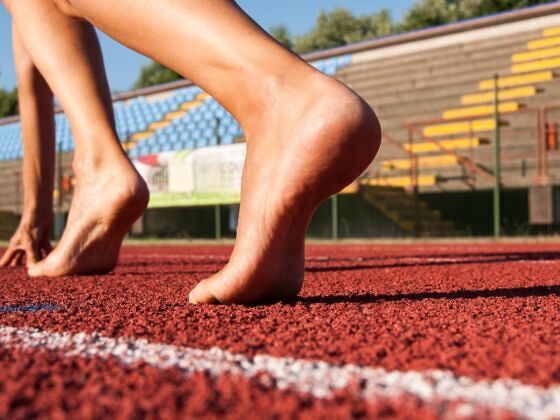
A PAPER PUBLISHED last week in Nature suggests that runners who go barefoot might be less likely to suffer stress fractures and other common use injuries.

Researchers from Harvard, the University of Glasgow, and Moi University analyzed the gaits of both shod and barefoot runners in the US and Kenya. The study, which was partially funded by minimalist shoe company Vibram, found that most runners who wore sneakers used a “heel-striking” gait that subjected their legs to massive shocks, while barefoot runners naturally adjusted their stride to land on the front of the foot.

“By landing on the middle or front of the foot, barefoot runners have almost no impact collision, much less than most shod runners generate when they heel-strike,” said Harvard evolutionary biology professor and paper co-author Daniel E. Lieberman.

“Most people today think barefoot running is dangerous and hurts, but actually you can run barefoot on the world’s hardest surfaces without the slightest discomfort and pain. All you need is a few calluses to avoid roughing up the skin of the foot.”

US runners stick to shoes

While many people in Kenya and other countries learn to run without shoes, barefooters have traditionally been a fringe group among US runners.

The practice started to get more attention in 2009, after the publication of Born to Run by Christopher McDougall. The book describes Mexico’s Tarahumara Indians, who run long distances at great speeds while wearing only thin sandals.

Born to Run also profiled “Barefoot” Ted McDonald, a marathoner and running coach who is one of barefoot running’s most famous advocates. In an interview with Runner’s World, Barefoot Ted said that he had received “thousands” of emails from readers since the book came out.

“Readers are so happy to hear that they’re not just broken by default,” he said. “Many people have been convinced, either by the media or somebody in the medical field, that they were not designed to run. They thought of their feet as injury-prone appendages that needed extra padding, protection and support in order to run.”

Even with science on its side, barefoot running isn’t likely to become the norm in the US anytime soon. In an ESPN poll conducted last year, only 34% of respondents said that they would consider running barefoot.

Geography also complicates things. In my home city of Chicago, running barefoot is out of the question during the winter, at least if you plan on keeping your toes.

Photo: vanRijn

Going barefoot

If you do choose to lose the shoes, it’s important to do it gradually. Because barefoot running uses a different set of muscles than shod running, runners who aren’t careful about making the switch risk damaging their Achilles tendons.

Dr. Lieberman recommends starting with short runs and increasing distance by no more than 10% a week.

Minimalist shoes can also provide some protection from scrapes and cuts without affecting your stride. Barefoot Ted’s site offers custom-made leather and rubber running sandals inspired by Tarahumara shoes. Vibram’s glove-like Five Fingers shoes are another popular option.

FootwearRunning
 

About The Author

Adam Roy

Chicago native Adam Roy is the former-Editor of Matador Sports and an aspiring renaissance man to boot. For more of Adam's writing, check out his blog at Ill-Advised Adventures.

  • http://www.dirtbagwriter.com Amiee

    Born to Run is on of the most fascinating books I have ever read. If you are even remotely interested in running (especially if you are plagued with injuries) it is a definite must-read. The book shows all sorts of evidence that us humans evolved as running creatures rather than the ‘not made to run stance’ held by many physicians, etc. Oh and golf courses make an excellent surface to give barefoot running a try.

  • http://www.candicedoestheworld.com Candice

    Do you think it’s ok if I tried this on the treadmill at the gym?

    • http://onceatraveler.com Turner

      Treadmill works, but just like with starting any new training, give your legs (and feet) time to adjust, particularly if you’re going with naked feet.

    • http://onceatraveler.com Turner

      Born to Run is what got me started:

      http://onceatraveler.com/barefoot-running-progress

      I would definitely go naked all the time if I had access to grassy fields or rock-free trails, but now, I stick with the Five Fingers Sprint, and walk in the KSO Treks. As far as training is concerned, I started VERY slowly when I made the switch to barefoot running, only going a few miles a week until my legs felt good and ready. Barefoot running style is better for you, no doubt about that, but the reason many people still stick with shoes is it’s very difficult to make the transition.

  • http://nancythegnomette.com Nancy

    This is great news; I hate having shoes on. One of my next goals is to (finally) learn how to run. Maybe I’ll start learning barefoot.

  • http://metalchick.net/travel Lindi

    I started using the Vibram Five Fingers after I read about them from Tim Ferris’s blog and love them.

    Candice I think it would be totally safe if you’re in the gym but the advice from the article is sound to do so gradually. You wouldn’t want to get blisters or hurt if you run 5 miles shoeless without building up gradually. Let us know if you try it. I’d love to hear what you think!

  • JoAnna Haugen

    I wear really lightweight running shoes, but I can’t imagine running barefoot. It drives me crazy to get sand between my toes at the beach!

    My husband owns a pair of the Vibrams, though, and he said his feet hurt after running a couple miles in them. I wonder if it’s something you have to work up to doing.

  • josh johnson

    Call me what you will but I love going shoeless too! driving, hiking strolling…maybe not downtown Seattle but anywhere I can shed my soles without catch hep C!
    great post adam!

  • http://www.nerdseyeview.com pam

    I heard this guy on NPR and shed my shoes on the treadmill. I don’t think most folks would like to see a barefoot runner at the gym, but we have a treadmill at home — hey, don’t judge me! it came from craig’s list and beats driving to the gym! — and I’m lots happier barefoot. I’m not a runner by nature, and going shoeless actually helped.

  • http://milesofabbie.com Abbie

    The great debate! I ran in my FiveFingers one day after my knee had been particularly bothering me and it felt fine… maybe they’re on to something.
    And Born To Run is an AMAZING book!

  • Pingback: uberVU - social comments

  • http://MaxTheITpro.com Maxwell

    Great post! Well, I’ve been hanging out in Kenya for the past 4 years and I always see lots of “new blood” (future marathoners) running everywhere. I’m sure the economic situation for some runners in the rural areas makes barefoot running a necessity. Perhaps this is a blessing in disguise?

    It also helps that the average elevation above sea level is around 7,000 metres so these runners have a better endurance capacity. I’m gonna try this technique out when I start running.

    Cheers!

    • Eido Cohen

      Maxwell,

      I invite you to check again your figures where you say that in Kenya the “average elevation above sea level is around 7,000 metres”. As shown here the heighest elevation is Mt Kenya which stands at 5,199 meters. Even if the were running the <a href="http://en.wikipedia.org/wiki/Aberdare_Range"<Aberdare Range you’re only talking about 3350 meters on average. Did you mean to say 7,000 feet elevation?

      • http://MaxTheITpro.com Max – The IT Pro

        Oops, my bad Eido!
        I meant about 700 metres (2300 feet) for average elevation. Heck, Nairobi alone is close to 6000 FEET above sea level.

  • Pingback: How to be a Hash House Harrier

  • nik

    Hm, I wonder if people who go barefoot in their home are more comfortable running barefoot?

  • http://londoniscool.com William K Wallace

    This article is all about plugging Barefoot Ted, shall I say it again Barefoot Ted…give me a break! and get real!

    • Adam Roy

      Hi William. While I appreciate your comments, they’re unfortunately not true. I have never had any contact with Barefoot Ted and, honestly, had never heard of him before I started the research for this article. If you count, you’ll notice that you mention Barefoot Ted almost as many times in your comment (twice) as I did in the entire article (three times).

  • Stefanie G

    This reminds me of the “Barefoot walk” I did in Germany. There are several of these public hiking paths. It’s really fun… and apparently really healthy.

    http://www.barfusspark.info/en/park.htm

  • http://www.davidcoxon.com/run david coxon

    While i love the idea of running barefoot on trails and stuff, i’m just not sure its possible, i mean does any one really not wear any shoes in the mountains on small pebbles and boulders. My feet are pretty tough, but I still run in a pair of inov8 xtalons which are about as close barefoot as i think i’d like to get, they have about 5mm of rubber sole and some pretty rubber studs, but no other cushioning. At 215g these kind of shoes are great on uphill stretches of trail, but they really slow me down on steep rocky decents.

  • nick alexander

    Abebe Bekele, Zola Budd most famously ran barefoot at world class level and Ron Hill ran cross country barefoot often (but not road). I used to do intervals barefoot on soft grassy fields in England – lovely. I found soft sandy beaches and dunes delightful until stepping on the occasional sharp shell edge or saw grass hidden in the dunes. And I did try, but the rubber ‘tartan’ surface of modern tracks would rip up my feet skin after only about 200 meters. I once ran a (5 mile) cross country in snowy Indiana in the winter barefoot. The cold didn’t bother me but my feet were in tatters at the finish due to the frozen short blades of grass – took me over a week to be able to run again. In short, I wish I could run barefoot – I don’t believe it is biomechanically a sound idea to use these big bulky, stiff shoes we’ve been marketed for decades and that have cost me thousands – but I can’t cos my feet simply won’t toughen up. So I just content myself with playing ‘Barefoot Athlete’ on my XBox 360 (check it out, the forest trails in Nepal are great!)

  • http://www.traveldroppings.com traveling_mike

    I use Terra Plana’s Vivo Barefoot and I love them. The shoes are awesome. Lightweight and made sustainably from environmentally friendly materials.

    Vivo Barefoot. Love em!

  • http://holesinmysoles.blogspot.com/ Jim

    The whole footwear industry is controlled by profit driven industry to perpetuate the myth you need the latest in high tech running shoes. We simply don’t -if we take care of what surfaces we run upon.
    What is missing in this article is a clarification that barefoot running is best on natural surfaces.i.e. grassy tracks and fields, sandy shores, leaf cushioned forests etc.
    The human foot has evolved over millenia when humans walked/ran over natural surfaces, and today if we run over similar surfaces there is no reason why footwear is better than barefoot.

    But today we cover our environment with tarmac and concrete and running barefoot on these surfaces is not recommended without good footwear for most of us.
    Now no company wants to promote barefoot simply because they can’t sell you anthing.
    After 28 years custom making shoes for specialist conditions, and having seen the changes in mass produced footwear where today almost every shoe you can buy has a beautifully moulded footbed inside, I suspect we are headed for an epidemic of foot and lower limb problems because they are just too over-protective, they support the feet too much, thereby weakening all the muscles and ligaments that Nature evloved to support themselves.
    But try and tell that to the Podiatry , and footwear industry….

  • Pingback: From The Editor: Digging Deep in 2011

  • binya

    interesting article but please don’t refer to an indigenous community in Mexico as “Indians”. it is a racist term that isn’t (or at least shouldn’t be) used anymore.

    • Adam Roy

      Hi Binya,

      Thanks for your comment. We certainly strive to be sensitive to issues like this, and take complaints seriously.

      I felt that “indian” was not an inappropriate term to use, for a couple of reasons. In my personal experience, “indian” (“indio”) is the most commonly used term in most Latin American countries for a person of native ancestry, much as “white” (“blanco”) is the most commonly used term for a person of primarily European ancestry. It’s not considered offensive, and in some countries is even used in the names of government agencies that deal with indigenous issues (like Brazil’s FUNAI).

      All the best,
      Adam Roy
      Editor, Matador Sports

  • Dave

    Great article! If you don’t want to take the leap straight to barefoot (or even if you don’t want to go straight to “barefoot shoes”), just change the way you run – switch to just running “on your toes” (i.e. stay off your heels) to simulate the same running style that you’d run in if you were barefoot. This is especially helpful if running through questionable city areas with broken glass or vomit all over the streets.

    If nothing more, I think you’ll find that it’ll improve your times! It definitely has for me.

  • Sue

    Several years ago my husband & I were hiking the Grand Canyon (rim-to-rim in one day) & there was a young fellow RUNNING BAREFOOT. He didn’t have ANYTHING on his feet & was running the trail &, if I remember correctly, was doing the rim-to-rim as well. We talked to him for a short period of time & he told me of a web site about running barefoot that had people from all over the world as “members” or contributors (can’t remember the site now).

    Don’t want to offend anyone, but he was a young, white American (from U.S.A.) male.

    The trail is a combo of powdery dirt, rocks that shift under your feet (hard on my knees & ankles so I wear knee & ankle braces!), large puddles of mule piss & piles of manure (sorry, but true!), rarely any plants (like cacti) on well-maintained trails but rocks can be sharp…

    I wear shoes recommended by podiatrist w/orthodics made from casts formed by podiatrist as I have had surgery for plantar fasciitis on my left foot performed by that podiatrist. I have a predisposition to plantar fasciitis & heel spurs as my father had them (though not as badly as I did as he got them from just walking while I got them from running & playing tennis extensively).

    Surgery for plantar fasciitis is rare (& was much more complicated when I had it about 20 years ago–there is a newer, easier procedure now; but I went through a year of trying to get it under control w/physical therapy, ultra sound, cortisone shots {OUCH!!}, wearing that huge “boot” even to bed, but I could not function w/out the boot on {so couldn’t drive my stick shift car as it was my left foot} & my hip was starting to get affected by walking w/that boot on all the time & my husband was bruised by my accidentally kicking him at night w/the boot).

    I didn’t know what the pain was at first; it felt like I had a tack in my heel. I kept running & playing tennis despite the pain until it became unbearable. That’s why I had damaged it so much I needed surgery & now w/the shoes & orthodics I can run, but I do stretch afterwards & ice (both feet as have it is right foot but not as severe as to need surgery) religiously. The surgery was a great success. Walking barefoot hurts, though. Walking in any other shoes for long hurts so the running shoes & orthodics help somehow to protect me from putting undue pressure on my foot.

    I’ve also had 2 knee surgeries for torn cartilage (arthroscopic) from overuse– again from tennis.

    I’ve just had surgery for severe carpal tunnel (tennis again; guess my body is not made for tennis or at least as much tennis I was playing) on right hand (so severe I ended up in the ER in pain & had to be on morphine pills before the surgery; right hand was the WORST pain). I’m going to have surgery on the left hand in a few weeks as the right hand is healing well & the pain reduction is so wonderful (not completely gone as I have some nerve pain but off morphine pills).

  • Stephanie

    I LOVE my vivo barefoots! I started working last summer at a retail job where I stood/walked for 6 – 10 hours every shift, and my feet in my “normal” shoes where killing me. I literally had to call in to work because I could not walk (I am TWENTY-FOUR! This shouldn’t be happening!) I did a LOT of research, and basically had come down to a choice between super orthopedic shoes and the vivos. What made me decide on the vivo was the fact that I could not find ANY bad reviews about them other than the sizes are funky and sometimes people don’t like “barefoot” lifestyle. My unbelievable pain immediately stopped once I started wearing them. I now have arches on my strong feet, and I have never looked back. Also, these things are constructed so well! I have wore these shoes for EVERYTHING and they look beat up, but if you look close not even the tread on the soles are faded. I am planning my next vivo purchase soon! (But I do walk barefoot w/o shoes whenever I get a chance. Let’s face it, shoes are still shoes and not barefoot! :) )

  • Pingback: Review : Vibram Fivefinger KSO Trek

  • Pingback: From the Editor: Changing Tides

Footwear →

Not only could I climb the wides, but I could edge on dimes.

Footwear →

"Clearly she does this volcano hiking shiz all the time.”

Footwear →

Megan Wood walks 13 miles through New York City to test a pair of Sanuk sandals.

Footwear →

It’s probable this company will get 90% of my shoe business from here on out.

Running →

As any good traveler will tell you, the journey is the goal.

Running →

"I had done what they said I could not do. Never in the thirty-five countries and...

Running →

Morgan deBoer takes an original angle about what constitutes a "Worst Case Scenario" when...

Footwear →

The more sports I pick up, the more I feel like Imelda Marcos: my shoe collection just...

Beginner's Guides →

Matador's Frank Johnson offers some tips to take you from couch potato to road warrior.

Extreme Sports →

This July, the US is hosting two of the toughest footraces in the world. Both aim to...

Running →

“Chuck Norris wouldn’t stop,” a sign boasted before the 20-mile mark in Boston.

Running →

If you're a runner, check out this site before your next trip. And don't forget your...