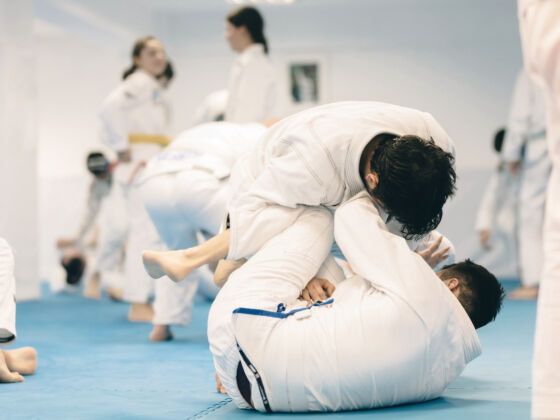
Brazilian Jiu-Jitsu practitioners have done exceptionally well in the Pan-American Championships and other international competitions – Photo: Ronald De Villa

“Go on, hit me!” says Jairo, who lies flat on his back. I straddle his chest. “Don’t be afraid!” he says. “Just do it.” I ball my hand into a fist and strike.

BEFORE I CAN BLINK, I’m lying flat on my stomach with Jairo smushing my face into the mat with his forearm. His fist pins my hand behind my back. I try to move, but I cannot, not even a little.

“This is not a good position for you,” he says. “If I want to, I can finish you now.” I quickly remind myself of what Jairo told me before we began the lesson–that he is a spiritual man, a man of God. I’m grateful when he lets me stand up again.

I’ve come to the island of Santa Catarina in southern Brazil to study with Jairo Teixeira, a master of Brazilian Jiu-Jitsu. I always wanted to know why the Brazilians have their own national version of a Japanese martial art. After all, Japan is on the other side of the world. How did Brazilian Jiu-Jitsu become so popular?

As we sit on the mat during a break, Jairo, a big man with cauliflower ears, a toothy grin and green eyes, explains it all it to me.

Photos: Ronald De Villa

Brazilian Jiu-Jitsu was invented by Helio Gracie, a skinny boy who lived in Rio de Janeiro. His family had learned the secrets of Japanese Jiu-Jitsu from a Japanese master named Mitsuyo Maeda, who went by the ring name of Conde Koma.

The Gracie family taught Jiu-Jitsu in Rio, but Helio was forbidden from fighting. He was too weak, too fragile. Then one day, a man came for a private lesson. The regular teacher was late, so Helio, who loved to watch his brothers practice, taught the man.

Afterward, Helio became a regular teacher at the academy. Through patient experimentation, he adapted Japanese Jiu-Jitsu for self-defense on the streets of Rio.

Today, many consider Brazilian Jiu-Jitsu the most efficient way to neutralize a real attacker. It allows you to fight from the ground, to turn a weak position into a strong position. Brazilian fighters now regularly win mixed martial arts competitions on the world circuit.

The break is over and we grapple again. I try to throw Jairo. “No, no,” he says. “Relax. Your body is too tense. When you fight, you have to keep your body loose. When you are tense, you stop thinking. This is how you defeat yourself.”

“When we fight, we must be like water. Always flexible, always attentive. Just like in life.”

Later he showed me how, if you can maintain your composure under attack, you can use the opponent’s strength against him. “People are afraid to clench,” he told me, “they are afraid to take on their problems close-up. But in Jiu-Jitsu, we learn to grapple with our enemies at close quarters. The closer you are to your enemy, the more protected you are.”

I straddle him again and Jairo effortlessly rolls me over onto my back. I try to stop him, I really do, but I’m powerless in his hands.

After practice, we sit in a café together, talking. I ask him about how his spiritual life twines with his martial art. “When I started Jiu-Jitsu, I was afraid. I felt like a dead chicken,” he says. “But I didn’t give up. Suddenly, I wasn’t afraid anymore.”

“And you know what? Once the question of physical fear is solved, then you can be open, you can become a spiritual person. When you are no longer afraid, then you can have compassion.”

He smiled his toothy grin one more time. Brazilian Jiu-Jitsu had made another disciple.


About The Author

Dan Madera

After living in various countries in South America for nearly fifteen years, Dan Madera finally settled on the beautiful island of Florianopolis, in southern Brazil. He is the managing editor of Sweet Home Floripa, the island's English-language magazine, where he writes about a wide range of topics, ranging from history to sports.

  • http://www.ianmack.com ian

    Great article – I trained in Hapkido for 4 years, and learned a bit of Jiu-Jitsu along the way. Can’t say I particularly enjoyed ground fighting, but it’s fascinating how you can use your opponents force against them. It’s appeared to lie in the redirection of force, as opposed to blocking or deflection.

  • http://matadortrips.com/ Hal Amen

    Fascinating stuff, thanks Dan.

  • http://jonnyontheroad.blogspot.com Jonny

    great article, though too short! i’d love to hear more about Jairo’s philosophy.

    i remember watching royce gracie fight over 10 years ago and being amazed at how calm and composed he looked, even in the midst of a fight with someone twice his size. he always won.

    i think one of the failures of MMA in its rapid commercialization over the last several years is a focus on the mental and spiritual discipline that has long been a foundation of martial arts training.

  • http://enlightenyourday.com/ Jonathan | EnlightenYourDay

    Great article! One of my favorite documentary movies is Choke. It features the Grace brothers and the tradition and spirituality of their sport.

    Peace

    Jonathan

  • Pingback: Everyone Wants to Watch the Foreigner Fight

Nonlinear Narrative →

"Eyes meet and a half smile, but you don’t meet someone on the ônibus."

Spirituality →

Jed Purses heads into the bush and learns about finding the quietness within.

Language Learning →

Careful in Portuguese - "ficar na" means stay at, but "ficar com" means make out with...

Sports + Adventure →

Seth Leighton had already gone three rounds with his Muay Thai trainer when a local boxer...

Yoga →

I was about to start on a path that would teach me lessons affecting every other part of...


As a newly minted Carioca (two months and counting), I’ve learned a few tricks that...

World Events →

Welcome to a new, occasional feature here at Pulse: "Three Stories from Under the Radar"...