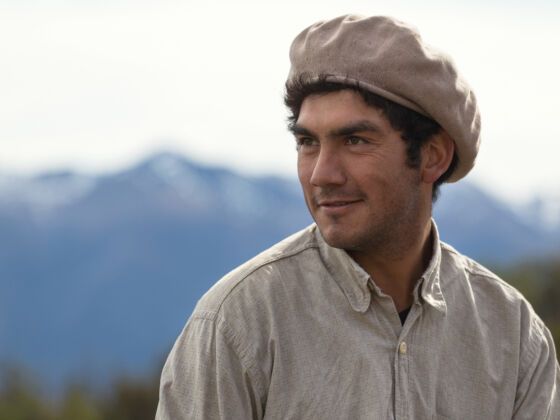
Valerie Ng explains why you’ll find Welsh tea culture in Northern Patagonia.

ARRIVE IN GAIMAN, Argentina, and you’ll notice a few things seem culturally and geographically misplaced.

Streets bear the names of J.D. Evans and Abraham Matthews. The dragon-emblazoned flag of Wales flies prominently from local businesses, and signs are posted not only in Spanish but also in Welsh, a language otherwise encountered only in the British Isles.

The Welsh settlement in Argentina began in the 19th century, when the Argentine government promoted immigration from European nations. The leader of the Welsh contingent, Rev. Michael D. Jones, wanted to create a colony of Welsh culture and language outside of Wales, away from the influence of the English.

He settled on Patagonia because of its remote location and the incentive of 100 square miles of land along the Chubut River offered by the government of Argentina.

Jones had studied Welsh communities in the United States, but found they quickly assimilated and lost their ethnic and cultural identity. The isolation of Patagonia would help create an insulated community that would maintain its language and culture.

Traditional tea in Gaiman

What brings many visitors to Gaiman, the cultural center of Argentina’s Welsh community, are the teahouses.

The full afternoon tea experience, much like one you could have in Britain, is served at tables covered in lace cloth with a large pot of tea and an assortment of cakes, marmalade, butter, and cream. The most traditional cake is the torta negra, a black cake similar to a fruitcake.

Every October, the town holds a Eisteddfod de Chubut, a Welsh cultural festival featuring performances of poetry and music in Welsh and Spanish, continuing a tradition that began in the province in 1875.

More Wales in Northern Patagonia

Elsewhere in Chubut province, remnants of Argentina’s Welsh settlement exists in windmills, chapels, and teahouses, as well as the Celtic names of its towns.

In nearby Trelew, the main commercial center in the region, the Museo Regional Pueblo de Luis, housed in a former train station, documents the history of the Welsh settlement and features photographs and belongings of the settlers. It was in Trelew that the Welsh settlers built the Salon San David, a replica of St. David’s Cathedral in Pembrokeshire.

The regional railway once linked Trelew with the town of Dolavon, another early Welsh settlement, where an old flour mill has been converted into a museum of rural life, and a monument pays tribute to the indigenous Tehuelche who aided the settlers when they arrived.

Over near the Chilean border, just south of Esquel, the town of Trevelin was established in 1889 by John Evans, who was instrumental in exploring the upper Chubut Valley for Argentina.

The town’s first settlers arrived here after having built towns along the way as they traveled inland from the coast. The main attraction is the grave of Malacara, the horse that made a heroic leap to save Evans’ life during a Tehuelche attack.

At the site of the first mill built by the settlers after their arrival is the Museo Regional Molino Viejo, which depicts life in early 20th century Trevelin.

While the prevalence of the Welsh language has declined since the early 20th century, it is still taught in schools and university students have the opportunity to study abroad in Wales.

Chubut is also a destination for scholars from Wales seeking to study manuscripts from the original settlers and expose themselves to what is considered the pure form of the language.

Getting to Gaiman

Travelers often base themselves in the coastal city of Puerto Madryn, popular for its whale and penguin watching tours, although some choose to stay in Trelew. There are B&B accommodations available in Gaiman — make reservations.

From Puerto Madryn, catch a bus to Trelew, where you can board a connecting bus that will drop you off in the center of Gaiman. The town is compact and easy to navigate on foot.

Having tea in Gaiman, Argentina

Photo: aokettun

Where to have tea

Ty Gwyn, which also operates as a B&B, is the oldest Welsh teahouse in Gaiman and is run by a descendant of the original settlers. The staff, dressed in traditional Welsh clothing, provides attentive service. 9 de Julio 111, Gaiman

Ty Nain is also run by descendants of some of the town’s first Welsh settlers. Make sure to check out its small museum, which showcases artifacts from colonial days. Hipólito Yrigoyen 283, Gaiman

Another of Gaiman’s B&Bs, Plas y Coed doubles as a teahouse and provides large and filling breakfasts and afternoon tea. MD Jones 123, Gaiman

Located on the banks of the Chubut River, Ty Cymraeg has owners that sometimes share with visitors stories of their Welsh ancestors, whose photographs decorate the walls of the teahouse. Abraham Mathews 74, Gaiman

Community Connection

For more suggestions on classic places to have tea, check out Six Cups: Tea Cultures Around the World.

About The Author

Valerie Ng

Valerie Ng is a freelance writer based in Berkeley, CA. When she's not traveling, she looks for ways to experience foreign culture in her backyard. Her writing has appeared in World Hum, The Travel Channel, The Dallas Morning News, Not For Tourists, and TangoDiva.

  • http://thetravelersnotebook.com david miller

    great piece valerie.

    the welsh culture in patagonia is really interesting.

    stayed at plas y coed last year. really recommend it (and gaiman in general).

    esquel and trevelin are also super good to go, right by the futalefu river and parque nacional los alerces, among my favorite places of all time.

  • http://matadortrips.com/ Hal Amen

    Seconds on Alerces. I blogged some photos from there last August: http://wayworded.blogspot.com/2009/08/secret-valley-of-parque-nacional-los.html

  • http://www.collazoprojects.com Julie

    I love these stories about “unexpected” people/cultures in other places. Thanks, Valerie.

  • http://www.realworldmeetsgirl.wordpress.com Megan Snedden

    Absolutely fascinating!!! Been living in Buenos Aires for while and won’t make it to Patagonia until next Spring, but when I do, I definitely will use your article to help guide me through Gaiman……can’t wait!!!

  • http://theworldistoobig.wordpress.com Matt Scott

    I’ve got Welsh blood in me and was really pleased to see Matador put a piece out on this. I love how cultures move, soemetimes to the most unexpected places.
    Thanks for writing this pice Valerie.

  • Allison

    Great article- I went hunting in Cordoba at an old welsh hunting lodge, it was really great. I wrote a blog about it here if you want to see. http://oasisluxuryrentals.com/2009/11/30/weekend-in-cordoba/

    There was/is also a huge German population, like in bariloche, which was built up after the 2nd world war. And the town outside of cordoba where everyone flocks to for Oktoberfest. Its all very interesting how these towns survive within a country that is so extremely different.

Activism + Politics →

Patagonia is the first ever Matador Project, with much more content forthcoming.

Trekking + Exploring →

My Nomading Film Festival finalist video explores Argentina in an unconventional way.

Parks + Wilderness →

MatadorU students Karin-Marijke Vis and Coen Wubbels line out 5 spots to pitch primitive...

Road Trip Guides →

Graham rides historic Ruta 40 though South America and breaks down in Chile

Trip Planning →

Jeff Bartlett offers an addendum to our original piece, adding 3 more ideas of where to...

Sports + Adventure →

Freelance travel photographer, current MatadorU student, and Matador contributor Jeff...

Photo Essay →

Exploring an endangered resource in Argentine Patagonia.

Activism + Politics →

An ongoing land struggle in the cold plains of Argentine Patagonia.

Snow →

The storm rages. The rain turns to snow. In the morning we venture out...


Trips co-editor Hal Amen wants to know: How are you going to spend your Southern...