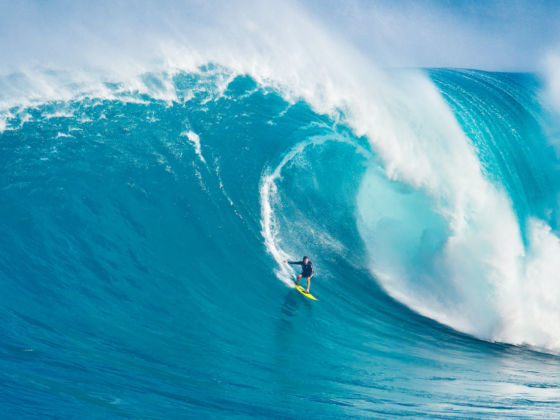
10 most dangerous waves in the world
Feature photo: REUTERS/Mike Hutchings / Photo above: kanaka
What makes a wave dangerous? Is sheer size an accurate indicator for how hazardous a surf spot is? Read on for our roundup of the top ten most dangerous waves in the world.
1. Cyclops (remote south coast Western Australia)
This ultra square-shaped, below sea level, one-eyed monster tops the list for good reasons. It’s impossible to paddle into on a surfboard and almost unrideable towing behind a jet ski.
If you blow a wave here you’ll be washed straight onto the dry rocks, which is a bummer because the nearest medical help is hours away.
Photo: REUTERS/Mike Hutchings
2. Teahupoo (Tahiti)
The scary thing about Teahupoo (pronounced Cho-poo) is that as the swell gets beyond 10 feet the wave doesn’t so much get taller, it just gets more enormous, often looking like the entire ocean is peeling over with the lip.
Falling off here is almost a guarantee of hitting the razor sharp coral reef below, which wouldn’t be so bad if the locals didn’t insist on using fresh Tahitian lime juice to sterilise the reef cuts. Ouch.
3. Shipsterns (Tasmania, Australia)
Set along a remote length of pristine Tasmanian coastline, you could almost call this area picturesque if the wave itself wasn’t so ugly.
Raw Antarctic swells come out of deep ocean and jack up into a roaring righthander in front of the cliff which gives the spot its name. The uneven reef causes weird steps and bubbles in the wave, which are always an unpleasant surprise when you’re still trying to navigate the drop down the face.
Photo: jurvetson
4. Dungeons (Cape Town, South Africa)
It’s not that shallow and it doesn’t break in front of any rocks, but it is located off the tip of South Africa in the freezing Southern Ocean in shark-infested waters. Dungeons regularly holds waves up to 70 feet, which is why organisers have chosen to put on the annual Big Wave Africa contest here since 1999.
5. Pipeline (Oahu, Hawaii)
The shallow lava reef that shapes Pipe’s famous round tube is actually full of trenches and bumps — meaning a nasty old time for anyone falling out of the lip from 12 feet above. Which happens with surprisingly regularity, even to the experienced locals.
Perhaps almost as dangerous are the insane crowds that flock to Pipe any time it gets good, with fearless Hawaiians competing with pros, wannabes, and tourists for the set waves.
Related Articles
Jump to More Related Articles ↓Rhys Stacker
Rhys Stacker is an Australian surfer currently based in landlocked London. When he is not on surf trips abroad he enjoys photography and riding his bike in the city.
More By This Author
- World's best surf spots for beginners (and 5 you should avoid) (69 comments)
- Surfing Morocco (17 comments)
- Top Surf Destinations for 2010 (10 comments)


grabeee na etech
Seal Beach, CA wasn’t mentioned. Don’t know why. The waves are killer.
What makes a wave dangerous? Before asking this question, we must ask the following question: why there are big waves in some places of the earth and we cannot see it in other places. I believe that there are three things that can be the fact of creating those kinds of waves:
- The weather and I mean the changing from low to the high atmospheric pressure weather or a stormy weather with strong wind.
- The position of the sun moon and the earth.
- The tectonic reaction in the ocean floor as volcanoes and earthquakes especially as we know that earthquake even major or minor in Richter scale level can happen every second in the ocean floor even we don’t feel it, also we know that the major big waves happen more in the countries like east cost of Australia new Zealand Japan west cost of use and all the west cost of the American continent, those countries is surrounding the pacific ocean and this area it call ring of fire because the volcano and earthquake activities that try to happen every second, this can lead to create big waves that sometimes can be a tsunami disaster, also phenomena we can see it in Hawaii island because this island is a land of volcano and earthquakes in that island and the pacific floor, also big waves we can see it in the Caribbean countries it’s because the earthquake in the Caribbean see floor and also because the weather especially during the hurricane season.
FYI: Teahupo’o isn’t pronounced Cho-poo. IT is prononced Te-a-hu-po-o (tay-uh-who-po-oh).the “Te” as the the Te-in Te-nnis, “a” as “a” in all, “hu” as in Hula, “po” as in pole, and “o”as in Oh. Please get it right! Thanks
This is ridiculous. I’ve just come back from Ireland and the waves off the north-west are enormous. In fact, Al Mennie, has even recorded them at 120 feet on a good day. When I’ve gone there they were not so big but were definitely the biggest I’ve seen…..and I’ve been all over. These things were giants. Amazing waves. Back soon again.