Photo: Michael Nosek/Shutterstock

Traveling by Train Through Eastern Europe Feels Like the Region's Last Great Travel Secret

Romania Slovakia Train Travel
by Eben Diskin Dec 8, 2025

The adventure of a road trip holds a special place in the imagination of most American travelers. When we think of exploring the US, visions of Jack Kerouac-ing our way west may fill our minds — along with quirky roadside attractions and rows of corn scrolling past the window.

But in Europe, the equivalent fantasy isn’t a road trip, but a train trip, thanks to the superb interconnectivity of the continent’s rail network and programs like the Eurail Pass that make train travel easy and affordable. Instead of a car bumping down Route 66, travelers in Europe can be captivated by the idea of waking up in a modern city and arriving in a small medieval town in time for lunch, savoring the blend of cultures and languages swirling around their second-class cabins.
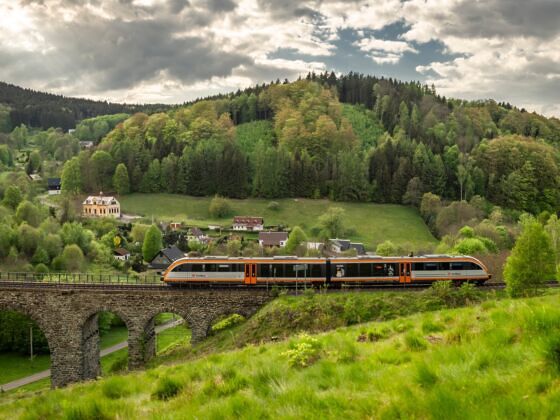
Some people may think of a European train trip as a ride on an elegant Orient Express-type train between cities like London, Paris, and Rome — or perhaps the famously efficient Deutsche Bahn trains throughout Germany. But few travelers go as far east as Romania. Who knows why; perhaps travelers don’t know the rail system is equally sophisticated or think the Carpathians aren’t as dramatic as the Dolomites. Both assumptions are wrong.

Traveling through Romania and its neighboring countries by train is not only a seamless experience, but also cheaper and less crowded than a similar journey through Western Europe. Here’s how to cover the most ground in Eastern Europe by train, and why you won’t miss your four wheels.

Leg 1: Bucharest to Sibiu, Romania


eastern europe train travel - bridge of lies, sibiu

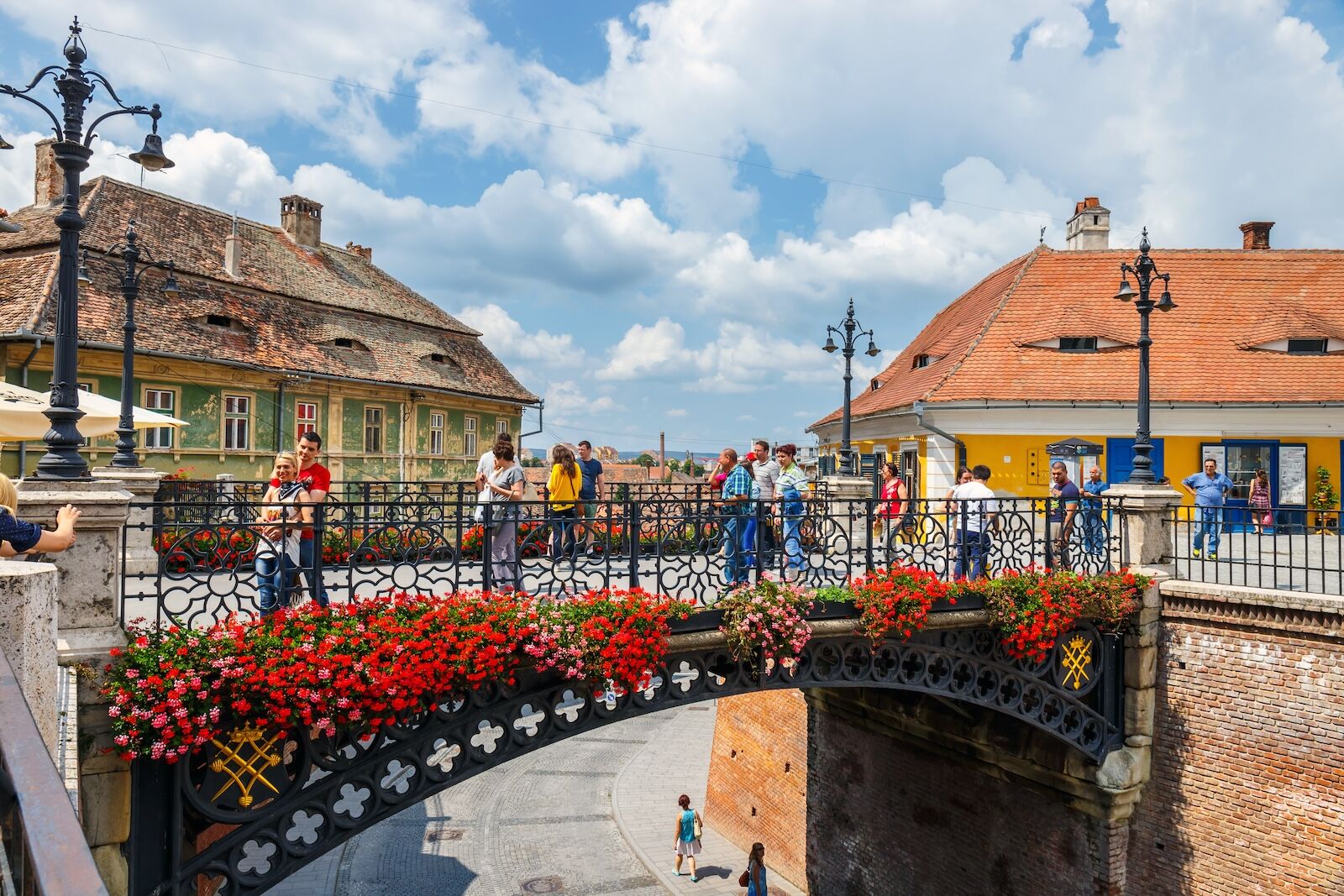
Sibiu’s famous “Bridge of Lies.” Photo: Dziewul/Shutterstock

Flying into Bucharest, Romania, might be the best hack for budget travelers to Eastern Europe. Since Budapest and Vienna are much larger airports with more flight routes, it’s easy to assume they’re the best gateways to the region — but not so. International flights to Bucharest often cost a fraction of flights into larger airports in neighboring countries like Austria or Hungary.

While there’s plenty to see in Bucharest, including the Palace of Parliament and the Therme Spa (which rivals the famous spas of Budapest), if you’re like me, you’ll be eager to escape the city bustle and start exploring the countryside.

Rather than trying to browse confusing train schedules online, it’s usually easier to buy a Eurail Global Pass. It allows for travel on 10 separate days over the course of two months, allowing for multiple train rides per day. There’s an English-language app with scannable digital tickets. It eliminates the need to arrive at stations 30 minutes early to nervously navigate a giant board with not-always-in-English text, as well as the potential embarrassment of boarding the wrong train entirely. The Eurail app updates the train schedule in real time to reflect delays and makes train transfers pretty clear, too.

The travel time from Bucharest to Sibiu is a bit long, at about six hours. Fortunately, the dining car has a robust menu, and the route through the Carpathian Mountain range, with dramatic views of the Transylvanian countryside, seems to cut the travel time in half.

Sibiu is known for its Germanic architecture dating back to the 13th century. Though the city is home to more than 130,000 people, it feels like a small medieval town, and much joy can be found in simply wandering its streets, grabbing gelato in Piața Mare square, and watching the artists on the Bridge of Lies paint the town skyline.

eastern europe train travel - hay hut country romania

Photo: Gaspar Janos/Shutterstock

Sibiu’s real draw, however, is its location at the foot of the Carpathian Mountains. A 20-minute drive brings you into what’s known as the “hay hut country,” so named for the surrounding huts traditionally used to store hay.

The three-mile out-and-back trail from Râu Sadului can be done on either a guided or self-guided tour. After a brief walk through the village, you’ll climb 1,300 feet into the mountains, ending at a collection of hay huts where traditional farming is still the way of life. A guided tour usually includes a picnic lunch with panoramic mountain views, and a lesson in humility when you learn that elderly villagers walk between the top and bottom of the mountain, often with heavy wheels of cheese in tow, multiple times a day. This is also near the the Transfăgărășan Highway, about an hour to the south. It’s a winding road through the mountains that Top Gear called “the best driving road in the world,” but you’ll need to rent a car for the day to explore it.

Leg 2: Sibiu to Cluj-Napoca, Romania


eastern europe train travel - cluj

Cluj-Napoca, Romania. Photo: Pani Garmyder/Shutterstock

The next leg of the trip is Sibiu to Cluj-Napoca. It’s a university city and the unofficial capital of Transylvania, as well as the second-most populated city in Romania. It’s about a two-hour ride from Sibiu to a small village called Vintu de Jos, then a transfer to a three-hour train ride to Cluj-Napoca.

Though it still has fewer than 300,000 residents, Cluj-Napoca feels significantly larger than Sibiu. Instead of a quiet Germanic town, Cluj is a bustling modern Romanian city, which is reflected in its architecture, business offerings, and nightlife. But that doesn’t mean the city lacks character. There are tons of parks throughout Cluj, like Central Park Simion and Cetățuia Park. At Cetățuia, you can even rent small boats to paddle around the pond.

Many hotels in the area are housed in older buildings and overflowing with character. Take Hotel Victoria, housed in a building from the 1980s. While it lacks no modern amenities, it still smacks of Soviet-era minimalism — and charm. After arriving at the hotel rather late, I went to the second-floor restaurant in hopes of catching dinner, only to find the dining room filled with elderly couples dancing a Romanian jig as if they’d been doing it for years.

eastern europe train travel - romania haunted forest

The “Poiana Rotunda,” a circular area in the forest that mysteriously grows no vegetation. Photo: salajean/Shutterstock

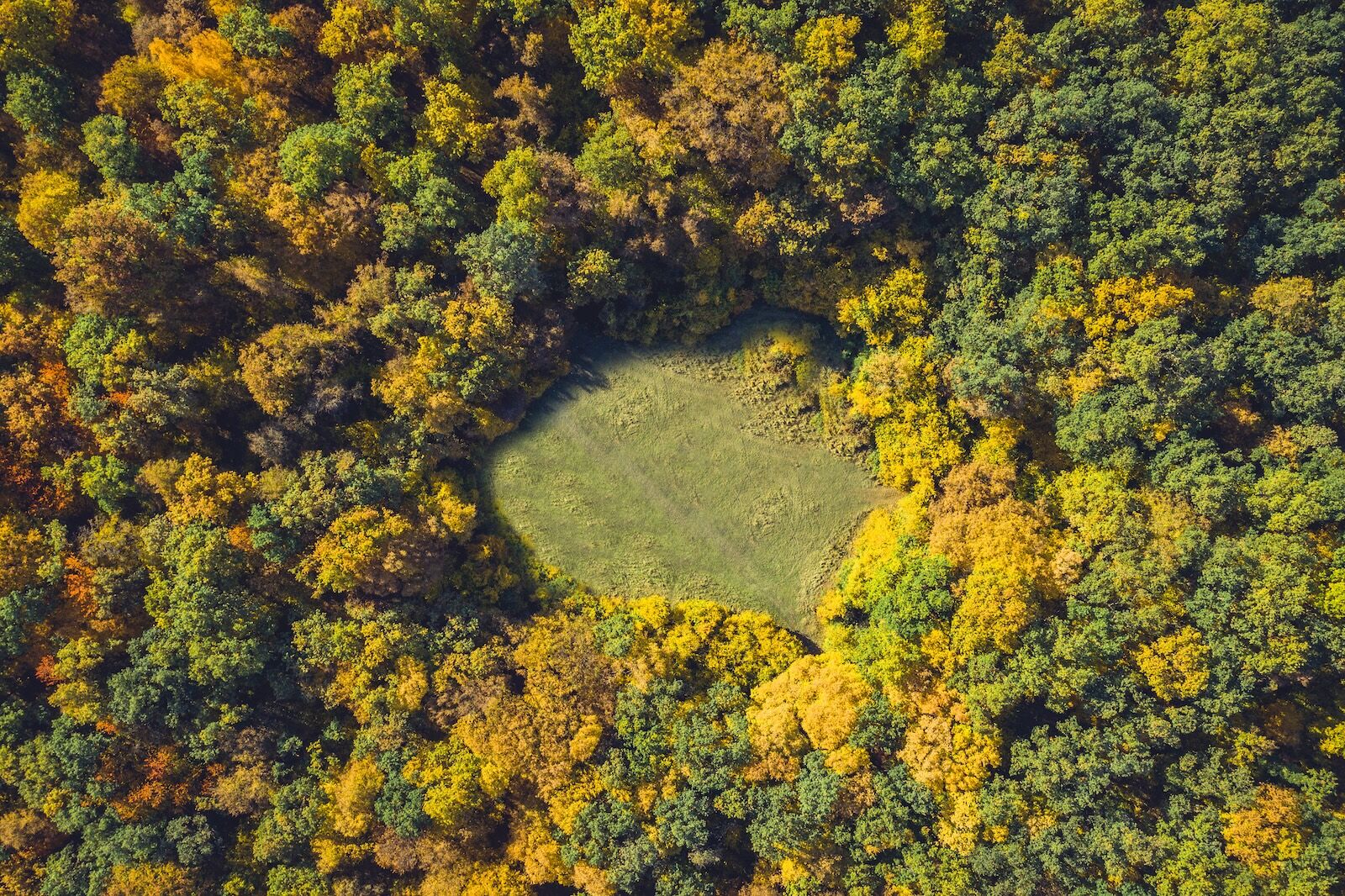
As if traditional evening dance parties weren’t cool enough, there’s even a haunted forest just a few miles from town. Hoia Baciu Forest, 20 minutes away, sits on a hill high above the city. Thanks to a significant number of paranormal activity reports going as far back as the late 1960s, it’s often considered the most haunted forest in the world. There have been multiple UFO sightings above the trees, accounts of ghost encounters, and claims of electronic devices malfunctioning or suddenly going awry. Perhaps most fascinating is the massive, perfectly circular clearing in the middle of the forest where no trees grow. The phenomenon has defied scientific explanation.

Whether you have a spine-tingling supernatural encounter or just an uneventful nature stroll, drinks at Bardot are the perfect way to cap off a day in Cluj. It’s a whisky bar with a sophisticated vibe and comfy leather chairs, in a pedestrian alleyway, making it a convenient place for an evening stroll before heading back to your hotel.

Leg 3: Romania to Budapest, Hungary


Chimneyy cake in budapest, hungary

Photo: Kurka Geza Corey/Shutterstock

The great thing about the Eurail Pass is that it’s not country specific, and crossing between countries is hassle-free (I’d been in Hungary for about 45 minutes before I realized I crossed a border). From Cluj, I stopped in Oradea for a night. It’s a small city defined by its colorful Art Nouveau architecture, star-shaped 12th-century fortress, and massive Piata Unirii square. The next day, in less than four hours, I was in Budapest, Hungary. As I walked from the Budapest train station to Hotel Memories in the Jewish Quarter, I marveled at the fact that I’d just been in a haunted Romanian forest 24 hours earlier.

There’s no shortage of things to see and do in Budapest, from marveling at the Jewish Quarter’s eclectic architecture to exploring “ruin bars” — abandoned buildings that have been turned into bars and lounges. Szimpla Kert inside a former factory is the most well-known, but Csendes Létterem and Kőleves Kert are equally worth checking out. Foodies need to grab a kürtőskalács, or chimney cake, from a street vendor. It’s roasted dough topped with sprinkles, cinnamon, sugar, and myriad other toppings, typically filled with Nutella or ice cream.

Leg 4: Budapest to Bratislava, Slovakia


bratislava castle - slovakia

Photo: Rasto SK/Shutterstock

Most travelers know Prague, the capital of the Czech Republic. But the country was formerly called “Czechoslovakia,” and the latter half, now the independent country of Slovakia, remains one of Europe’s least-visited countries. And skipping Bratislava is a mistake, as it’s one of the rare European capitals that doesn’t feel overcrowded.

I stayed at Downtown Bratislava B&B, about 15 minutes from the train station. I quickly learned 15 minutes is about how long it takes to walk anywhere in the city you’d want to go. I was in Old Town in 10 minutes, which feels like a residential neighborhood rather than a tourist hub, and walked 15 minutes to reach the Slovak Philharmonic on my last night in town.

Bratislava Castle is absolutely worth visiting, but so is Devin Castle, on the outskirts of town. Built in the 13th century, it’s a true medieval stone fort, skillfully built into the side of a cliff.

If you end your Eastern European train trip in Bratislava, you’ll be in luck. The town is only about an hour from Vienna, Austria, one of Europe’s most central flight hubs.

Discover Matador

Save Bookmark

We use cookies for analytics tracking and advertising from our partners.

For more information read our privacy policy.