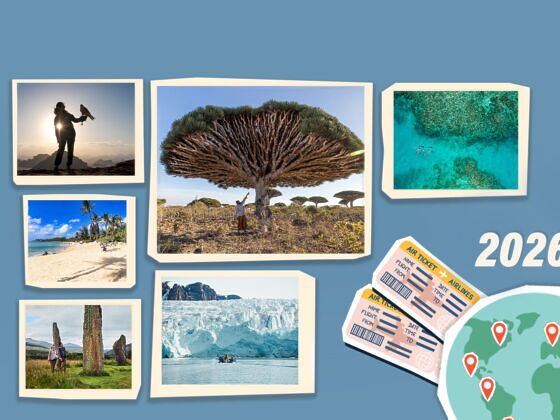
25 Unforgettable Places
to Visit in 2026
People travel for many reasons: to witness a once-in-a-generation moment, to experience a familiar place in a new way, to understand a destination beyond the headlines. Sometimes the motivation is celebratory, like a global sporting event, a cultural milestone, or a long-awaited reopening. Other times it’s quieter, even as simple as walking a new trail.
There’s no bad time to plan future travels, but a new year tends to bring fresh inspiration. In 2026, there’s plenty to be inspired by. The Winter Olympics and FIFA World Cup will draw people from around the world to Italy and across North America. Governments and businesses alike are using tourism to help protect some of the Earth’s most fragile ecosystems. Some places that once felt beyond reach are getting more accessible.
Matador Network’s 25 Unforgettable Places to Visit in 2026 is a snapshot of the destinations near and far on our travel lists, each with a distinct reason why the time is right for a trip. All, of course, are worth the journey.
See you out there,
Nickolaus Hines, editorial content director
Newfoundland and Labrador | Liepāja | Chihuahua | Socotra | Isle of Arran | Bajdah Wildlife Reserve | Mauritius | Māui | Svalbard | Providence | Taipei | Basque Country | Los Glaciares National Park | Chengdu | Asheville | Nuremberg | Nyungwe National Park | Great Barrier Reef | Cambodia | Burgundy | Salt Lake City | Milan | Lima | Little Ethiopia, Los Angeles | Guadalajara
Socotra
Socotra is closer to the Horn of Africa than to Yemen, the country it’s part of. It doesn’t feel shaped by the same forces that influenced the rest of the world. Flora and fauna on the island have evolved in distinct ways, producing landscapes and species found nowhere else on Earth. Its umbrella-crowned dragon blood trees, ghost crabs, and endemic birds and reptiles make the island strikingly unfamiliar to most people — a divergence of species that earned Socotra UNESCO World Heritage status for biodiversity.
Socotra is open to limited, tightly managed tourism, with access centered on small groups, local guides, and conservation safeguards. For travelers willing to plan ahead, the island is a rare place still largely untouched by algorithmic tourism, where the landscape and the species that evolved to survive here are the focus rather than finding the same spot as everyone else for a picture.
Los Glaciares
Los Glaciares National Park has long stood as one of Patagonia’s defining landscapes, but in 2026 it carries added urgency. Spanning nearly 3,000 square miles of southern Argentina, the park protects a vast section of the Southern Patagonian Ice Field, where dozens of glaciers descend from the Andes toward wind-lashed lakes. Many of these ice masses are retreating at measurable rates and reshaping shorelines and access routes — even Perito Moreno, which was once thought to be stable.
In response, park authorities have invested in trail maintenance, visitor infrastructure, and guided access designed to protect the landscape while expanding understanding. New accommodations like OVO Patagonia, with rooms suspended against a cliff face, push the boundaries of what feels possible while, importantly, taking a low-impact approach to the fragile environment.
Milan
Milan has long defined itself through fashion, but in 2026 the city steps into a larger global role. From February to March, it will co-host the Olympic and Paralympic Winter Games, placing Italy’s financial and cultural capital at the center of the sporting world. The Olympic Torch Relay will culminate here, and competitions for ice hockey, figure skating, and speed skating will unfold across the city, drawing visitors well beyond the traditional fashion calendar.
The timing underscores Milan’s strengths as a transport hub and urban base. Three international airports, high-speed rail links across Italy, and the recently relaunched Milan–Paris train route make it easy to pair the Games with a wider European itinerary. Between events, travelers will find a city operating at full capacity: world-class museums, enduring design culture, and a hotel scene that continues to evolve.
CREDITS
Editorial lead
Nickolaus Hines
Contributors
Debbie Gonzalez Canada
Morgane Croissant
Suzie Dundas
Katie Gavin
Tim Wenger
Design
Rulo Luna
Special Thanks
Ross Borden
Jessica Devnani
Scott Sporleder