There was finally a break in the rain, and Copper River Brewing in tiny, remote Cordova, Alaska, was buzzing. The two-floor brewery was packed with locals, but a small handful of visitors lingered, too — including one of the 17 people currently running for governor of Alaska. Not a single person was scrolling on a phone, and it seemed like the kind of place where everyone seemed to know everyone — or at least was willing to strike up a conversation. Plates of hearty sandwiches sat on tables, with a line at the bar for house-brewed beers like the Sour Sea Witch, a Berliner Weisse made with kelp harvested just a few miles offshore. It’s light, crisp, and easy to drink, with a subtle salty finish that nods to the kelp without dominating the flavor.
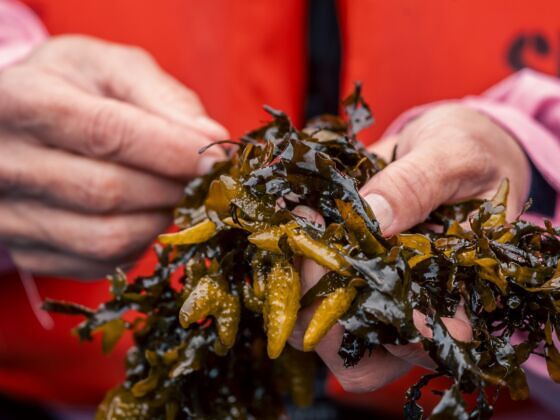
The Best Seafood Trip in Alaska Isn't About Salmon
Dinner at the brewery with my cousin and local seafood producers was an ideal way to end a long weekend trip in May 2026, when I’d spent the last few days out on the water with the farmers who make their living from the icy waters a stone’s throw from the brewery.
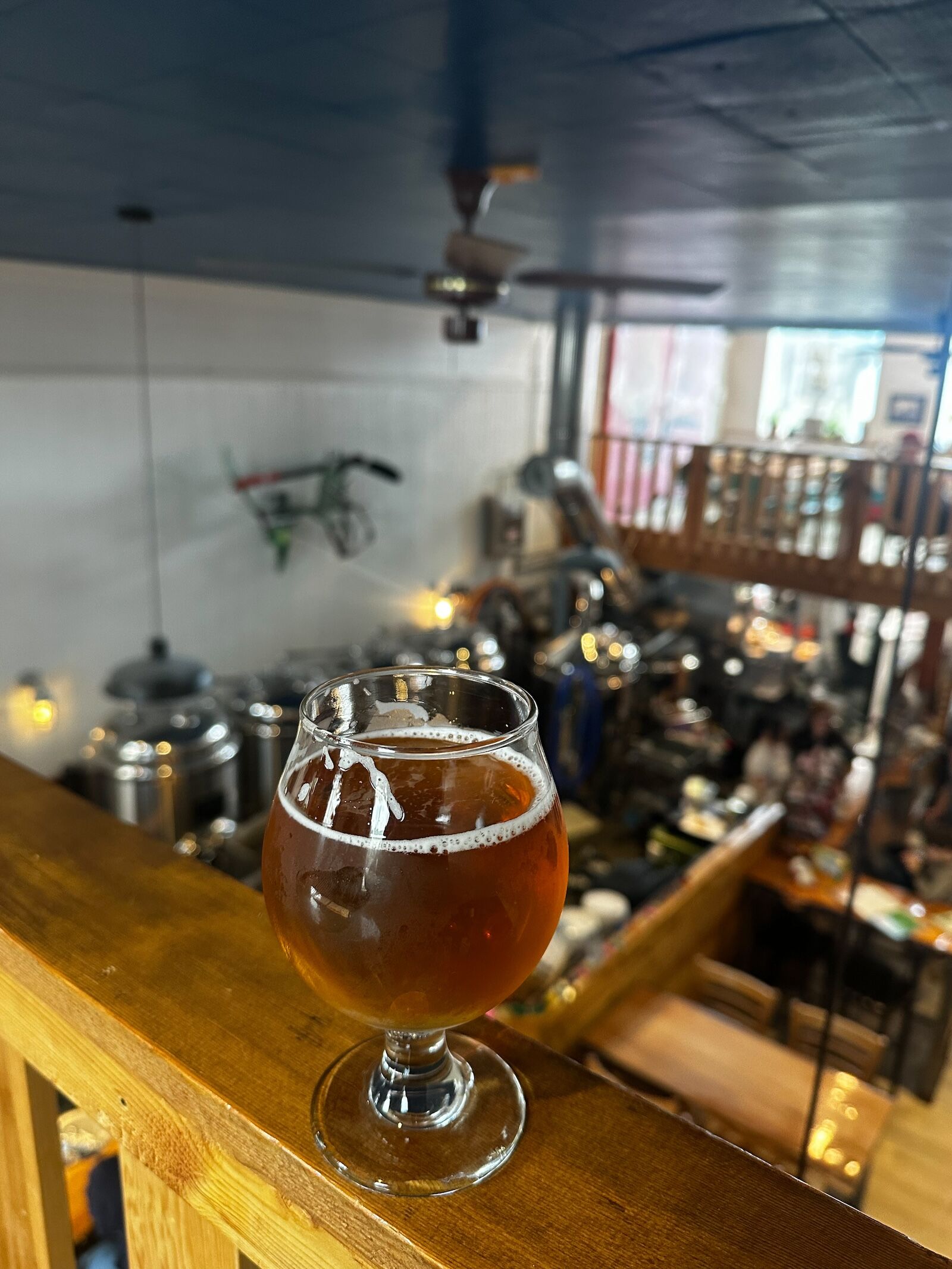
A Sour Sea Witch beer from Copper River Brewing in Cordova, AK. Photos: Bridget Shirvell
When most people think of Alaskan seafood, the first thing that comes to mind is salmon. But while Alaska’s wild salmon industry has struggled in recent years (due in part to climate change and collapsing fish stocks), a small cohort of mariculture farmers is trying to build a regenerative industry in the same cold, nutrient-rich waters that built Alaska’s reputation as one of the world’s premier seafood producers.
On the eastern edge of Alaska’s Prince William Sound is Cordova, where mountains rise straight out of the water and mist lifts off the water’s surface most mornings. It’s inaccessible by land and overlooked by most travelers, but the waters that surround the town may be among the best in the world for growing kelp and oysters. Thea Thomas and Cale Hershcleb of Royal Ocean Kelp Co., Sean and Skye Den Adel of Noble Ocean Farms, and Seawan Gehlbach of Simpson Bay Oyster Company are proof.
“It’s a struggle, life here, and the largest benefit of kelp is the diversification,” Thomas says. “It can’t support you completely, but it can play a part — create jobs, local incomes, benefit the economy.”
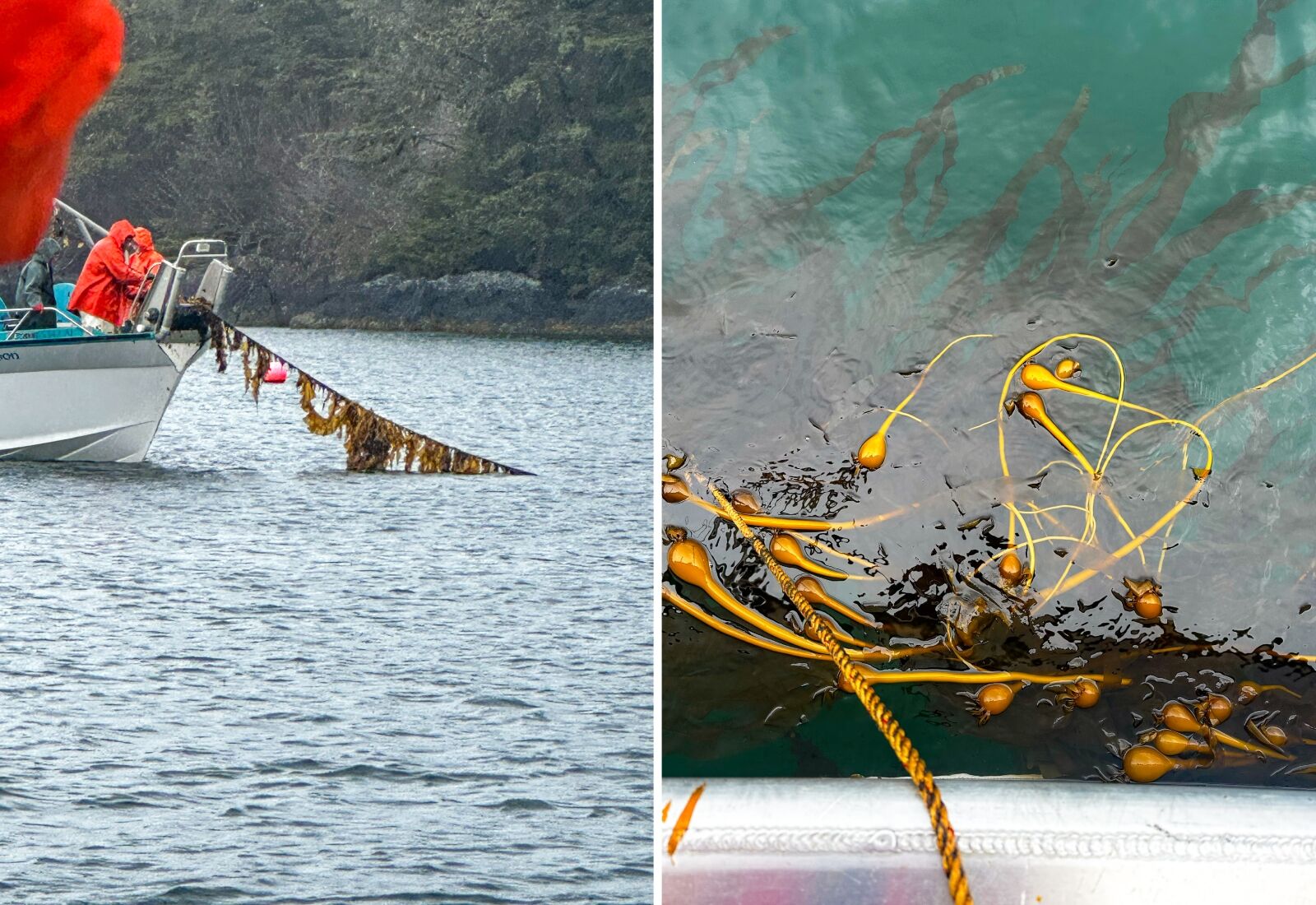
Pulling up kelp from the cold waters of Cordova, Alaska. Photos: Bridget Shirvell
On an early morning in May, Thomas told me she’s wearing seven layers of clothing aboard her boat called the FV Myrmidon, but still got cold while harvesting kelp. In spring, precipitation is usually a cold drizzle, and the wind often ferocious, but this year was colder than normal, even for Alaska. She spends her mornings out on the water at their seaweed farm, pulling lines of sugar kelp grown on ropes suspended in the water with buoys, not harvested from the wild. On this day, her boat is one of the only vessels in sight.
Thomas came to kelp farming from salmon fishing, and while she knows work on the water, she still had to learn how to create this new industry: navigating permits, building farm infrastructure, and figuring out what grows here. Ask Thomas about the work itself and she lights up. “It’s really fun and energizing. Developing new buyers, new products. It keeps the work interesting.”
View this post on Instagram
Kelp harvest season in the Prince William Sound runs roughly from late April through May, but it’s not a fixed schedule. It’s timed to when the kelp reaches peak biomass before it starts to degrade. Some years in May, depending on the harvest, Thomas occasionally takes visitors onto the same waters during Cordova’s annual Copper River Delta Shorebird Festival, when she captains natural history and birding cruises that pass the areas where local kelp farms operate.
Always, the farmers are out early — Thomas is typically on the water by 8 AM — working usually for about six hours, depending on the weather and the processing schedule waiting on the other end. She’ll harvest about 3,000 pounds for processing over five or six days. Ribbon kelp is more temperamental than sugar kelp. Some years it grows well, some years it doesn’t, and you don’t always know which it is until you’re pulling the lines.
Sean Den Adel of nearby Noble Ocean Farms knows that uncertainty well, as his business wasn’t always the success it is now. Kelp farming is still a brand-new industry in Alaska, and in the US more broadly, so the process is still a lot of trial-and-error. The first location the husband-and-wife team received a permit to farm ended up not being well suited for kelp. They discovered that freshwater runoff from the nearby glacial valley interfered with how the kelp grew, and the bay itself froze solid in winter, leaving them unable to access their farm for part of the year. They had to amend their required Alaska farming permit to a new location and start over, losing a full season.
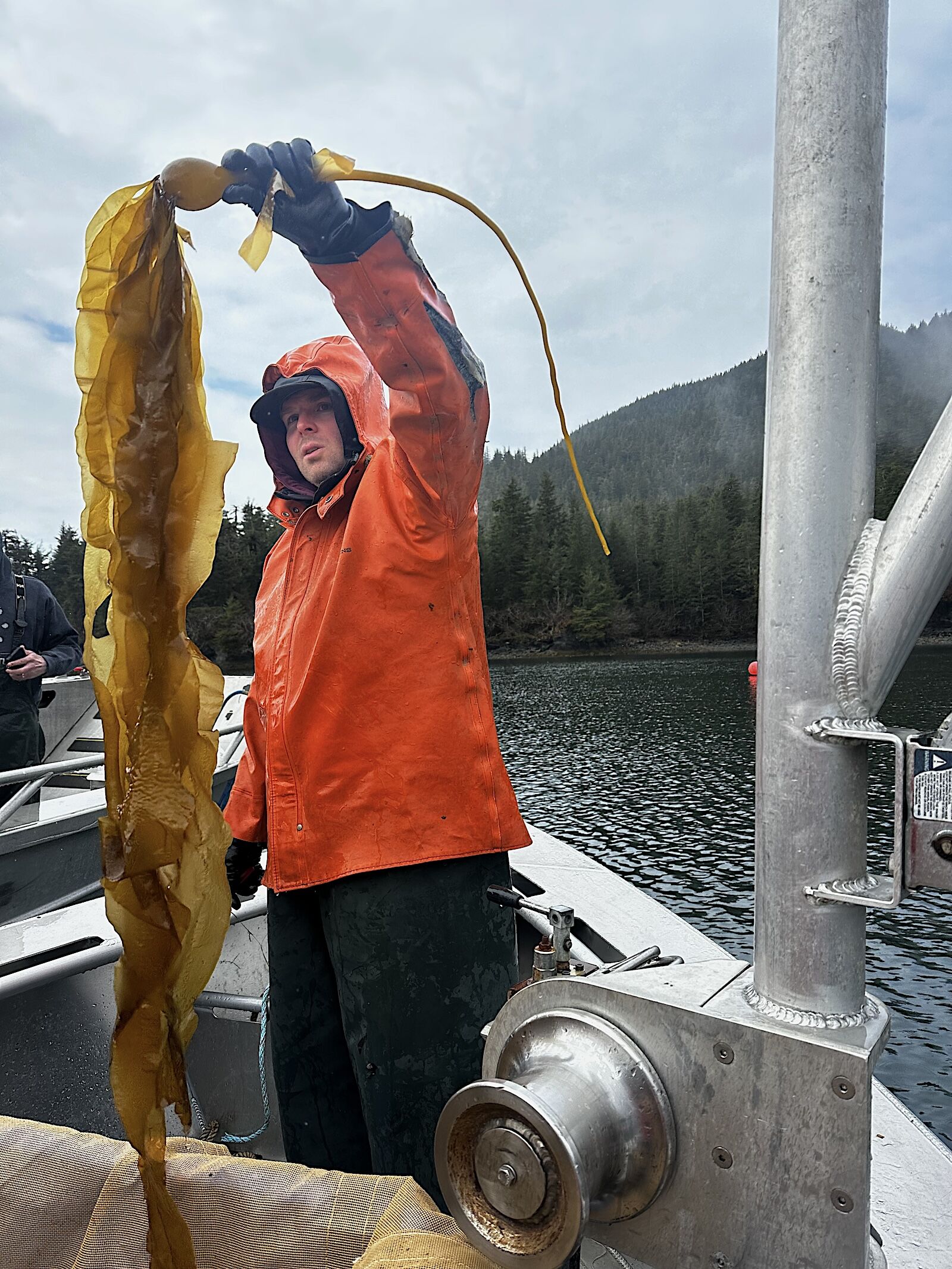
A kelp farmer showing off the bounty near Cordova, Alaska. Photo: Bridget Shirvell
The new site has been a different story. It’s productive enough to grow bullwhip kelp. It’s the same variety used in Barnacle Foods’ seaweed pickles, an Alaskan favorite that almost always sells out online. Den Adel hopes to become one of the company’s suppliers.
“Kelp farming is a regenerative, zero-input crop that doesn’t require any freshwater, land space, or use of fertilizers. Kelp absorbs carbon, filters excess nitrogen from the ocean, and provides habitat for native fish species at key life cycle stages,” says Den Adel. He sees kelp farming as having a positive impact on the marine ecosystem, which was a major reason they began the company in 2020. “Growing a sustainable food source and supporting marine biodiversity, what’s not to love about that?” he says.
Of course, not all farmers on the Sound are farming kelp. A few miles away in Simpson Bay, near Den Adel’s original kelp farm, Seawan Gehlbach spends her days from early May to October pulling up trays of oysters, suspended on long lines.
Gehlbach tells me she didn’t set out to be an oyster farmer. She came to Cordova to work as a biologist with the Alaska Department of Fish and Game, and decided she wanted to stay and try another line of work. She started the farm in 2019 as a way to keep working on the water.
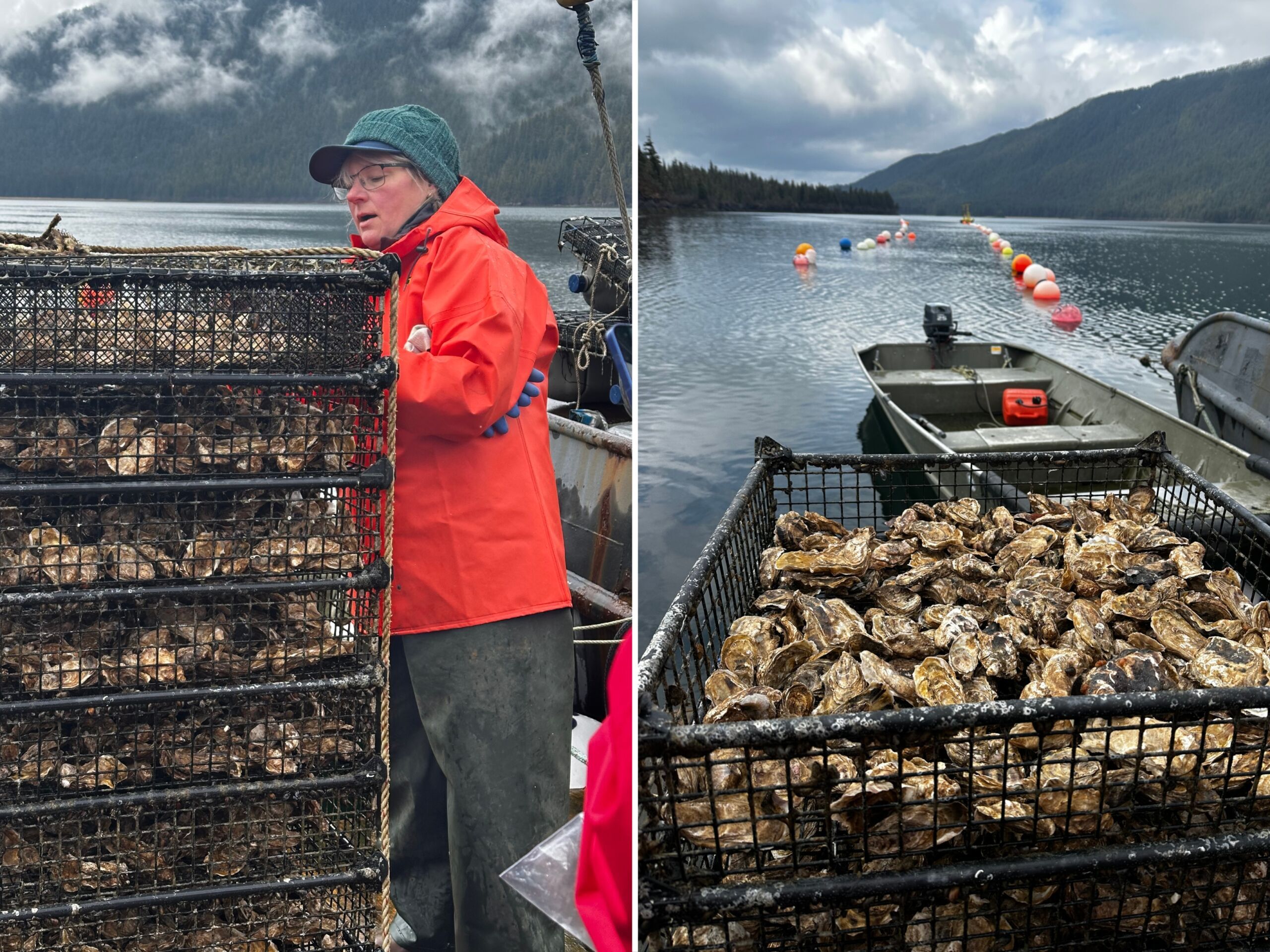
Seawan Gehlbach with her oyster catch in May 2026. Photo: Bridget Shirvell
Cordova is a commercial fishing hub, and people are particular about their seafood, so Gehlbach knew she would have to earn the locals’ trust. “I’m new to aquaculture,” she told me during my May visit, “so there’s been a lot to learn.” But when a longtime fisherman started buying her oysters and kept coming back, she knew something was working. One regular, a local man known for his smoked salmon, started showing up to her pop-ups not just to buy oysters, but to bring her gifts. Once, that included a jar of his own smoked Copper River king salmon. It warms my heart,” Gehlbach says, “and it keeps me growing oysters.”
Her oysters, for what it’s worth, taste like the water they come from: briny and sweet, with a deep umami richness that lingers on the palate. For travelers who want to keep following the oyster trail beyond Cordova, the Alaska Shellfish Growers Association’s Alaska Oyster Voyage program maps oyster farms and tasting opportunities across the state.
What struck me most, visiting the farms on that May morning, wasn’t just the scale of the work, but the cold, sharp feel of the air. It was clean, full of the sounds of nature, not cars. Near Gehlbach’s oyster lines, I saw a sea otter rolling lazily in the water a few yards off the bow. And when Gehlbach pulled a tray of oysters from the water, we found small spiny sea urchins stowed away on the bottoms.
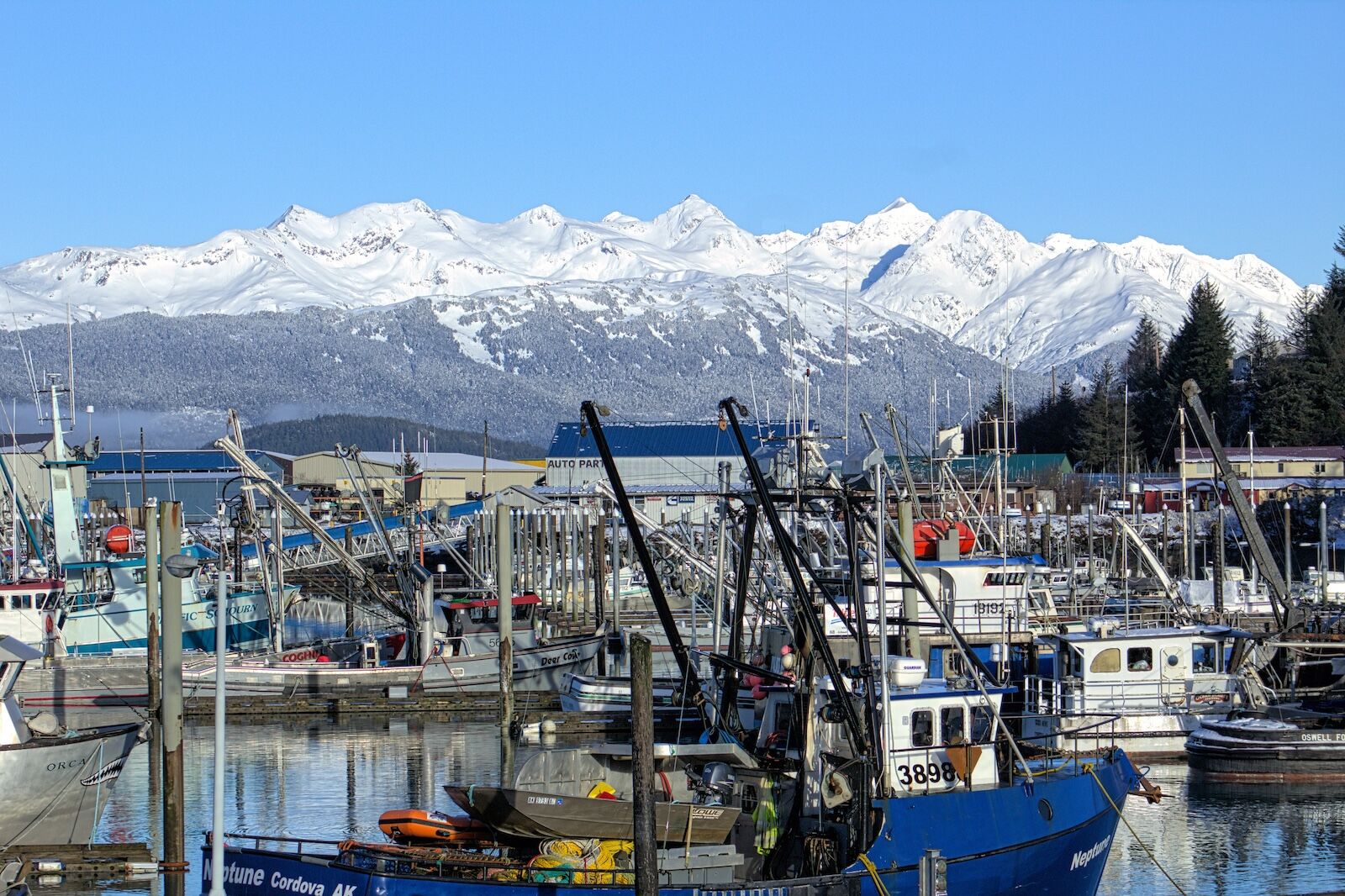
Boats in the Cordova harbor. Photo: Wirestock Creators/Shutterstock
Visitors who want to get out on the water but don’t know a fisherman with a boat can also book half- or full-day charter fishing trips from Cordova, many of which travel through the same protected bays and inlets where kelp farms and oyster lines are located. It’s a great way to get a firsthand look at the region’s emerging mariculture industry, especially since many of the captains and guides are connected to it.
Cordova-based outfitters Orca Adventure Lodge offers guided sea kayak and hiking tours through Prince William Sound. And if you’re visiting on a cruise, check your available excursions. Many Alaska cruise companies offer Cordova activities as an add-on, including boat tours through the harbor and active kelp mariculture operations.
Back on land, the kelp these farmers produce doesn’t stay raw for long. Both Royal Ocean and Noble Ocean sells to the wholesale and fertilizer markets, and Thomas’ partner Cale Hershcleb has been experimenting with it in his smokehouse, too. For now, he’s drying and smoking kelp, then grinding it into furikake (a seasoning blend popular in Japanese cooking). It’s been popular, Thomas says, though it’s still just a small part of the business, advertised on social media and sold in small batches from their homes. In other words, you have to be in Cordova to try it. The Reluctant Fisherman, a restaurant and inn in Cordova, also occasionally features local mariculture products on its menu.
Noble Ocean also sells smaller batches locally to Copper River Brewery for its kelp beer, and to Baja Taco in Cordova, where bull kelp has starred in salsa. The farm also sells kelp to the Native Village of Eyak‘s food distribution program, which works to provide the Indigenous community with access to culturally relevant, locally harvested foods.
View this post on Instagram
The most direct farm-to-table operation is Gehlbach’s Simpson Bay Oyster Company. At first, she sold oysters wholesale to restaurants, but realized she wanted more direct feedback from customers. Now, when oysters are ready, she’ll announce a harvest on her Facebook page and take pre-orders to sell directly to the public from her Cordova storefront. It doesn’t follow a fixed schedule, which means visitors lucky enough to be in town at the right time can buy shellfish harvested just hours earlier.
For travelers, this is the payoff for coming to Cordova: being able to get oysters from Gehlbach, buy locally smoked kelp, and sip on a Sour Sea Witch beer at Copper River Brewing. For foodies, hiking and fishing with views of glaciers, humpback whales, orcas, and sea otters is just an added bonus. 