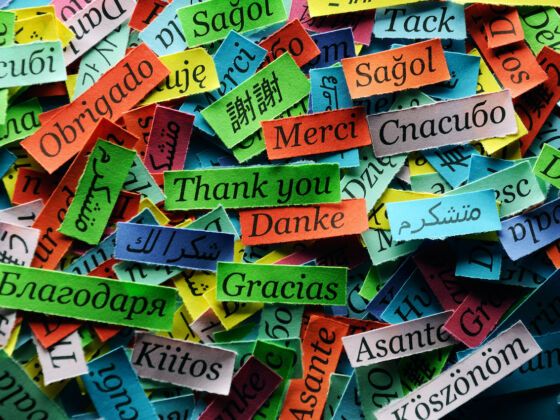
Anne Merritt lists 9 languages with similarities to English.

A SWEDISH FRIEND of mine speaks English and German with near-perfect fluency. “They’re easy to learn,” she insists with what I had believed to be sweet humility.


I had always assumed the Swedes were just good at everything, hence their omnipresence on North American hockey teams.

She firmly denied these superpowers. “English is a lot more like Swedish than you realize.”

English is a part of the Germanic family, and is linked to many European languages by descent or influence. It was also a big mooch in its formative years, with over 50% of its vocabulary stemming from Latin or French.

The result?

There are a lot of languages out there sharing common traits with English, which is great news when it comes to language study. When familiar structure or vocabulary is in place, the learning process becomes faster and easier. Hence my friend, the nonchalant polyglot.

Below are nine of the easiest for English speakers to learn, as classed by the Foreign Service Institute.

1. Afrikaans

Afrikaans and English both derive from the West Germanic language family. Phonetics and pronunciation are comfortable for English speakers; the one wee hurdle is the Afrikaans “g”, pronounced like the –ch in Bach.

Unlike English though, the Afrikaans language is not inflective. This means that with some memorized vocabulary, you can build sentences as you would a Lego tower, stacking words without worry of conjugation.

In Afrikaans, there is no conjugation of verbs (write, wrote, written), gender (think gato or gata in Spanish) or pronouns (my, mine; who, whose). In other words, you’ll hardly be a grammar slave if you take up this logical language.

2. Danish

As with most Scandinavian languages, the biggest hurdle with studying Danish is in being able to practice. English is spoken widely and fluently across northern European countries.

Danish is said to be the hardest Scandinavian language to learn because of its speaking patterns. It is generally spoken more quickly and more softly than other Scandinavian languages. Danish is also flatter and more monotonous than English.

Grammatically, though, it’s relatively easy. Danish has only nine verb forms, including the passive, which is peculiar to Scandinavian languages but familiar to English speakers. Danish has a lot of Germanic-based cognate vocabulary too: Monday Tuesday Wednesday, in Danish, are Mandag, Tirsdag, Onsdag.

3. French

Like all romance languages, French has a few difficulties for prospective speakers. There are more verb forms (17, compared to the English 12) and gendered nouns (le crayon, la table). Pronunciation is especially difficult in French, with vowel sounds and silent letters.

The bright side?

Like all Romance languages, French’s Latin derivations make much of the vocabulary familiar to English speakers (edifice, royal, village). Linguists debate the concrete number, but it’s said that French has influenced up to a third of English vocabulary, giving it more lexical common ground with English than any other romance language.

4. Italian

Another romance language, Italian has the great feature of readability. Italian is written as its spelled. For learners, reading comes fluidly once a few new phonemes are learned ( like –ghi- or –ci-).

Italian words tend to end in vowels, which makes for really fun, flowing speaking, as you might hear in Italians speaking English (“that’s-a my-a house-a”).

Grammatically, the language follows typical Romantic structure, with gendered nouns and similar word order. One perk: Italian has fewer verb forms than French or Spanish.
Italian is widely seen as the language of gastronomy. Many English speakers like to “study” by reading Italian restaurant menus and salivating.

5. Norwegian

The language is structurally similar to Danish, but with pronunciation more familiar to English speakers. Norwegian, like Swedish, uses a tonal “pitch accent” to distinguish homonyms, stressing either the first or second syllable of the word. It’s an easy concept to grasp: think “decent” and “descent” in English.

Verbs are a relative breeze in Norwegian, with no conjugation according to person or number. The past tense is formed with a simple –e suffix; the future is formed with the auxiliary vil; the conditional perfect with ville ha. The passive tense is formed by adding a simple –s. It’s a walk in the park compared to English.

6. Portuguese

Grammatically, Portuguese is similar to other Romance languages. There are fewer prepositions in Portuguese than in English (easy to remember!) However, their uses don’t always have direct parallels in English (easy to mix up).

One great element of the language is that interrogatives are beautifully easy, expressed by intonation alone (“You love me?”) If you can say it in Portuguese, you can ask it. What’s more, in Brazilian Portuguese, there’s one catchall question tag form: não é.

Pronunciation is fairly comfortable for English speakers, though the more nasal vowel sounds take some practice

7. Romanian

The geographic dark horse of the romance languages, Romanian is often assumed to be the most difficult of the bunch, with its Slavic influences. Not so fast.

They say that Romanian is the closest living language to Latin, and has preserved a lot of Latin’s grammatical structure. Articles are a bit of a puzzle in Romanian, with definite articles attached as a suffix to the end of nouns (frate/ fratele, brother/the brother), while indefinite articles appear before nouns (copil/un copil, child/a child).

Though the language has taken Slavic influences in its vocabulary, the language is still about 80% Latin-based, and full of cognates like sub (under) or obiect (object).

8. Spanish

Spanish pronunciation is fairly easy for English speakers, with only ten vowel/dipthong sounds (English has 20), and the easy-to-master letter ñ. Like Italian, the orthography is clear and simple; words are written as they’re pronounced, which makes reading easier. Grammatically, Spanish has fewer irregularities than other romance languages too.

A slippery element of the language (and all the Romances) is in false cognates: word pairings that sound the same as an English word, but mean something different. Particular means “private” in Spanish, and eventual means possible. See how that could get confusing?

Still, there’s no shortage of people in the world to help you fix these slip-ups. With 330 million native speakers, it’s the most popular language on this list.

9. Swedish

A fellow Germanic language, Swedish has some vocabulary common with English (mus for “mouse”, kung for “king”), and a similar syntax too.

Pronunciation may be a struggle at first, with nine vowels (like ö or å) and the sje- sound, which is unique to Swedish. Once you master it, though, the language is surprisingly melodic.

Students of the language gripe about the complicated grammar system, but the syntax shouldn’t be unfamiliar to an English speaker. In Swedish, the Subject-Verb-Object pattern is standard word order.

Also, verb formation uses many of the same patterns as English. The future tense, for example, is described with komma att + infinitive (will), or ska + infinitive (going to). Also, verbs are normally constant, even if the person changes. I am, you are, he/she is would be Jag är, du är, han/hon är.

Honorable Mention: Frisian

Never heard of it? It’s spoken by less than half a million people in the province of Friesland in the Netherlands. It wasn’t included on the list because Frisian is rarely studied as a second language, so finding a textbook or tutor outside the North Sea would be nigh impossible.

Linguistically it is the closest language to English, stemming from the same subfamily of West Germanic languages. There’s a catchy saying: “Good butter and good cheese” (Goed bûter en goed tsiis) is good English and good Fries. Phonetically, the phrases are almost identical. Uncanny.

Community Connection

Have you studied any of these languages? Share your learning tips and advice in the comments.

Language Learning
 

About The Author

Anne Merritt

Anne Merritt has lived in Canada, Europe, and Asia. She teaches ESL, writes, haggles, hikes, and wears sunscreen fanatically. Her work has appeared in The Globe and Mail, GoOverseas.com, and The Compass. Check out her blog.

  • http://www.geminicourses.com/spanishcourses/ Sarah

    Great post Anne. I have always loved how Swedish sounds and would love to learn it. It just seems to sound cheerful and light all the time.

  • http://www.mokakan.com/spanish_courses/ Umer

    This was indeed a great post. I’ve learned French and these days I’m learning Spanish. I never knew Afrikaans could be included in this category too. Would certainly try my luck on it after Spanish. Thanks a lot for posting. :)

    Umer.

  • Saanvi

    Really a nice and informative post.But this guy knows speak english in twenty four different accents.
    http://funnyandspicy.com/telephonic-conversation-in-english-with-24-different-accents-never-miss-this-crazy-video.

  • http://adventureswithben.com adventureswithben

    I’ve spent 6 months in South Africa and found Afrikaans one of the most unpleasant languages ever. I love the country, but the spellings and pronunciations are messy. I’m surprised it made this list. It’s a tough language! Dankie!

  • http://www.glampacker.com Natasha

    Great post – particularly the line about Italian being the language of gastronomy! I’ve been learning Spanish and Italian from my native speaking friends – will definitely be practising a lot more in preparation for my trips to both countries in summer.

  • http://twitter.com/Hyperglot Gary Dale Cearley

    Great article, Anne! I do think that you missed two very obvious choices though:

    Dutch
    Esperanto

    If you do another version of this article in the future let me know.

    • http://expatheather.com Heather

      Thanks for adding to the conversation Gary. For the list Anne used rankings from the US Foreign Service Institute. I’m not sure if they teach Dutch there, and they certainly don’t teach Esperanto, which would be why those languages aren’t included in the rankings.

      • http://leisureguy.wordpress.com Leisureguy

        It’s too bad that the language education program fails to include Esperanto. UNESCO ran an experiment in Finnland some years back that showed greatly improved comprehension and facility in the target language if learning that language were preceded by learning Esperanto. One can think of several reasons: the second foreign language one learns is easier, the students who first took Esperanto had a very positive experience (because Esperanto was designed for ease of learning and use) and thus entered the study of their target language (German) with a good attitude and some foreign language experience, etc.

        At any rate, the students with 1 year of Esperanto and 2 years of German performed much better than students who simply had 3 years of German. And they were not the best students.

  • http://suneeleroux.blogspot.com Sunee

    As a native Afrikaans speaker, I was quite surprised to see it make this list. Sure, it’s an easy language, but is it easy for English speakers to learn? I doubt that. There are very few words the two languages have in common, unless you count anglisations. I found German has a lot more in common and was easy to learn, while being able to speak English fluently helped immensely in trying to learn French.

  • Roland

    Cool article. I speak several languages, Afrikaans (I am South African) and French being two of them. Afrikaans is totally rocking because of its lack of conjugation etc, but is also pretty useless since it is only spoken in South Africa. I actually found learning German (which I also speak) to be easier than French (but maybe that’s because I speak Afrikaans.) French is a pain in the bum and I wouldn’t recommend learning it because the French hate you for speaking their language as a non-native and are condescending and rude. Learn German, it’s awesome, similar to English and is the most widely spoken language in Europe.

  • http://multemusic.com Multe Music

    Danish, Norwegian and Swedish may seem “easy” for English speakers to learn to read or write, but they are *very* difficult for most English (and other language) speakers to pronounce correctly. The citizens of these Scandinavian countries take a bit of pride in this fact — and often use the pronunciation ability of a non-native speaker when judging how “fluent” that person really is. So perhaps they are not really that “easy” after all. Language fluency takes work and practice, no matter what the language.

  • http://multemusic.com Multe Music

    I’ll also mention that if you learn Norwegian well, you’ll be able to communicate reasonably well with the Danes and the Swedes. It’s really the “bridge” Scandinavian language.

  • http://www.theoneeyedturtle.com Maria Carreño

    Having taught Spanish for over three decades, and recently studying Italian, I wonder at the word “easy.” Some people are talented in many ways. I always admire the musician, artist and mathematician. Each requires visualization of concept. Now what about language. It requires memorization, repetition of sound and “soul.”

    I discovered hidden talents of some and often it took students a longer time to realize that foreign language study was not so difficult.

    I love words, no matter. Maria

    • http://annemerritt.blogspot.com Anne

      A good point Maria. “Easy” is a relative word here, in that these languages are acquired more quickly than others by English speakers. Of course, I know that any language study is a huge challenge.

      “I love words, no matter.” A great attitude!

  • Julie Fricke

    Well, it’s interesting to rate languages according to which is the easiest to learn. But I think that’s largely irrelevant. What IS actually important is who you wish to talk to (or listen to.)

    I studied French and then German and then Norwegian. I also was involuntarily subjected to Spanish while in elementary school. I had only unremarkable success with French and German. But I LOVED Norwegian. By then I had been there and met people and eaten Norwegian food, etc, etc. My success was nearly guaranteed!

    • Ely

      That’s true. It’s great that Danish and Swedish are easy to learn but living in the U.S. it’s far more practical to learn Spanish or French. Especially for me as I live on the Canadian border and everything is in French and English. I would assume it’s the same in Spanish for those living along the Mexican border.

  • Kirsten

    My parents are Danish, I am Canadian and live in French province. I find both Danish and French difficult and I’ve heard them my entire life.
    My dad always used to say that Danish isn’t a language, it’s a throat disease.

  • http://leisureguy.wordpress.com Leisureguy

    The obvious omission: Esperanto. Of course, it’s easy to learn for speakers of any language, not just English, and for the obvious reason that it was constructed to be a second language—i.e., very easy to learn and use. The obvious first step: few rules, no exceptions.

    At any rate, interesting article—aside from the omission. :)

  • Vilhelm

    Nice list. I’m Danish, and one thing you haven’t addressed, is how Danish is incredibly difficult to pronounce. I’ve met people who’ve lived here for 30 or 40 years, and still stand out, because they can’t get the pronunciation right. Unlike English, where I can easily blend with native speakers.

    • Marc

      blend in haha

      I am English, and allow me to assure you that i would know that you’re a foreigner, foreigners always seem to think that they speak English so well and no mistakes are noticeable when they speak it, the opposite is true, they make  alot of mistakes with pronounciation and our complex tenses.

    • Marc

      blend in haha

      I am English, and allow me to assure you that i would know that you’re a foreigner, foreigners always seem to think that they speak English so well and no mistakes are noticeable when they speak it, the opposite is true, they make  alot of mistakes with pronounciation and our complex tenses.

      • SSH

        Well, that’s unkind and a little shortsighted. The Dutch, for example, are notoriously good English speakers. In fact, I have met a few who speak English better than some native English speakers. I’ve heard similar comments about the Danish, though not met anyone myself.  Perhaps, Marc, you just haven’t noticed these people because they did such a good job of blending in?

    • Marc

      blend in haha

      I am English, and allow me to assure you that i would know that you’re a foreigner, foreigners always seem to think that they speak English so well and no mistakes are noticeable when they speak it, the opposite is true, they make  alot of mistakes with pronounciation and our complex tenses.

  • http://marion-travel-pictures.blogspot.com/ Marion

    Cool blog post! :)

    I took a Danish course a few years ago when I lived in Copenhagen. I’m French and I have to say that speaking English helped me learning Danish, but believe me: the real difficulty when studying Danish is the pronunciation… even for native English speakers! :) )

    • Marc

      how would you know if you’re not a native speaker what is and is not difficult for us English to learn?

  • Thomas

    What about Bahasa Indonesian? There is practically no grammar compared to the other Latin based languages!

    • http://www.nickyreiss.blogspot.com Nicola Reiss

      Indonesian is by far the easiest language I’ve ever learnt – and I’ve studied French, German, Spanish, Italian, Thai, and Javanese. This is a very euro-centric post!

      • Heather Carreiro

        Nicola,

        The list comes from the US Foreign Service Institute and is specifically geared toward speakers of English. So yes, the list includes languages that are more similar to English and many of those are European languages. The post was not meant to be ‘euro-centric’ or to offer a new ranking/list of some of the easier languages for English speakers to learn, but instead to offer details on the list of Category I languages given by the Foreign Service Institute.

      • http://youthnasia.wordpress.com Tanya

        I found Bahasa pretty easy, too – although to be fair I’ve studied almost exclusively Asian languages, I haven’t spent time on anything European other than Latin. Still, I think it’s a language that’s easier in the classroom than on the street. It’s pretty easy to become literate and it’s not that hard to pronounce, but there’s OODLES of slang and different sets of pronouns. I suppose that’s true of most languages, though?

  • Ely

    I’m a native English speaker who has studied Latin, French, Spanish, and German and out of all these, I would say French was the easiest for me. The tenses can be a bit hard but there’s not the sheer volume of vocabulary words in French as compared to other language.
    I’m surprised that more people haven’t suggested German. The sentence structure is closer to Latin than to English but the speaking style and accents are closer to English and there are words that sound almost identical (zehn/ten, kommt/come).

  • Greg

    I agree with Afrikaans.

    I’m a second language afrikaans speaker (Roland and Sunee, i did eerste taal for Matricand lived in Stellenbosch for a bit) and I’ve studied French and Spanish at beginners level.

    I always found Afrikaans a lot easier as I’d had to study it at School in South Africa, and although I’ve not really used it much in 8 years (in uk and Australia), I still find it easy to converse when required to on trips home or the odd occasion here.

    I find it relatively easy to write, its phonetic and the basics really do go a long way. Great to know that someone else thinks this – I had many friends at school who dreaded learning it, but I always thought it was relatively easy. That being said, I find that Afrikaans speakers speak Engish better than English speakers speak Afrikaans. Thoughts?

    • http://suneeleroux.blogspot.com Sunee

      It’s probably easier for a South African English-speaker to learn Afrikaans than for someone from say, the US. Especially with 12 years of schooling in it and hearing and seeing it all over the place. Someone sitting on the other side of the world who randomly decided to learn the language would probably struggle a bit more, I think :)

      As to Afrikaans speakers speaking English better – probably (if you ignore the horrible accent). But I’ve found that in a group of mixed languages, people will always turn to English, even though everyone present can understand Afrikaans. So we just get more practice at it than English speakers do.

  • http://www.bahasa-malaysia-simple-fun.com Wan

    @Thomas- there are still genders and pronouns in the Malay language. The Malaysian Malay language ever changing definition on the functions of personal pronouns makes it difficult for average learners to master the grammar. As a speaker of Malay who have learned English as well, I would have to say Afrikaans is simpler.

  • http://jerick.blogspot.com Jerick

    How about Dutch?

    I am currently taking dutch classes and sentence construction and most of the words are quite similar…. I think the only difficulty having is that because it’s similar I often confuse using English words in Dutch sentences.

  • Jeffrey

    I have been learning Portuguese for about two years now. it’s not too hard, especially if you actually speak, listen and write it all the time to practice and get better. Very beautiful language and I would suggest it to anyone who want to start learning a second language-it’s worked for me :)

    Great article, nice research!

  • Pingback: 9 of the Hardest Languages for English Speakers to Learn

  • Pingback: This Week On The Web w/e 25th Feb | The Dame

  • e

    I think you should have swapped out French for German or Dutch, clearly easier to master than French.

  • Pingback: Easiest and hardest languages to learn « Hands Wide Open

  • claudia

    I speak, read and write German, Afrikaans and English fluently. Now we live in a Spanish speaking country and I have to learn Spanish. I must say I am not finding it that easy, but then I suppose some people are able to pick up languages a little easier than others. Does anyone have some some good tips which one could apply?

    • http://leisureguy.wordpress.com Leisureguy

      The book Polyglot: How I Learn Languages, by Kató Lomb, collects her advice. She began to learn languages only after getting a doctorate in chemistry, and became fluent in six and able to get around in 8 more. Fascinating book, and she has quite specific advice and worked out effective techniques. Available here: http://is.gd/P4qe1E

      My connection with the book is as a reader only.

      • Heather Carreiro

        Thanks for sharing!

  • http://www.travnar.com Alex Cowan

    I think the title of this article should be changed to “9 Languages for English Speakers to Admire and Respect.” True, the languages on this list are “easier” for English speakers to read and write, as oppose to, let’s say, Japanese, but to speak? Hmm… And by putting Danish on the list as number two, well, now I question the validity of this article. I can tell you first hand Danish is an extremely difficult language to pronounce. The Danes themselves call it a throat disease because they use their throat a lot when pronouncing words. Then there’s the other linguistic nuances like adding soft d’s at the end of words. If you aren’t a native speaker it’s almost impossible to master DANSK. The Danes often size up foreigners attempting to speak Danish by asking them to say, “Rød grød med fløde,” which means redberry sauce with cream – a delicious dessert. Most non-native speakers fail miserably. I think Dutch is the only other language that beats Danish in terms of harsh pronunciation. I can’t imagine how Afrikaans made the list as number one. To drive my point home, Danish makes German sound like a romance language.

    On the topic of romance languages, it’s very rare I ever meet English native speakers who can pronounce Spanish correctly. They always seem to chop this beautiful language up with their Anglo-tied tongues. For example, they might be able to get away with pronouncing the letter ñ but they hardly ever pronounce the r correctly. However, of the languages listed in this article, I would recommend Spanish or Italian for English speakers. They’re also the most practical for English speakers.

    • Heather Carreiro

      Thanks for sharing your experience with Danish and Afrikaans!

      One thing to point out. You write, “And by putting Danish on the list as number two, well, now I question the validity of this article.” – Just want to make clear that the list comes from the US Foreign Service Institute and was not compiled by Matador. As a contributing author, Anne has simply offered details about each of the languages. Also, the numbers are not rankings and are there only for formatting.

    • Acbaggott

      Dutch is actually pretty easy to pronounce. the only hard parts are the diphthong eu and getting the accent, and if you have any experience with attic greek, it’s a smoother pronunciation of the eu diphthong as if it had a circumflex accent pronounced with musical pitch. but the accent part is the same as in any language.  Danish is only slightly more difficult in dutch in terms of pronunciation.

    • Acbaggott

      Dutch is actually pretty easy to pronounce. the only hard parts are the diphthong eu and getting the accent, and if you have any experience with attic greek, it’s a smoother pronunciation of the eu diphthong as if it had a circumflex accent pronounced with musical pitch. but the accent part is the same as in any language.  Danish is only slightly more difficult in dutch in terms of pronunciation.

  • Zuazua

    I wonder, if these 9 languages are kind of easy to learn to english speking people, ho come 99.9999999999% of the population only speaks English???

    • http://www.travnar.com Alex Cowan

      Zuazua,

      Yes, it’s sad. One report estimates that one language dies every 14 days (http://on.natgeo.com/91BGpS). When a language dies so does a wealth of human knowledge. The human population is exploding but our wealth of languages is dying. You may not believe this but in my country, the United States, we still have languages which erode on a daily basis. Aside from the tribal languages of our American Indians, we’re losing variations of the English language itself. In the Blue Ridge Mountains there’s an English dialect of the Southern Highlands which still incorporates a lot of the characteristics of archaic English from bygone eras such as the Elizabethan Period. This dialects days are numbered.

      Regarding your numbers of English speaking people worldwide, I think you may be a little off. Mandarin is the dominant language. Over a billion human beings claim Chinese as their native tongue. Some day, the English language will be something of the past. But I guess this is just part of the human story – we evolve and so do our languages which define us.

      Alex

  • http://www.travnar.com Alex Cowan

    Hi Heather,

    Thank you for the clarification. I misunderstood and interpreted the languages list as being ranked in order of difficulty since it was stated they were “classed” by the Foreign Service Institute. The fact that the list was generated by the US Foreign Service further validates my point. US diplomats aren’t know for their foreign language abilities. Those who master a foreign language like a native speaker usually either received their college degree in that particular language or they were exposed to it at a young age.

    As for my comment yesterday which questioned the validity of the article, looking back at what I wrote I realize I was a bit too harsh and a little reckless. What I should have said was, ” I question the validity of the Foreign Service Institute’s list.” In no way did I mean to undermine Anne’s or Matador’s credibility. Please accept my apologies.

    On a final note, one should never let the difficulty of a language deter one from learning it. Although the task may be daunting, the rewards are definitely worth the effort. The process of learning a foreign language and engaging with people abroad in their native tongue is a mind blowing experience which transforms one’s mindset forever. But, like the saying goes, “nothing good ever comes easy.”

    Alex

    • Heather Carreiro

      Thanks for coming back Alex. : ) The FSI is linked with the Defense Language Institute, basically a military-run school that focuses on language learning. Languages offered as classed as I, II or III with level I languages having the least amount of course hours to reach proficiency and level III courses having the most. The majority of languages offered are classed as II. I don’t have any connection with the DLI other than I attended a promotional presentation for the school one time about 10 years ago and was impressed at the course of studies offered there – made me briefly consider joining the military to take advantage of the language training! Of course that was the point of their presentation, to entice students with a love of language learning to apply.

      I agree, no one should let the difficulty of a language be a discouragement if he or she wants to learn it, and mastering any foreign language takes a lot of determination, practice and time, no matter how closely related it is to one’s native language!

      • http://annemerritt.blogspot.com Anne

        I just wanted to add that these 9 languages are listed alphabetically. None are ranked as easier or harder than the other within the list.

  • Fernando

    I’m native spanish speaker, and this language is different to danish. The pronuntiation is very, very easy, also readi it. But gramatical rules and tenses are very very hard. we use a lot of tenses and persons. Also we have a lot of exception. Spanish is easy to understand and read, but harder to speak it well in grammar). We have like 20 tenses and 10 persons (yo, tu, vos, el, ella, nosotros, vosotros, ustedes, ellos, ellas). i

  • Pingback: 47 « riverjumper

  • Djordje

    Helo, here is my opinion: i am Serbian, I speak SERBO-CROATIAN (there is no Serbian, Croatian, Bosnian and Montenegrian languages, there is only one language, Serbo-Croatian), which is Slavic.I also speak very well English, Russian,Norwegian French and Italian.I am also familiar with Spanish, Portuguese, and Latin.Slovenian and Macedonian are very similar to my language, so I can grasp a lot of words.Well, for me, the easiest one is Norwegian, and i will explain why.SLAVIC GROUP: they are all very hard to learn, especially for non-slavic speakers.Lots of flections, both for nouns, adverbs, verbs.Bulgarian and Macedonian don’t have flections, but the syntax is as complicated, as in Serbian, or Russian.Polish-you dont want to mess with it!Serbo-Croatian-even for us it is hard to learn the accent! ROMANCE GROUP: romanian-hardest (similar to latin which is the hardest language that i have ever learned).itallian-easiest. but writing is hard-you must have the feeling for double letters.FRENCH-pronunciation is very hard.spanish-everyone says it’s easy, but believe me it is not! just try to learn difference betwen verbs ser and estar-everything will be clear!portuguese-well, not as hard as spanish, but it has the most complex verb sistem.GERMANIC GROUP:german-the hardest.long words, noun flexion.islandic and faroese-worse than german!dutch-pronunciatin!long words.danish-hard pronunciation.swedish-pronunciatin slightly harder than norwegian.ENGLISH-my second favourite language, but writing is complicate.FINALLY NORWEGIAN: no noun flexions, verb system is pretty easy, pronunciation is not as hard as danish and swedish.But i must say Serbo-Croatian (CYRILIC writing) has the most perfect alfabet: ONE SOUND ONE LETTER!!!

    • http://pulse.yahoo.com/_PQTZT27JCSU5KFWLO4X5O4Z4KQ Mariana

      Sorry Đorđe, but there is NO Serbo-Croatian language (or vice-versa, as we have been taught in elementary school, once upon a time); it is a name coined for political purposes. There is Serbian, and there is Croatian language. If you’re so informed and know so many languages, you should be aware of this little fact.
      Pozdrav iz Zagreba.

      • Gustavo

        You are misinformed.
        There is a single language spoken in several nations. Each nation calls this language by a different name (for political reasons, as you noted), however the language remains mutually intelligible.
        That is to say, a Serbian can understand a Croatian. A Croatian can understand a Bosnian. Et cetera, et cetera.
        At some point in history what you say may have been true, but today it is not.
        Croatia and Serbia share a language just as surely as Mexico and Spain, or Canada and Australia. The political climate within the former Yugoslavia may make this an unpopular fact, but a fact it remains.

      • Gustavo

        You are misinformed.
        There is a single language spoken in several nations. Each nation calls this language by a different name (for political reasons, as you noted), however the language remains mutually intelligible.
        That is to say, a Serbian can understand a Croatian. A Croatian can understand a Bosnian. Et cetera, et cetera.
        At some point in history what you say may have been true, but today it is not.
        Croatia and Serbia share a language just as surely as Mexico and Spain, or Canada and Australia. The political climate within the former Yugoslavia may make this an unpopular fact, but a fact it remains.

    • Dejan

      I live in Canada and so far I speak, read, and write English, French, and Serbo-Croatian very well. I also started studying Japanese in university which is of course very different since it is not European at all, but I wanted a challenge. I just wanted to thank you for your opinion on all of these languages, it’s very helpful.

    • Dejan

      I live in Canada and so far I speak, read, and write English, French, and Serbo-Croatian very well. I also started studying Japanese in university which is of course very different since it is not European at all, but I wanted a challenge. I just wanted to thank you for your opinion on all of these languages, it’s very helpful.

    • Rrezarta

      Thank you for that! I have met a lot of people who have tried to insist on calling them different things, but in my opinion it is very silly. Especially the distinction of Montenegrin and Serbian! I can understand why Bosnians may not want to call it serbo croatian though. There should be a better name for it I guess

      • Stancu Mihai

        Romania and Moldavia have allot of common history. The Moldavian language is 100% identical to Romanian, in recent years Moldavia has been calling its language “Moldavian” and using Cyrillic alphabet.

        The Romanian region called “Moldavia” has a thick accent the same that the Moldavians do and there is full comprehension between us and Moldavian speakers.

        History has a way of creating divergence and hence inducing discord. Perhaps it’s just a solid and healthy part of evolution.

      • Stancu Mihai

        Romania and Moldavia have allot of common history. The Moldavian language is 100% identical to Romanian, in recent years Moldavia has been calling its language “Moldavian” and using Cyrillic alphabet.

        The Romanian region called “Moldavia” has a thick accent the same that the Moldavians do and there is full comprehension between us and Moldavian speakers.

        History has a way of creating divergence and hence inducing discord. Perhaps it’s just a solid and healthy part of evolution.

      • Emina D.

        I’m assuming your saying Bosnian’s may dislike calling it Serbo-Croatian/Serbian, because of the Bosnian War (’92-’95.) I agree, many Bosnian’s, even the younger generation, despise anything Serbian. I find it  natural that they would, but I do wish the children would disregard their parents’ prejudice and from their own opinion based on experience, about Serbians, or even anyone in general. 

      • Emina D.

        I’m assuming your saying Bosnian’s may dislike calling it Serbo-Croatian/Serbian, because of the Bosnian War (’92-’95.) I agree, many Bosnian’s, even the younger generation, despise anything Serbian. I find it  natural that they would, but I do wish the children would disregard their parents’ prejudice and from their own opinion based on experience, about Serbians, or even anyone in general. 

    • Acbaggott

       I would just like to say, as an avid studier of linguistics, that there are a few problems in what you are saying.  Firstly, I find it hard to believe that you find the difference between the copulae ser and estar the difficult part of spanish yet say Italian is easy even though it has a similar difference in copulae with essere and stare,  both meaning “to be” but reflecting “essence” and “state” respectively.  though I can agree with the statement that Romanian is similar to latin as it developed in relative isolation.  Second, german and dutch do not have very many very long words, they allow for the combination of words relating to one another into a single word, for example uitgang means exit, uit = out, gang = gait/hallway.  although german has noun INflection, though you can say flection, it is very uncommon, it has considerably fewer than latin or greek. if you are familiar with latin or greek and german, you would know that nouns only have four cases, 2 numbers, essentially only 2 declensions and 3 genders.  latin has 5 cases, 2 numbers, 5 declensions, and 3 genders.  And lastly, Norwegian does have noun inflection.  it has 3 cases, it has 2 genders (in more modern speech, 3), and it inflects for plurals as well.  also, there are many alphabets that have that idea.  in fact, the cyrillic alphabet was taken from the ancient greek unicil, and greek has less letters.  the cyrillic alphabet also has a few very close repeats is sound of particular letters. if you want to talk about one UNIQUE sound per letter, the kana system and the classical pronunciation of Latin and the runic alphabet far exceed the perfection of the Cyrillic alphabet.

      On another note, I really enjoyed this article!!  although i would recommend dutch rather than Afrikaans.  although i agree with you in terms of ease, as a dutch speaker i have to say that it is far more useful and if you speak dutch you can read Afrikaans, it has the equivalent of a childs grammar in dutch (not to be mean but that’s what it looks like), and it can be used in more places. also south africans learn dutch in school so they will understand you.

    • Acbaggott

       I would just like to say, as an avid studier of linguistics, that there are a few problems in what you are saying.  Firstly, I find it hard to believe that you find the difference between the copulae ser and estar the difficult part of spanish yet say Italian is easy even though it has a similar difference in copulae with essere and stare,  both meaning “to be” but reflecting “essence” and “state” respectively.  though I can agree with the statement that Romanian is similar to latin as it developed in relative isolation.  Second, german and dutch do not have very many very long words, they allow for the combination of words relating to one another into a single word, for example uitgang means exit, uit = out, gang = gait/hallway.  although german has noun INflection, though you can say flection, it is very uncommon, it has considerably fewer than latin or greek. if you are familiar with latin or greek and german, you would know that nouns only have four cases, 2 numbers, essentially only 2 declensions and 3 genders.  latin has 5 cases, 2 numbers, 5 declensions, and 3 genders.  And lastly, Norwegian does have noun inflection.  it has 3 cases, it has 2 genders (in more modern speech, 3), and it inflects for plurals as well.  also, there are many alphabets that have that idea.  in fact, the cyrillic alphabet was taken from the ancient greek unicil, and greek has less letters.  the cyrillic alphabet also has a few very close repeats is sound of particular letters. if you want to talk about one UNIQUE sound per letter, the kana system and the classical pronunciation of Latin and the runic alphabet far exceed the perfection of the Cyrillic alphabet.

      On another note, I really enjoyed this article!!  although i would recommend dutch rather than Afrikaans.  although i agree with you in terms of ease, as a dutch speaker i have to say that it is far more useful and if you speak dutch you can read Afrikaans, it has the equivalent of a childs grammar in dutch (not to be mean but that’s what it looks like), and it can be used in more places. also south africans learn dutch in school so they will understand you.

    • Acbaggott

       I would just like to say, as an avid studier of linguistics, that there are a few problems in what you are saying.  Firstly, I find it hard to believe that you find the difference between the copulae ser and estar the difficult part of spanish yet say Italian is easy even though it has a similar difference in copulae with essere and stare,  both meaning “to be” but reflecting “essence” and “state” respectively.  though I can agree with the statement that Romanian is similar to latin as it developed in relative isolation.  Second, german and dutch do not have very many very long words, they allow for the combination of words relating to one another into a single word, for example uitgang means exit, uit = out, gang = gait/hallway.  although german has noun INflection, though you can say flection, it is very uncommon, it has considerably fewer than latin or greek. if you are familiar with latin or greek and german, you would know that nouns only have four cases, 2 numbers, essentially only 2 declensions and 3 genders.  latin has 5 cases, 2 numbers, 5 declensions, and 3 genders.  And lastly, Norwegian does have noun inflection.  it has 3 cases, it has 2 genders (in more modern speech, 3), and it inflects for plurals as well.  also, there are many alphabets that have that idea.  in fact, the cyrillic alphabet was taken from the ancient greek unicil, and greek has less letters.  the cyrillic alphabet also has a few very close repeats is sound of particular letters. if you want to talk about one UNIQUE sound per letter, the kana system and the classical pronunciation of Latin and the runic alphabet far exceed the perfection of the Cyrillic alphabet.

      On another note, I really enjoyed this article!!  although i would recommend dutch rather than Afrikaans.  although i agree with you in terms of ease, as a dutch speaker i have to say that it is far more useful and if you speak dutch you can read Afrikaans, it has the equivalent of a childs grammar in dutch (not to be mean but that’s what it looks like), and it can be used in more places. also south africans learn dutch in school so they will understand you.

    • Acbaggott

       I would just like to say, as an avid studier of linguistics, that there are a few problems in what you are saying.  Firstly, I find it hard to believe that you find the difference between the copulae ser and estar the difficult part of spanish yet say Italian is easy even though it has a similar difference in copulae with essere and stare,  both meaning “to be” but reflecting “essence” and “state” respectively.  though I can agree with the statement that Romanian is similar to latin as it developed in relative isolation.  Second, german and dutch do not have very many very long words, they allow for the combination of words relating to one another into a single word, for example uitgang means exit, uit = out, gang = gait/hallway.  although german has noun INflection, though you can say flection, it is very uncommon, it has considerably fewer than latin or greek. if you are familiar with latin or greek and german, you would know that nouns only have four cases, 2 numbers, essentially only 2 declensions and 3 genders.  latin has 5 cases, 2 numbers, 5 declensions, and 3 genders.  And lastly, Norwegian does have noun inflection.  it has 3 cases, it has 2 genders (in more modern speech, 3), and it inflects for plurals as well.  also, there are many alphabets that have that idea.  in fact, the cyrillic alphabet was taken from the ancient greek unicil, and greek has less letters.  the cyrillic alphabet also has a few very close repeats is sound of particular letters. if you want to talk about one UNIQUE sound per letter, the kana system and the classical pronunciation of Latin and the runic alphabet far exceed the perfection of the Cyrillic alphabet.

      On another note, I really enjoyed this article!!  although i would recommend dutch rather than Afrikaans.  although i agree with you in terms of ease, as a dutch speaker i have to say that it is far more useful and if you speak dutch you can read Afrikaans, it has the equivalent of a childs grammar in dutch (not to be mean but that’s what it looks like), and it can be used in more places. also south africans learn dutch in school so they will understand you.

      • Stancu Mihai

        I don’t know about Slavic languages but a significant hurdle for a person native in a Romance/Latin language when learning Germanic languages is the extent to which word composition can go.

        Identification and comprehension of a “long composed word” is a different language paradigm compared to what is common in say Romanian or French where that long composed word would simply be a part of a phrase (perhaps a “fixed expression” containing the same words).

        I for one had an easier time adjusting my “minds eye” to Cyrillic or Greek letters than adjusting to identifying “long composed words” without decomposing them into what felt more comfortable to me, a phrase.

      • Stancu Mihai

        I don’t know about Slavic languages but a significant hurdle for a person native in a Romance/Latin language when learning Germanic languages is the extent to which word composition can go.

        Identification and comprehension of a “long composed word” is a different language paradigm compared to what is common in say Romanian or French where that long composed word would simply be a part of a phrase (perhaps a “fixed expression” containing the same words).

        I for one had an easier time adjusting my “minds eye” to Cyrillic or Greek letters than adjusting to identifying “long composed words” without decomposing them into what felt more comfortable to me, a phrase.

        • Acbaggott

          this is also a hurdle for english speakers, as all romance languages and the english language are far more analytic than german or dutch.  it depends on how flexibly you can interpret words at that point in order to get used to reading these words.

      • Stancu Mihai

        I don’t know about Slavic languages but a significant hurdle for a person native in a Romance/Latin language when learning Germanic languages is the extent to which word composition can go.

        Identification and comprehension of a “long composed word” is a different language paradigm compared to what is common in say Romanian or French where that long composed word would simply be a part of a phrase (perhaps a “fixed expression” containing the same words).

        I for one had an easier time adjusting my “minds eye” to Cyrillic or Greek letters than adjusting to identifying “long composed words” without decomposing them into what felt more comfortable to me, a phrase.

      • Stancu Mihai

        I don’t know about Slavic languages but a significant hurdle for a person native in a Romance/Latin language when learning Germanic languages is the extent to which word composition can go.

        Identification and comprehension of a “long composed word” is a different language paradigm compared to what is common in say Romanian or French where that long composed word would simply be a part of a phrase (perhaps a “fixed expression” containing the same words).

        I for one had an easier time adjusting my “minds eye” to Cyrillic or Greek letters than adjusting to identifying “long composed words” without decomposing them into what felt more comfortable to me, a phrase.

    • Acbaggott

       I would just like to say, as an avid studier of linguistics, that there are a few problems in what you are saying.  Firstly, I find it hard to believe that you find the difference between the copulae ser and estar the difficult part of spanish yet say Italian is easy even though it has a similar difference in copulae with essere and stare,  both meaning “to be” but reflecting “essence” and “state” respectively.  though I can agree with the statement that Romanian is similar to latin as it developed in relative isolation.  Second, german and dutch do not have very many very long words, they allow for the combination of words relating to one another into a single word, for example uitgang means exit, uit = out, gang = gait/hallway.  although german has noun INflection, though you can say flection, it is very uncommon, it has considerably fewer than latin or greek. if you are familiar with latin or greek and german, you would know that nouns only have four cases, 2 numbers, essentially only 2 declensions and 3 genders.  latin has 5 cases, 2 numbers, 5 declensions, and 3 genders.  And lastly, Norwegian does have noun inflection.  it has 3 cases, it has 2 genders (in more modern speech, 3), and it inflects for plurals as well.  also, there are many alphabets that have that idea.  in fact, the cyrillic alphabet was taken from the ancient greek unicil, and greek has less letters.  the cyrillic alphabet also has a few very close repeats is sound of particular letters. if you want to talk about one UNIQUE sound per letter, the kana system and the classical pronunciation of Latin and the runic alphabet far exceed the perfection of the Cyrillic alphabet.

      On another note, I really enjoyed this article!!  although i would recommend dutch rather than Afrikaans.  although i agree with you in terms of ease, as a dutch speaker i have to say that it is far more useful and if you speak dutch you can read Afrikaans, it has the equivalent of a childs grammar in dutch (not to be mean but that’s what it looks like), and it can be used in more places. also south africans learn dutch in school so they will understand you.

    • Acbaggott

       I would just like to say, as an avid studier of linguistics, that there are a few problems in what you are saying.  Firstly, I find it hard to believe that you find the difference between the copulae ser and estar the difficult part of spanish yet say Italian is easy even though it has a similar difference in copulae with essere and stare,  both meaning “to be” but reflecting “essence” and “state” respectively.  though I can agree with the statement that Romanian is similar to latin as it developed in relative isolation.  Second, german and dutch do not have very many very long words, they allow for the combination of words relating to one another into a single word, for example uitgang means exit, uit = out, gang = gait/hallway.  although german has noun INflection, though you can say flection, it is very uncommon, it has considerably fewer than latin or greek. if you are familiar with latin or greek and german, you would know that nouns only have four cases, 2 numbers, essentially only 2 declensions and 3 genders.  latin has 5 cases, 2 numbers, 5 declensions, and 3 genders.  And lastly, Norwegian does have noun inflection.  it has 3 cases, it has 2 genders (in more modern speech, 3), and it inflects for plurals as well.  also, there are many alphabets that have that idea.  in fact, the cyrillic alphabet was taken from the ancient greek unicil, and greek has less letters.  the cyrillic alphabet also has a few very close repeats is sound of particular letters. if you want to talk about one UNIQUE sound per letter, the kana system and the classical pronunciation of Latin and the runic alphabet far exceed the perfection of the Cyrillic alphabet.

      On another note, I really enjoyed this article!!  although i would recommend dutch rather than Afrikaans.  although i agree with you in terms of ease, as a dutch speaker i have to say that it is far more useful and if you speak dutch you can read Afrikaans, it has the equivalent of a childs grammar in dutch (not to be mean but that’s what it looks like), and it can be used in more places. also south africans learn dutch in school so they will understand you.

    • Emina D.

      There is a difference between Croatian, Bosnian and Serbian. Please note that. I notice that you felt the need to say you were from Serbia. Why? I must say though, Slavic languages are fairly easy to learn. The pronunciation is simple then most languages and most read as they sound. 

    • Emina D.

      There is a difference between Croatian, Bosnian and Serbian. Please note that. I notice that you felt the need to say you were from Serbia. Why? I must say though, Slavic languages are fairly easy to learn. The pronunciation is simple then most languages and most read as they sound. 

    • Emina D.

      There is a difference between Croatian, Bosnian and Serbian. Please note that. I notice that you felt the need to say you were from Serbia. Why? I must say though, Slavic languages are fairly easy to learn. The pronunciation is simple then most languages and most read as they sound. 

  • Djordje

    it is very hard to learn latin and esperanro because they are not native to us.for example, word order in latin is very complicated.word order is more similar for example in russian and french than in latin and french!!!

  • GenerationalSavant

    I am surprised German wasn’t on this list, especially with so many other similar or partially derivative languages making it. People really don’t believe me when I tell them how much of the vocabulary is similar.

    I suppose the conjugation can be a bit difficult at first, but that is true of almost any language with verb forms. 

    • BlackHoleBird

      It’s not on here because studying German grammar is staring into the mouth of madness, from which there is no escape.

  • GenerationalSavant

    I am surprised German wasn’t on this list, especially with so many other similar or partially derivative languages making it. People really don’t believe me when I tell them how much of the vocabulary is similar.

    I suppose the conjugation can be a bit difficult at first, but that is true of almost any language with verb forms. 

  • Dholroyd216

    One aspect that I would have emphasized more is the ease of practicing. When I tried my high-school French in Montreal in the late 1960s I was ignored every time. The Quebecers at that time were taught that they had been oppressed by anglos so they refused to respond to anything said in French by an Anglo. After a few months I decided that they could speak English or talk to someone else.
    When I moved to Guadalajara, Mexico in the mid-90s I never had this problem at all. I arrived barely knowing “My casa o tu casa.” Nobody tried to belittle me for my lack of language skills.  

    • Brenda0052

      Sorry to hear of your negative experience!  I’m an anglo-Montrealer who, when I first moved to Montreal in the late 70′s, never experienced that kind of reaction when I spoke my rudimentary French.  If the listener switched to English, it was done as a matter of courtesy and because he or she wanted to practise English.  Things have changed considerably since the 60′s, I can assure you.  Linguistic peace prevails!

  • http://MasaiMaraMarathon.org Masai Mara Marathon

    Nice blog post, Anne! Thanks for the great info. I wonder where KiSwahilli fits into this language maze. :-)

  • http://twitter.com/PDXMadeline Madeline Herrle

    Swedish conjugation is the best! makes it so easy.  Now my 2 cents on the most difficult language – That list should have included Lithuanian!  I’m married to one and tried classes to learn but like latin with no subjects and the end of the word changes to indicate tense as well as who is doing what to whom,  it’s just boggling.  Thankfully spelling is phoenetic.  As a french and german speaker and having had latin as well, I thought I would pick it up but I gave up!

  • http://twitter.com/PDXMadeline Madeline Herrle

    Swedish conjugation is the best! makes it so easy.  Now my 2 cents on the most difficult language – That list should have included Lithuanian!  I’m married to one and tried classes to learn but like latin with no subjects and the end of the word changes to indicate tense as well as who is doing what to whom,  it’s just boggling.  Thankfully spelling is phoenetic.  As a french and german speaker and having had latin as well, I thought I would pick it up but I gave up!

  • Mari

    Really?
    Portuguese is my first language, and I’ve always heard that it is very difficult for English speakers, because of all the verbal forms that don’t exist in your language, and also because everything is male or female – what in English would be a “it” is either “he” or “she”, sometimes with no apparent explanation to why one or the other…
    Anyway, good to know some people disagree! Portuguese is a beautiful language and has some great poetry and literature, and you should not be put off of learning it.

    I would like to add that Esperanto is very easy to learn, by anyone, and everyone should give it a try. It can be learned for free and you can become fluent in only a few months.
    (well, Tolstoy used to say he learned it in three days, but that’s a bit at one end of the curve…)

  • http://www.bahasa-corner.com Bahasa-corner

    One more language,INDONESIAN LANGUAGE, that you should try to study which is not too difficult for English speakers especially the survival  phrases and for more information and free lessons online you can visit http://www.bahasa-corner.com.

  • Mike Wireman

    I studied Spanish in high school many years ago, but I have never mastered speaking it fluently; not enough practice I suppose. I have retained many of the nouns, but find the verb conjugations and tenses difficult.  I wish all languages  (including English) could be simplified by using only the infitive form of verbs plus a few simple auxiliaries like: will, did, etc.  I eat, I will eat, I did eat. At first it sound a bit primitive, but look at the liberties we take in texting! Monolingual Mike

    • Benito Saldivar

      My chinese  teacher in Mexico speaks Spanish using almost no conjugations, and has no problems getting understood. Just say for example ¨Yesterday I go, ayer yo ir¨ for the past ¨Tomorow I go,  manana yo ir¨ for the future, ¨I go, you go, he go, yo ir, tu ir, el ir¨ etc for the present. Believe it or not, as long as you keep the gender of the words right, all the rest of the grammar can be simplified and your Spanish will still sound good.

  • Heidi

    Danish? Easy?!?! You’ve gotta be joking.

    Sure, the grammar is relatively easy, plus the fact that there are not that many words, but the pronunciation is the killer. Get a vowel off and the word changes completely. 

    I might also add that Danish people really have NO patience with foreign tongues and will not understand a word you’re trying to say, and may possibly mock your attempts (children AND grown strangers, no less!). 
    Think I’m exaggerating? Check this out. The dead man in the article is Norwegian. He shares a Scandinavian language. Unfortunately the hospital admitting clerk couldn’t understand his accent and assumed he was a homosexual and not a hemophilac. The late Norwegian died of his injuries at home after being refused admittance. 

    http://cphpost.dk/news/crime/155-crime/51834-man-dies-in-disco-after-assault.html

    “Norwegian Andreas Bull-Gundersen died after an assault at Rust in Nørrebro in 2009.
    The 25-year-old, who was a haemophiliac, had a glass smashed on his head and died from his wounds after hospital staff misunderstood him when he told them he was a ‘hemofili’ – thinking he had told them he was a ‘homofil’, Danish for homosexual, he was sent home where he died from a brain haemorrhage.”

  • http://www.facebook.com/roanne.deweerd RoAnne de Weerd

    i speak dutch which is KINDA close to fries. dutch should be added to the list

  • http://www.facebook.com/roanne.deweerd RoAnne de Weerd

    i speak dutch which is KINDA close to fries. dutch should be added to the list

  • Ro-esp

    Esperanto should be on this list too

  • Ro-esp

    Esperanto should be on this list too

  • Cvi solt

    You should mention Esperanto – an easy language for everyone, not only English speakers.

  • http://www.facebook.com/chadballer Chad Ball

    Glad that I happened upon this list. I grew up in both english and french, learned spanish in high school, swedish on a foreign exchange program and am currently studying russian in college. Maybe it’s just growing up in it, but french is a lot easier to speak than it is to write (or maybe I’m just out of practice!). It’s a nice easy language for your first and I would definitely recommend it because of its similarities with english. Spanish is pretty similar to french but feels weird on the tongue to me. Swedish was very easy to learn. If you’re a pronunciation whiz, it doesn’t take too long to get “sj” down. Russian is actually surprisingly similar to both english and swedish (with a small bit of french thrown in as well). The hardest part I’ve found is learning the alphabet and getting used to not having articles (In Soviet Russia, law breaks you!). With time and dedication though, it’s overcomable. I’d definitely like to try Romanian or German next, perhaps with italian or portuguese as side hobbies. I’ve heard german and it just sound horrible and ugly to speak, but I imagine with the right language background that it’s pretty doable as well. A parting thought on swedish, danish and norweigian: If you stuck a person from each country in a room, they would probably all understand each other (the swede would have the most difficulty). Languages are fun to learn. Learn on friends!

    • Stancu Mihai

      Supporting your move on learning Romanian. It may be easier than you think. And with your experience in acquiring languages you have a sweet vantage point.

  • Chris

    As a native English speaker learning Portuguese for the last year, I would NOT say this is an easy language for us to learn. Some words are similar, and there are certain patterns of speech that are easily discovered, but there are 11 or so different accents all around Portugal, and many of them are almost indecipherable if you are only used to primarily one (like me with Lisbon).  As well, it’s a very nasally language, and while the basic sounds are not difficult to emulate, trying to make these nasal, high pitched sounds in the rhythm the Portuguese do is difficult. Lots of vocabulary, lots of synonyms, lots of words that simply do not exist in certain other languages. This is a tough one.

    Currently learning French, and the sentences in general just look so much more basic than they do in Portuguese, but it seems to me that word placement is very precise in French and getting the hang of that seems to be the toughest part.

  • Angel

    in my view, difficulty and simplicity of a language vary according to many factors. A person’s origin language that he used to speak, the culture, surroundings can lead him to conclude a language as easy or difficult. But i have read at many sites such as wiki, http://www.funlearninglanguage.com and so on that ESPRANTO is a artificial language that made specially for easy learning.I found that this site provides more about this language:

    http://www.funlanguagelearning.com

    • Ro-esp

      The website you mention doesn’t look very serious. They haven’t even gotten the name ESPERANTO right. Esperanto has been around since  1887, despite serious attempts at wiping it out by several wellknown dictators.
      For serious info on it I recommend http://www.esperanto.net (in over 40 languages)  and yahoogroups such as http://groups.yahoo.com/group/esperanto-angla

    • Ro-esp

      The website you mention doesn’t look very serious. They haven’t even gotten the name ESPERANTO right. Esperanto has been around since  1887, despite serious attempts at wiping it out by several wellknown dictators.
      For serious info on it I recommend http://www.esperanto.net (in over 40 languages)  and yahoogroups such as http://groups.yahoo.com/group/esperanto-angla

  • Tuklas Annan

    german must be top in the list, if not atleast below Afrikans, it has a similar construct, almost same words. and as u had mentioned, both english and german are close cousins, both are germanic languages.

  • http://www.facebook.com/profile.php?id=100002776969154 Sólo Quiero Unpocomás

    I don’t know much about european languages except English and Spanish.My english is pretty good and i can have a pretty good conversation with anyone without any difficulties.
    Spanish is something that i am trying to learn on my own and  ser and estar they both are most toughest part of this language and sometimes i feel maybe even natives they do make mistakes while using it(my conscience tells me that  =P).
    Complex grammer after the basics spanish has easy present tense grammer and not so difficult future tense grammer for someone who already knows english or is a native english speaker but past tense of spanish is the most difficult part and sentence order is also complex.
    Many people they say spanish is the easiest language to learn for native english speaker or for someone who already understands english pretty well is wrong.
    I am not trying to be a pessimist here but spanish seriously has complex grammer system.

  • http://www.facebook.com/profile.php?id=100002776969154 Sólo Quiero Unpocomás

    I don’t know much about european languages except English and Spanish.My english is pretty good and i can have a pretty good conversation with anyone without any difficulties.
    Spanish is something that i am trying to learn on my own and  ser and estar they both are most toughest part of this language and sometimes i feel maybe even natives they do make mistakes while using it(my conscience tells me that  =P).
    Complex grammer after the basics spanish has easy present tense grammer and not so difficult future tense grammer for someone who already knows english or is a native english speaker but past tense of spanish is the most difficult part and sentence order is also complex.
    Many people they say spanish is the easiest language to learn for native english speaker or for someone who already understands english pretty well is wrong.
    I am not trying to be a pessimist here but spanish seriously has complex grammer system.

  • http://www.facebook.com/profile.php?id=100002776969154 Sólo Quiero Unpocomás

    I don’t know much about european languages except English and Spanish.My english is pretty good and i can have a pretty good conversation with anyone without any difficulties.
    Spanish is something that i am trying to learn on my own and  ser and estar they both are most toughest part of this language and sometimes i feel maybe even natives they do make mistakes while using it(my conscience tells me that  =P).
    Complex grammer after the basics spanish has easy present tense grammer and not so difficult future tense grammer for someone who already knows english or is a native english speaker but past tense of spanish is the most difficult part and sentence order is also complex.
    Many people they say spanish is the easiest language to learn for native english speaker or for someone who already understands english pretty well is wrong.
    I am not trying to be a pessimist here but spanish seriously has complex grammer system.

  • Girl about World

    It’s a French thing!  What FSI doesn’t mention is that this is the one language they are the least likely to be forgiving on in one of their exams.  Cultural snobbery?  Maybe.  I’ve been trying to pass their exam for a year now and despite all the other francophones I know believing my French to be quite good- FSI still denies me.  Continue with French?  Pas de tous!  I am switching to German or back to Bulgarian.  Au revoir mon amour!

  • Stancu Mihai

    I’m a native Romanian speaker. What i could remark about Romanian is that the link between phonetics and writing is extremely simple. There are basically five diacritical letters/sounds and two letter groups that yield different phonemes.

    Romanian grammar is indeed heavily Latin as is the foundation of our lexicon, so the greatest part of our vocabulary is Latin it just took a different evolutionary path through the Eastern Roman Empire. It is true that we have a lot of notable influences such as Turkic and Slavic but neither are as present as the (bastardized byzantine) Latin heritage and modern influences include German, English and French.

    Learning English for me was a breeze, starting young and growing up with Cartoon Network and subtitled american movies in stead of voice-overs fueled the passion, i always participated in the intensive English classes that our schools offered, and in the end reading a lot of English literature sealed the deal.

    I’ve had many years of French classes (almost as many as English, I’ve done them in parallel but not in an intensive environment) sadly I’ve had neither the passion nor the environment to develop my speaking skill so for now my vocabulary & speaking skills are peacefully degrading (perhaps i should read a book or two to polish it up).

    I’ve had only two years of German classes (and erratic at that, with German teachers hard to find and hard to keep), after four months spent in Germany complacently managing in English while understanding allot but being a complete chicken about trying to speak or even speak i think i might try it on more seriously soon enough.

  • Stancu Mihai

    Maybe it depends on the age you start a new language, the amount of exposure to speakers of that language or even your level of interest/passion/curiosity for that language.

    I’m Romanian as well and i learned English and French for the same number of years but i was very into English while being very not into French. English felt right (because of exposure) while French felt awkward, cumbersome, just plain wrong (lack of exposure). As the years went by all of the French grammar settled in my mind hearing French sounds much more logical and natural.

    Since Romania was much more pro-French let’s say 5-10 years before my generation and more pro-Slavic (Russian or Polish) 5-10 years before perhaps it’s a question of luck if you happen to be riding on top of the new wave or be engulfed by the crash of the old one.

  • Mark o’domhnaill

    Your forgetting the scots language, which is the sister language of English , this is my. First language, though from experience I know it is not mutaly intelligible to English speakers ,but the two are both descended from old English(SCOT=auld ingils) and as for writing it? Well we have no standard spelling in scots

  • Mark o’domhnaill

    Your forgetting the scots language, which is the sister language of English , this is my. First language, though from experience I know it is not mutaly intelligible to English speakers ,but the two are both descended from old English(SCOT=auld ingils) and as for writing it? Well we have no standard spelling in scots

  • http://twitter.com/AllanEHall Allan Hall

    Spanish’s pronunciation isn’t as clear as it lets on.

  • http://twitter.com/AllanEHall Allan Hall

    Spanish’s pronunciation isn’t as clear as it lets on.

  • Alex

    No mention of Greek having a large influence on English as usual..? & for those of you that are unaware, “Macedonian” is a form of Bulgarian/Slavic.. Having said that, knowing more than one language is an absolute blessing and always practical..

  • Anne

    I completely disagree with this list. I’m an American of Germanic descent and French, for example, is particularly hard for me to pronounce and understand. It has an excessive amount of useless mute letters. German and Dutch, on the other hand, share much of their vocablulary with English. German is almost entirely a phonetic language and it much easier for me to pronounce and understand.

  • Anne

    I completely disagree with this list. I’m an American of Germanic descent and French, for example, is particularly hard for me to pronounce and understand. It has an excessive amount of useless mute letters. German and Dutch, on the other hand, share much of their vocablulary with English. German is almost entirely a phonetic language and it much easier for me to pronounce and understand.

  • Aaron_W

    I was able to learn Norwegian on my own simply by visiting the country for short periods and reading and listening to various forms of media. It’s a fun language for me, and I’m always fascinated at how many dialects that country manages to fit in such a small space! I speak French too, but haven’t yet visited a Francophone country (besides Québec). I also know a bit of Spanish, but it didn’t come to me as easily as French and Norwegian for some reason. 

  • Anonymous

    for english speaker german is not hard to learn

    • guest

      Kidding me? I speak English, French and Portuguese and I study German for five years. (still can’t say I know it) The hardest thing I’ve done in my life.

      • Laurab

        I agree, i study german and spanish, german is very difficult (studied for 7 years)

  • Daniel3927

    where is dutch? dutch is the most similar language to english

    • Arctic_fox7

      There is no such place as Dutch, they speak Dutch in Holland. 

      • Logan

        he’s asking about dutch on the list, not a country. but gosh, you’re smart!

      • Anonymous

        He’s talking about the language, stupid. By the way, it’s ‘the Netherlands’. Holland is IN the Netherlands. Oh snap.

      • Anonymous

        He’s talking about the language, stupid. By the way, it’s ‘the Netherlands’. Holland is IN the Netherlands. Oh snap.

    • Arctic_fox7

      There is no such place as Dutch, they speak Dutch in Holland. 

    • Sannetussch22

      you’re right especially with Afrikaans on the list. Dutch and Afrikaans is almost two drips of water. Only difference is that Afrikaans is old dutch.

  • Ronaldo

    To be exact, dutch is the *national* language closest to english. Scots and Frisian are even closer to english.
    Whether dutch is easy for anglo’s I don’t know. I do know that too many dutch will switch to english at the first hint that they are talking to a foreigner – whether the foreigner in question speaks english or not…

  • Keith Rusler

    Where is German? I managed to learn 700 words of German in like 3-4 months. It’s far easier than Spanish. Spanish is a romance language, while German is close to English like Afrikaans, Dutch, Norweigian, Swedish, etc.

  • Okos21

    whats the need to learn all these languages when one can manage with english only

  • ACA’s GF (:

    I’m learning German and French at school. Later on I want to learn Spanish :)

  • Bbegliocchi

    Romanian the closest language to Latin? Maybe only in classical Latin verb cases and that’s about it. Italian is the closest language to Vulgar Latin (which all the romance languages derive from, not from Classical Latin) in vocabulary, pronunciation, and morphology. Mario Pei, a professional linguist, once did a study on the romance languages and found that 91% of Italian vocabulary came directly from Latin. Spanish, Portuguese, French, and Catalan were in the 80′s %, and  Romanian was in the 70′s.

  • http://www.facebook.com/profile.php?id=579456123 Rachel Lebzelter

    Afrikaans actually came from Dutch.

  • Ejfakjd

    I speak English, French, German, Dutch and I have studied Scandinavian languages along with Finnish, Turkish, Japanese and a couple others. 

    I should say Dutch is quite easy to learn for English speakers followed by German and French. 
    Those with a more logical frame of mind would find German more interesting (and therefore easier) but most others would say French is easier. 

    Interestingly, I personally think Norwegian is the EASIEST for English speakers. Surprisingly consistent pronunciation (unlike Danish) and an uncanny similarity to English when it comes to syntax, verb conjugations and word order. 

    I find Italian and Spanish rather hard. Portuguese was the hardest of the non-Slavic non-Finno-Ugric European languages. 

Language Learning →

Begin at the beginning, and put one foot in front of the other.

Language Learning →

"My mother-in-law is coming to stay." "Really? May it pass quickly!"

Language Learning →

“If it’s business, it’s English. But if I’m not getting paid...it’s Kriol.”

Language Learning →

Just two hours of Mandarin instruction per week is ineffective.

Language Learning →

Camden Luxford, Abroad's regular contributor in Peru, shares her recommendations for...

Language Learning →

Eileen Smith breaks down how to text in Spanish and explains how words like demasidao end...

Language Learning →

My host mother sensed my obstinacy against her mother tongue.

Language Learning →

Anne Merritt shares her 5 goals for learning Korean in 2011. Learning a language? Join...

Language Learning →

Associate Editor Michelle Schusterman reviews Mango Language's new program aimed at...

Language Learning →

Camden Luxford's language learning journey takes her from Basque Country to Mexico City,...

Musicians →

Mi Querido Amor? Mein Girl? Le Hoky Poky? L’Amore Verrà? You betcha!

Language Learning →

Portuguese is a logical next step after learning Spanish. It is different enough from...