A crinkled $5 bill punched my ticket into Winnipeg. I’d dug it out of my passport holder, where I keep leftover cash from international trips in a zipped compartment, just before the bus arrived, scrambling among some lira, a couple hundred pesos, and, thanks to a river trip in Canada’s far north two months prior, just enough CAD for the Route 20 bus from Winnipeg James Armstrong Richardson International Airport into the city. I’d flown up from Colorado to see Propagandhi, the seminal punk band known for its socially charged lyrics and unabashed working-class and animal advocacy, who call the city home. I’ve been a fan since high school around the turn of the century and have long been curious about the band’s backstory. The punk movement I came of age in had sprung largely from the American coasts, where major cities drew in international influence and sent back out the cultural shockwaves that defined my youth. How, then, did one of the genre’s loudest voices emerge from the plains of Manitoba?
Winnipeg Is 500 Miles From Anywhere. That’s Exactly Why Its Music Hits So Hard.
I found not just the rowdy show I came for, but the story behind why this city produces such fired-up musicians. For a dive into the movements behind modern human progress, there are few better places to visit than the hub of the Canadian prairie.
Winnipeg’s long history of making noise
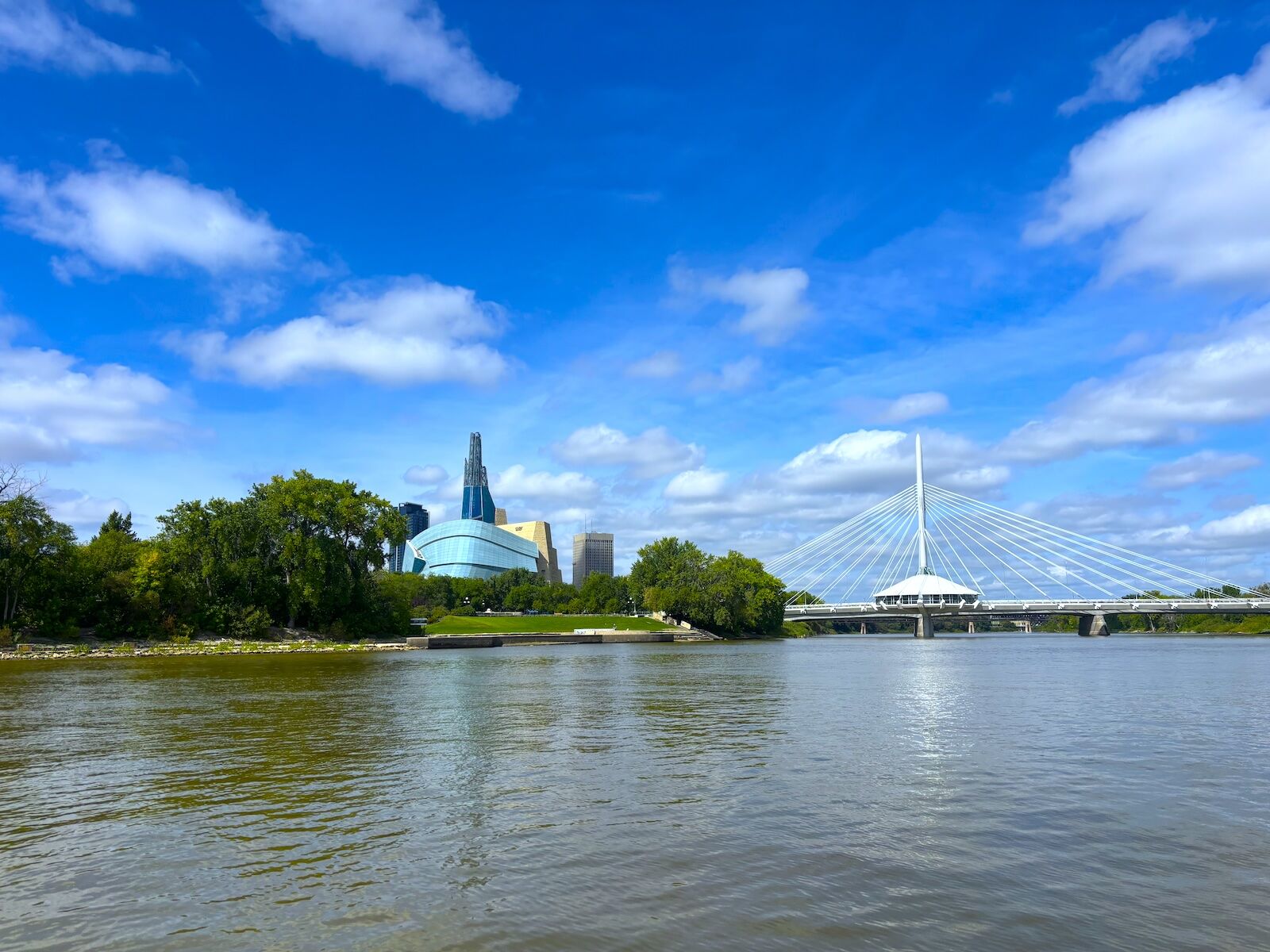
Rising above the Esplanade Riel pedestrian bridge, the Canadian Museum for Human Rights documents the struggles and movements towards progress throughout Canada’s history, its design an ode to “moving from darkness into light.” Photo: Tim Wenger
Propagandhi wasn’t Winnipeg’s first progressive loudspeaker. The city has been home to, or at least played a part in, many of Canada’s most notable social movements, and before the concert I toured the Canadian Museum for Human Rights to learn about some of them. Prominently featured is the Winnipeg General Strike of May and June 1919, which effectively shut down commerce in the city over poor wages and working conditions. Two protesters died. Wages didn’t immediately rise, but the city’s workers unionized in a manner that ultimately changed the quality of life in Winnipeg for the better. The strike’s legacy still shapes how the city sees itself.
“Winnipeg has often been described as a blue collar city,” Winnipeg journalist and music historian John Einarson told me via email after I returned from the trip, noting that Bachman-Turner Overdrive recorded a Fred Turner song titled, fittingly, “Blue Collar.”
Nearly a century later, the Indigenous Peoples’ Solidarity Movement united Native Canadians against economic and cultural displacement and environmental degradation, and played a large role in the 2017 signing of the Winnipeg Indigenous Accord, which guides the city in a collective, and obviously still ongoing, effort toward reconciliation.
The years in between saw struggles both local and national, including the LGBT Purge of military, civil service, and police staff in the latter half of the 20th century. A striking exhibit on the museum’s main floor documents the purge and highlights activists including Martine Roy and Michelle Douglas, whose 1992 legal challenge of her honourable discharge from the military ended its discriminatory policies.
Where two rivers and 6,000 years of history meet
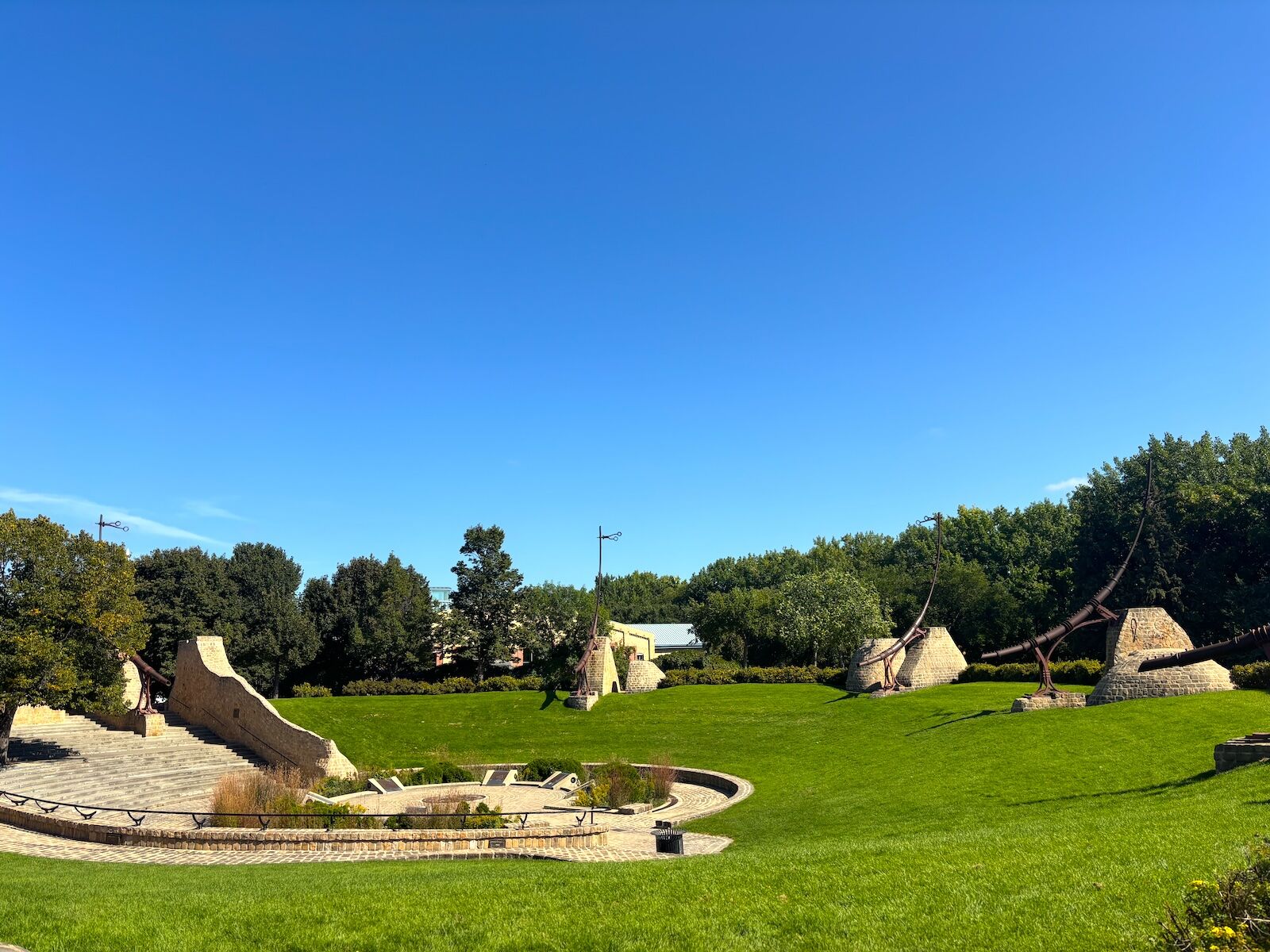
The Oodena Celebration Circle is at the heart of The Forks. Oodena is the Cree word for “center of the city.” Photo: Tim Wenger
Winnipeg is defined by its two rivers, the Assiniboine and the Red. Indigenous peoples have gathered at their confluence for more than 6,000 years at what is now The Forks, a 52-acre park and public space designed around the MMIWG2S monument at its heart. The granite structure honors Missing and Murdered Indigenous Women, Girls, and Two-Spirit plus (2SLGBTQQIA+) people, recognizing not just those lost but the systemic injustices against their communities.
I spent an afternoon at The Forks, walking through the Oodena Celebration Circle (Oodena is the Cree word for “center of the city”) and past the 30-foot Niimaamaa sculpture of a pregnant Indigenous woman representing Mother Earth. Then I got on the water for a 40-minute tour with Winnipeg Waterways, passing the historic city hall and wrapping around The Forks to the Esplanade Riel pedestrian bridge, the “glass cloud” of the human rights museum dominating the sightline back onshore with its visual missive of traveling from darkness into light.
As much as the museum had, strolling The Forks as a straight, white, middle-class guy from the US became an exercise in humbling contemplation. I thought about the privilege that allows me to hop on a plane and cross a border for a reason as petty as a rock concert. The publication running this article prides itself on a mantra to “travel fearlessly,” and as a traveler I generally agree with the principle. But who gets to do so? Largely people like me, I reckoned, who often travel to places where their money goes further and their economic status is amplified.
I also noticed a stark difference in how Canada and my own country approach Indigenous history. Displacement can never be offset, but the conversation around recognition and reconciliation is far more mainstream, and the efforts more coordinated, north of the 49th parallel.
Five languages, one food hall, and 500 people in a curling rink
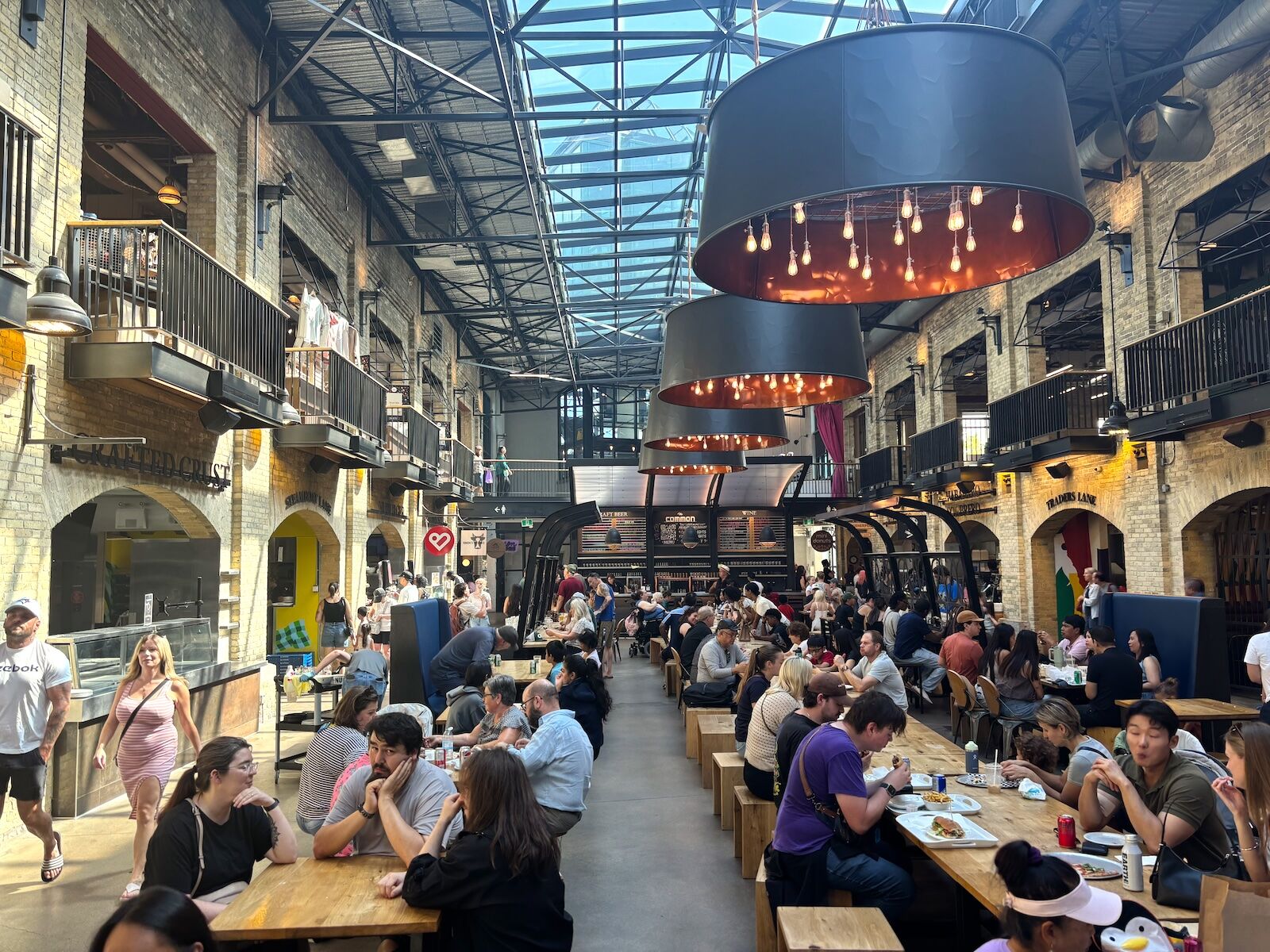
The Forks Market features global dining and local purveyors in a modern, multistory hall. Photo: Tim Wenger
These thoughts led me to a noontime pint at The Common bar inside The Forks Market. However fearless my travels may or may not be, I always love a good market, and this one is as solid as they come. I paired my local craft brew with a falafel pita and fries from Zorba’s, the market’s Greek outpost, and picked up a wristband for my daughter from Dconstruct Jewelry.
The market’s open design and high ceilings welcomed, on this Sunday, people from across the city and the globe: I overheard at least five languages in the dining hall. It was an inspiring look at the makeup of Winnipeg, which has both the largest Indigenous population of any major Canadian city and a substantial South Asian community. That mix has long fed the city’s music.
“Many artists started out playing music for their ethnic communities such as Randy Bachman playing Ukrainian socials and wedding receptions in his teens,” Einarson said. “These communities supported their own and gave the first break for many artists.”
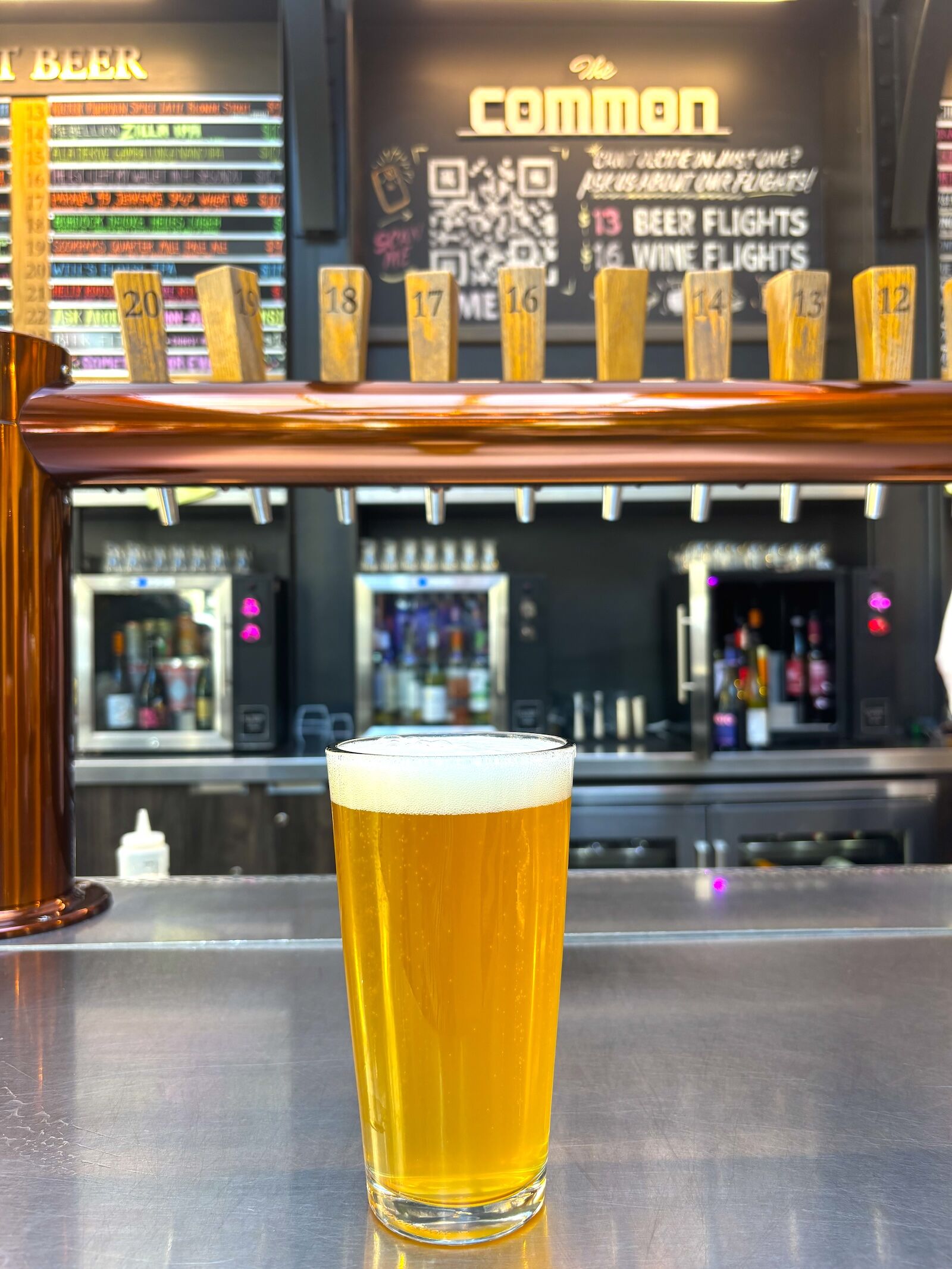
The Common sits at the center of The Forks Market and specializes in local and regional beers and wines. Photo: Tim Wenger
At one time, he added, Winnipeg was the center of a thriving Ukrainian music industry for all of Western Canada.
The social, for the uninitiated like me, is a Winnipeg institution.
“A social is very much an Eastern European tradition brought to Canada by immigrants,” Einarson explained. “Pack 500 people into a curling rink with a band and big sound system.” From the 70s through the 90s, socials were where bands like Harlequin, Streetheart, and Queen City Kids made their names.
Einarson, a man who has spent decades choosing his words carefully in print, summed up the format in one: “Awesome.”
Many market-goers had arrived by bike. The racks outside the main entrance were jammed with two-wheelers, and the patio was lined with lycra-clad loungers.
Us against the world, beyond the Perimeter
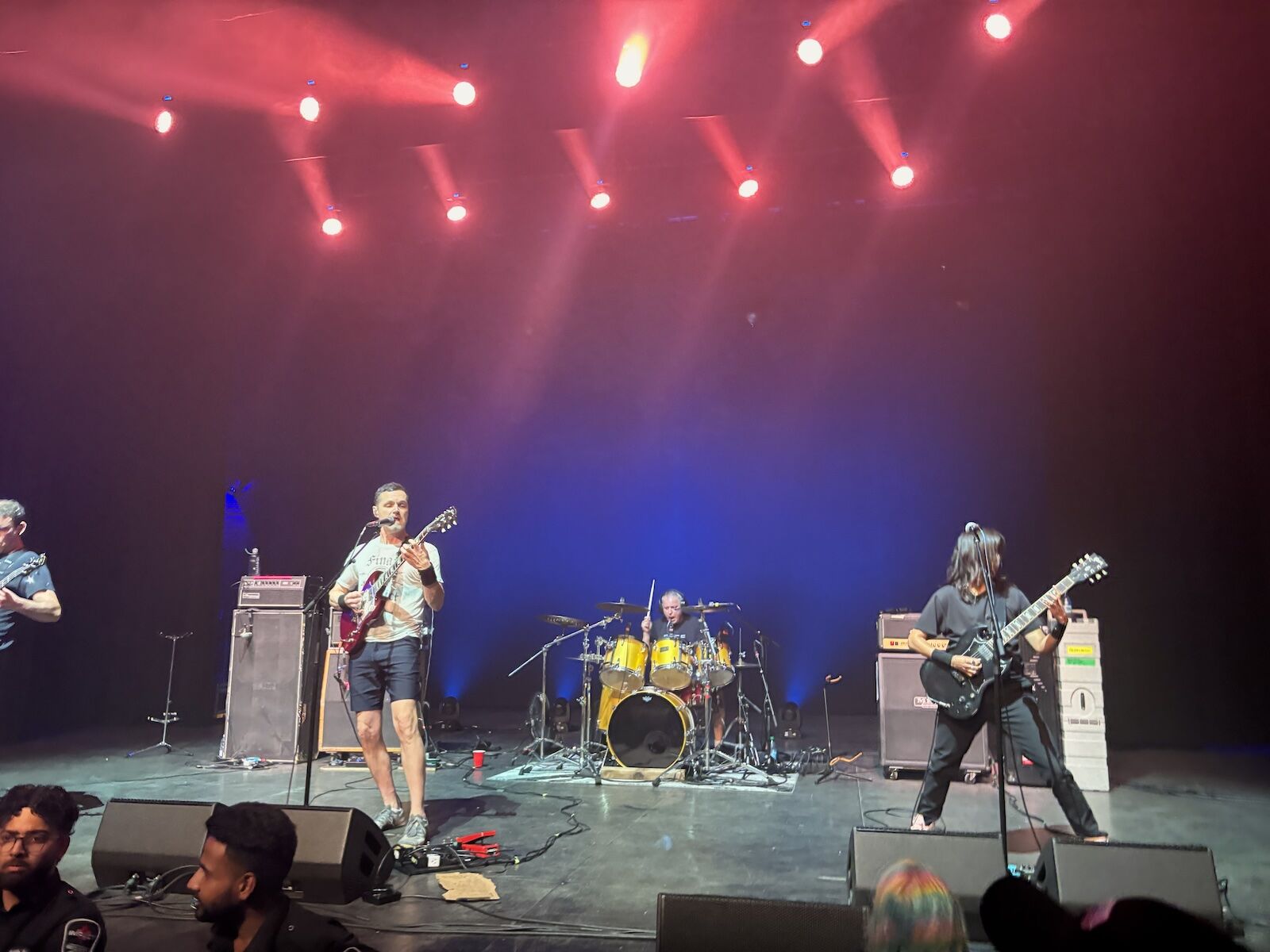
Propagandhi onstage at the Burton Cummings Theatre. Photo: Tim Wenger
“We strive to be something more than a faded sticker on a skateboard,” Propagandhi frontman Chris Hannah sings on the band’s first album, “How To Clean Everything.” Winnipeg’s music scene seems to have embraced the call. Former Propagandhi bassist John K. Samson’s band The Weakerthans carries a similar ethos, dialed down on the angst.
Einarson, who has written biographies of Neil Young, Randy Bachman, and The Guess Who and leads music history tours of the city, complicated my theory when I put it to him.
“Political statements weren’t a part of the music scene in Winnipeg, Propagandhi being the exception,” he told me, adding, with the precision of a man who has fact-checked a lot of liner notes, that the band is technically from Portage la Prairie, an hour west. “Neil Young didn’t get political until he moved to California.”
Still, Einarson pointed out that the New York Times named Young’s “Ohio” the greatest protest song of all time. “Yet it was a Canadian, a guy who got his start playing in Winnipeg, who wrote it.”
What the city did give its musicians, Einarson argued, was the attitude.
“There is an ‘us against the world’ mentality that permeates the city. Musicians that come from here know the odds of ‘making it’ beyond the Perimeter are daunting.” The Perimeter is the highway ringing Winnipeg and, in local parlance, the edge of the known world. “I always think of a band like The Watchmen who represented that blue collar hard graft ethos. Those guys were on the road something like 300 days a year.”
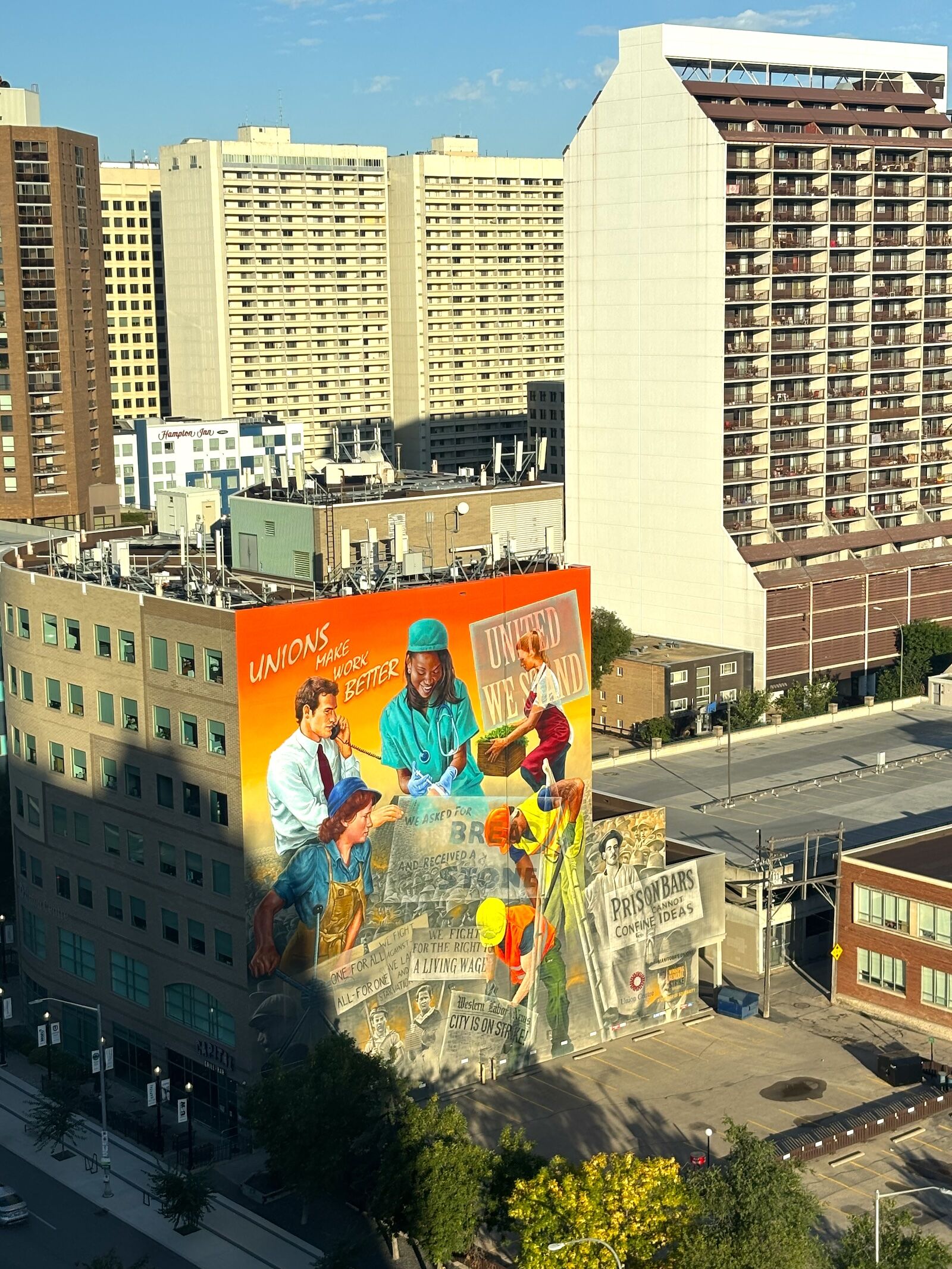
How fitting it was that I spent Labor Day in Winnipeg. Photo: Tim Wenger
Isolation did the rest. The nearest major city is Minneapolis, 500 miles south, and big touring acts largely skipped the prairie through the 1960s and 70s.
“We were the fly-over city,” Einarson said. “So that resulted in strong support for local artists.”
That support was on display before Propagandhi took the stage at the Burton Cummings Theatre. The opener was Op-Ed, a Winnipeg protest rock band fronted by Tarek Abdel Aziz, a Palestinian-Canadian refugee who formed the group in late 2023 and whose debut album, “75 Years,” follows a young Palestinian couple through war. It was a pointed choice of support act, and the room treated it as one.
The city’s grassroots machinery is about to get a national showcase, too. The JUNO Awards, Canada’s answer to the Grammys, return to Winnipeg for JUNO Week April 1 through 4, 2027, with the ceremony at Canada Life Centre. It’s the city’s third time hosting, after 2005 and 2014, and a good excuse to plan a trip. Einarson’s pick for a show while you’re in town is the Times Change(d) High and Lonesome Club on Main Street, “the home of roots music in Winnipeg. Funky ambience but great music, food and terrific people.”
Back at the Fort Garry Hotel that night, a few blocks from the theatre, I could see from my window a giant pro-union mural on the side of an adjacent building. I had a better sense now of why Winnipeg produces such mission-forward musicians. The mural stood as a testament to those who stood together in 1919, and to the city that grew into its current self as a result. 