Previous Next

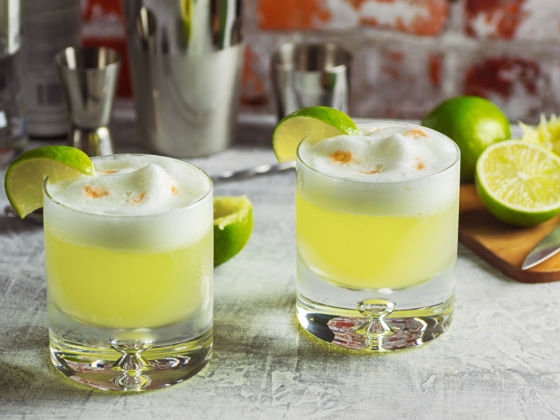
A bartender at Manhattan Inn, Lima pours some frosty, blended pisco sours. Photo: ActiveSteve.

If you travel to Peru and don’t come across a pisco sour, you might be in the wrong country.

I spent three months working with a nonprofit organization outside of Huaraz, Peru, and quickly learned pisco sours are an important part of Peruvian nightlife. From Huaraz to Aguas Calientes, promotional staff from restaurants and bars would entice me into their establishments with a free pisco sour (two if I haggled).

But there’s more to Peruvian drinks than pisco.
For the Jetlagged: Pisco Sour

My first day in Peru, I had a bad case of jetlag. After a redeye flight from New York with the air conditioning on full blast, I spent two minutes in the hostel before I crashed and slept the day away. Luckily, when I woke up in time for dinner, a pisco sour snapped me out of my foggy daze.

A pisco sour, made with lime juice, sugar syrup, egg white, and pisco, was the perfect cocktail to ward off jetlag on that first day. The Spaniards introduced grapes to colonial Peru, but when the King of Spain outlawed wine, they invented a distilled wine brandy and named it pisco. Jetlagged travelers and Peruvian nationals alike have been enjoying it ever since. It’s also popular in Chile.

For the Beer Lover: Cusquena Red Lager

Photo: Chupacabras.

Don’t expect any Coronas around these parts. Peruvian beer has a reputation all its own. For a classic experience, Pilsen offers a 147 year old brand of “quality and tradition.” With its iconic bottles and light flavor, Cristal claims to be “the beer of Peru.”

Yet most of the beer I’ve tried in Peru has been very dark. In fact, at a birthday party in Huaraz, the entire family mixed their dark Cusquena Malta with Coca Cola to make it sweeter. If you’re looking for something out of the ordinary, Cusquena Red Lager is a limited edition treat. It’s a mild lager with a slightly sweet edge. Don’t let the rosy hue blind you; this baby packs a punch.

For the Romantic: Wine

When I think of wine, I think of Italy, France, and California. But wine is Peru’s less famous pisco counterpart. When I took a bus from Lima to Huaraz, I was offered a choice between soda or wine. I figured cheap wine from the bus company would be only mildly palatable, but it was actually light and refreshing.

When I visited Bodega Vista Alegre in Ica, I learned that where there’s pisco, there’s wine. Pisco is essentially a stronger form of wine, and there are many artisan vineyards throughout southern Peru.

At the bodega, we sampled a light rose wine (Vino Rose Semi-Seco from the Vinos Vista Alegre Classic Collection), and several semi-dry varieties. At 18 soles or about $6 US a bottle, I bought a few well-packaged varieties to take home.

For the Designated Driver: Inca Kola

Photo: Körschgen

In some countries, it’s either Pepsi or Coke. In Peru, it’s Inca Kola or Coca Cola.

This florescent yellow bubble-gum flavored soda is considered “el sabor de Peru” (the taste of Peru), but it’s sold in the United States and Canada with the label Golden Kola. A taxi driver in Lima who used to work in Ohio told me you can buy it at Rite Aid, but I haven’t seen it yet.

For the Sweet Tooth: Chicha de Jora

Bottled chicha de jora and a huge pot-full.
Photo: Go!Pymes Fotos

There are many different ways to prepare chicha throughout Latin America, but it’s always made with corn. The Peruvian varieties include chicha de jora and chicha morada.

Chicha de jora is prepared with fermented yellow maize and tastes like spiked apple cider. I tried this in a small village right after the local elections closed.

One family killed a cow to celebrate the political year, and all the townsmen shared glasses of chicha de jora.

Chicha morada is non-alcoholic and made with purple maize, pineapple, cinnamon, sugar, and lemon. I think the morada (purple) version looks and tastes like a thick grape Kool Aid.

For the Hungover: Té de Coca

Coca tea is an made by boiling coca leaves and sugar. This tea, also known as mate de coca, is popular in the Andean region.

Photo: Roubicek

Yes, the coca plant is used to make cocaine, but the leaf itself is only a mild stimulant; coca leaves have been used for their medicinal properties for centuries.

According to the Transnational Institute, “When chewed, coca…suppresses hunger, thirst, pain, and fatigue. It helps overcome altitude sickness.” I’ve had té de coca several times when I felt nauseous from the altitude or had a sore throat from nights up in the mountains; it’s also a great pick-me-up after a long night out.

Community Connection

Check out Matador Network’s Peru Focus Page to find information about the best time to visit, how to score an internship, and how to trek the Inca trail.

For more on chicha and other strange drinks, have a look at You Gonna Drink That? 5 Odd Libations from Around the World.

CocktailsWine


About The Author

Hope Nardini

Hope Nardini is a freelance writer addicted to three things: traveling, writing, and dulce de leche. She has done research on immigration policy in Ecuador, played in an international frisbee tournament in Colombia, and is currently interning in Peru with OLPC, a non-profit organization. Check out her blog at www.hopeandjosh.com.

Archived Responses to Pisco, chicha, and Inca Kola: A guide to Peruvian drinks

  1. Milana says:

    Fun article! I haven’t tried the Peruvian wine, but all the other drinks you describe are right on. I think my favorite would have to be the chicha morada – there’s not too many purple corn drinks out there.

  2. Kobra696 says:

    Great Article!  As a Peruvian I am happy that you had a wonderful time in Tierras Incas.  One of my favorite wines is  Santiago Queirolo’s red wine and I always recommend  my friends to try it.  You can  find a lot of Peruvian drinks, corns (jora, purple), pisco and soda in northern New Jersey.  

  3. Gabriela Ruiz Gordon says:

    Bebidas peruanas

Take it beyond capirinhas, mojitos, and pisco sours.
Burning alcohol deepens the flavors of a drink. It also looks pretty cool. Here are 10...
A wildly popular drink from 1910 to around 1930, strange variants of this drink can...
Really, it's an American holiday, and we celebrate it the way we do all holidays with...
A guide to tea in six spots around the globe.
Burners Without Borders work to help rebuild the community of Pisco, Peru after the 2007...
Have you ever been stuck with a bottle of wine and no corkscrew? So was this guy.
Here's what you need to know about the most popular tourist activity in western Argentina.
What and where to eat in Paris while making the most of every euro.
"With Cheez-its I think Sancerre could be an interesting play."
Germany started doing “things” to their beer. I’ve been drinking those things.
Your complete guide to the wineries of Mendoza.